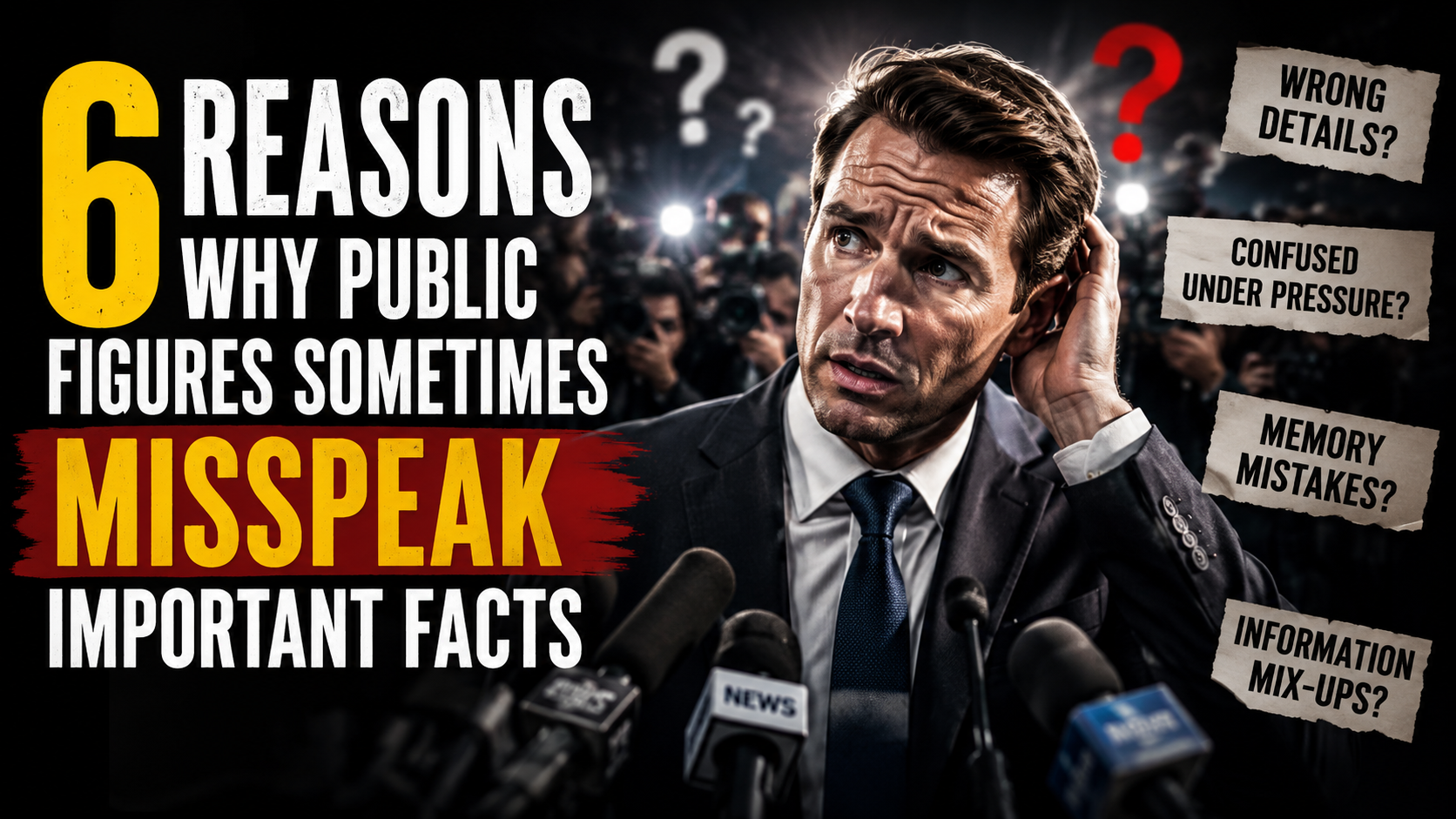
Public figures are often expected to communicate flawlessly. Whether they are politicians, business leaders, celebrities, athletes, or media personalities, their words are analyzed, quoted, recorded, and discussed by millions of people. A single statement can generate headlines, spark debates, or influence public opinion within minutes.
Because of this intense scrutiny, many people are surprised when well-known individuals accidentally get facts wrong. Sometimes they mix up dates, confuse names, misremember details, or incorrectly describe events. In other cases, they may state something confidently only to later clarify or correct it.
When these moments occur, critics often assume dishonesty or incompetence. However, psychology and communication research suggest that many factual mistakes happen for much more ordinary reasons. Human memory is imperfect, attention is limited, and speaking under pressure can affect even highly intelligent and experienced individuals.
Understanding why public figures sometimes misspeak important facts offers valuable insight not only into communication but also into the way the human mind works.
Here are six key reasons these mistakes happen more often than many people realize.
1. Human Memory Is Less Accurate Than Most People Think
Many people imagine memory as a video recording that stores events exactly as they occurred. In reality, memory works more like a reconstruction process.
When we remember something, our brains don’t simply replay a perfect recording. Instead, they rebuild information from various pieces of stored knowledge, experiences, emotions, and associations.
This process is usually effective, but it isn’t perfect.
Research in cognitive psychology has repeatedly shown that people can confidently remember details that are partially incorrect. They may mix together similar events, confuse timelines, or substitute one piece of information for another without realizing it.
Public figures are not immune to these limitations.
In fact, because they often participate in thousands of meetings, interviews, speeches, and public appearances throughout their careers, their brains are managing an enormous amount of information. Under these circumstances, occasional memory errors become understandable.
A person may sincerely believe they are recalling a fact accurately while unknowingly reconstructing it incorrectly.
2. High-Pressure Environments Increase Mental Mistakes
Most people have experienced moments when they knew the correct answer but couldn’t recall it under pressure.
Public figures face this challenge regularly.
Press conferences, live interviews, debates, public speeches, and media appearances create conditions that place significant demands on attention and working memory.
Unlike everyday conversations, these situations often involve:
- Bright lights
- Cameras
- Time constraints
- Large audiences
- Unexpected questions
- Immediate public scrutiny
When stress levels rise, the brain’s ability to retrieve information can become less reliable.
Psychologists refer to this as cognitive load—the amount of mental effort being used at a given moment.
When cognitive load increases, people are more likely to make slips of the tongue, confuse details, or unintentionally substitute one term for another.
The mistake may not reflect a lack of knowledge. Instead, it can result from the pressure of processing multiple demands simultaneously.
3. Similar Information Often Gets Mixed Together
The human brain is remarkably efficient at organizing information into categories.
This helps people learn quickly and recognize patterns.
However, this same efficiency can occasionally create confusion.
When multiple concepts are related, the brain may accidentally retrieve the wrong one.
For example, people often confuse:
- Dates and timelines
- Medical procedures
- Scientific terms
- Locations
- Names
- Statistics
- Historical events
A public figure discussing a technical subject without notes may accidentally mention a related term instead of the correct one.
The substitution may happen instantly and unintentionally.
Psychologists sometimes refer to these errors as retrieval mistakes. The information exists in memory, but the wrong piece gets selected during the speaking process.
This phenomenon affects everyone.
Most people simply experience it in smaller settings where fewer people notice.
4. Speaking Frequently Increases the Chance of Errors
The more a person talks publicly, the greater the likelihood they will occasionally misspeak.
This is partly a numbers game.
A public figure who gives hundreds of interviews and speeches each year may speak millions of words annually.
Even highly skilled communicators will occasionally make mistakes when producing such a large volume of content.
Athletes miss shots.
Musicians hit wrong notes.
Writers make typos.
Speakers occasionally say the wrong thing.
The difference is visibility.
When an ordinary person misspeaks in conversation, the moment is often forgotten immediately.
When a public figure does the same thing, the statement may be recorded, shared online, analyzed by commentators, and viewed millions of times.
As a result, minor errors that would normally go unnoticed become highly visible events.
This visibility can create the illusion that public figures make more mistakes than everyone else when, in reality, their mistakes are simply more public.
5. The Brain Relies on Mental Shortcuts
Human beings process an enormous amount of information every day.
To manage this workload efficiently, the brain relies on mental shortcuts known as heuristics.
These shortcuts help people make quick decisions and communicate rapidly.
Most of the time, they work extremely well.
However, they can occasionally lead to mistakes.
For example, when speaking quickly, a person may rely on their general understanding of a topic rather than carefully verifying every detail.
This approach allows communication to flow naturally, but it can increase the risk of factual inaccuracies.
Public figures often answer questions in real time without access to notes, research materials, or preparation.
Under these conditions, mental shortcuts become particularly important.
The downside is that shortcuts sometimes produce errors.
What sounds correct in the moment may later prove to be slightly inaccurate.
This is one reason why organizations often issue clarifications after interviews or public appearances.
6. People Sometimes Prioritize the Main Message Over Precise Details
Communication experts frequently emphasize the importance of conveying a central message.
As a result, speakers often focus on the broader point they are trying to make rather than every individual detail.
In many situations, this strategy is effective.
Audiences tend to remember stories, themes, and conclusions more than exact statistics or technical terminology.
However, prioritizing the larger message can sometimes lead to factual slips.
A speaker may recall the overall concept correctly while unintentionally misstating a supporting detail.
For example, they may remember that a medical test occurred but confuse the specific type of scan involved.
The primary event remains accurate, but a particular detail becomes mixed up.
Because modern media allows statements to be reviewed repeatedly, these small inaccuracies often receive significant attention.
Yet they frequently stem from the natural way humans communicate rather than deliberate deception.
Why These Mistakes Capture So Much Attention
Public mistakes attract attention because people naturally notice unexpected events.
Psychologists call this the novelty effect.
When someone known for authority, expertise, or leadership says something incorrect, it violates expectations.
The contrast makes the moment more memorable.
Additionally, modern media environments amplify these incidents.
A single statement can quickly circulate through television broadcasts, social media platforms, podcasts, websites, and online discussions.
What might once have been a brief verbal slip now becomes a widely shared topic.
This increased visibility creates the impression that factual mistakes are more common than they actually are.
The Difference Between a Mistake and Misinformation
It’s important to distinguish between an honest mistake and intentional misinformation.
An honest mistake typically occurs when someone unintentionally provides incorrect information, often due to memory limitations, stress, confusion, or communication errors.
Intentional misinformation involves knowingly presenting false information.
The difference matters.
Not every inaccurate statement reflects bad intentions.
In many cases, people later correct themselves once they recognize the mistake.
Understanding this distinction helps encourage more thoughtful discussions and fairer evaluations of public communication.
What We Can Learn From These Moments
Rather than focusing solely on the individual who misspoke, these situations provide an opportunity to better understand human cognition.
They remind us that:
- Memory is imperfect.
- Stress affects performance.
- Communication is complex.
- Confidence does not guarantee accuracy.
- Everyone makes occasional mistakes.
These lessons apply to all people, not just public figures.
Most individuals have experienced moments when they misremembered a date, confused two similar terms, or confidently stated something that later turned out to be incorrect.
The difference is that most of these moments occur in private rather than in front of millions of viewers.
How Critical Thinking Helps
The best response to factual errors is not blind acceptance or immediate outrage.
Instead, critical thinking provides a balanced approach.
Critical thinkers:
- Verify information before accepting it.
- Check multiple sources.
- Consider context.
- Distinguish between mistakes and patterns.
- Remain open to corrections.
This approach reduces emotional reactions and encourages a more accurate understanding of events.
In an age where information travels rapidly, these skills have become increasingly valuable.
Final Thoughts
Public figures occupy highly visible positions where every statement is scrutinized and remembered. While factual mistakes often generate headlines, psychology suggests that many of these errors arise from ordinary human limitations rather than extraordinary circumstances.
Memory is imperfect. Stress affects recall. Similar information can become confused. Mental shortcuts occasionally produce errors. And people frequently focus on communicating larger ideas rather than memorizing every detail.
Understanding these realities doesn’t mean ignoring inaccuracies. Instead, it encourages a more informed perspective on why mistakes happen in the first place.
Ultimately, the occasional factual slip serves as a reminder that even the most experienced speakers remain human. And the same cognitive processes that sometimes lead public figures to misspeak are the very ones that influence all of us every day.







