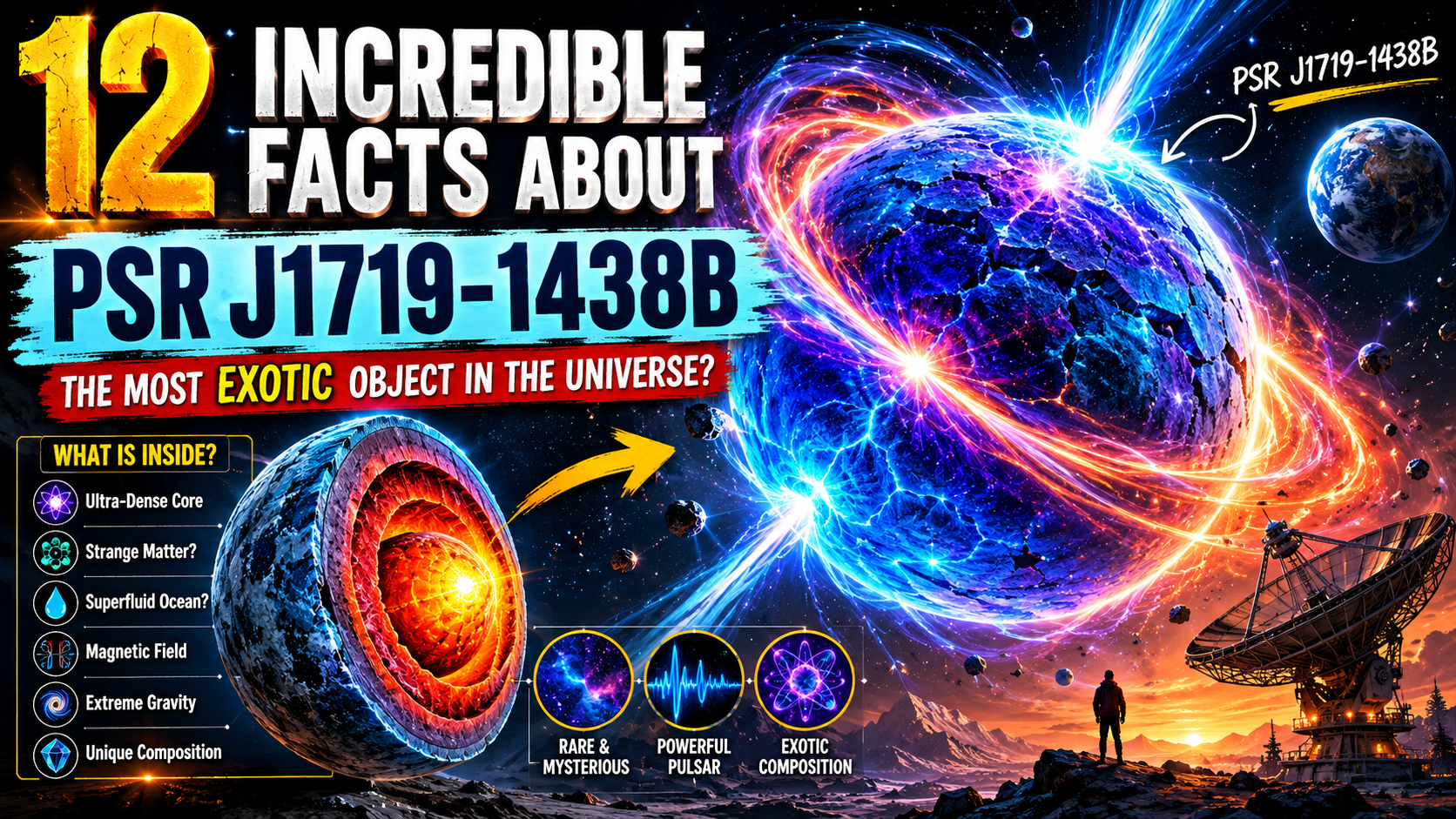
The universe is home to some truly extraordinary objects, but few are as unusual as PSR J1719-1438B. Orbiting a rapidly spinning pulsar thousands of light-years from Earth, this remarkable world has fascinated astronomers ever since its discovery. What makes it so intriguing isn’t simply its size or location—it’s what scientists believe it may be made of.
Often described as one of the strangest known planetary bodies, PSR J1719-1438B has earned a reputation as a possible “diamond planet.” While that nickname simplifies a far more complex scientific reality, it reflects the object’s extraordinary density and unusual composition. Researchers believe this exotic world may be the remnant core of a once-larger star that lost most of its outer layers, leaving behind a compact object unlike anything found in our solar system.
Here are 12 incredible facts about PSR J1719-1438B and the fascinating science behind its exotic nature.
1. It Orbits a Pulsar Rather Than a Normal Star
Most known planets orbit ordinary stars similar to the Sun. PSR J1719-1438B is different.
It circles a pulsar known as PSR J1719−1438, a rapidly rotating neutron star that emits powerful beams of radiation. Pulsars are among the most extreme objects in the universe, formed when massive stars explode as supernovae and leave behind incredibly dense remnants.
Living in such an environment would be impossible by any conventional standard, making the system one of the most unusual planetary neighborhoods ever discovered.
2. The Pulsar Spins Hundreds of Times Per Second
The star at the center of the system is a millisecond pulsar.
It rotates so quickly that it completes hundreds of revolutions every second. As it spins, it emits beams of radiation that sweep across space like a cosmic lighthouse.
When those beams cross Earth’s line of sight, astronomers detect regular pulses, allowing them to study the system with remarkable precision.
The extraordinary rotation rate provides important clues about the history of both the pulsar and its companion.
3. It Is Roughly the Size of Jupiter
Although PSR J1719-1438B is often described as exotic, its overall size is not completely unfamiliar.
Researchers estimate that it is approximately comparable in diameter to Jupiter, the largest planet in our solar system. However, similarities largely end there.
Despite having a size similar to Jupiter’s, its mass and density are dramatically different, making it one of the strangest known planetary-mass objects.
4. It Is Far Denser Than Ordinary Planets
One of the most remarkable characteristics of PSR J1719-1438B is its density.
Scientists determined that the object must be significantly denser than conventional gas giants. If it were composed primarily of hydrogen and helium like Jupiter, it could not survive in its observed orbit without being torn apart by the pulsar’s gravity.
Instead, its density suggests a composition rich in heavier elements such as carbon and oxygen.
This discovery immediately set it apart from typical planets.
5. It May Be the Remnant Core of a Star
Researchers believe PSR J1719-1438B did not form like an ordinary planet.
The leading explanation suggests it was once part of a binary star system. Over time, the pulsar stripped material away from its companion star through intense gravitational interactions.
Eventually, only the dense stellar core remained.
In this scenario, PSR J1719-1438B is less a conventional planet and more the exposed remains of a star that lost nearly all of its outer layers.
6. It Earned the Nickname “Diamond Planet”
The object’s unusual density led to widespread attention after astronomers proposed that much of its interior could consist of crystalline carbon.
Because carbon under extreme pressure can form diamond-like structures, the media quickly popularized the nickname “diamond planet.”
While the reality is more complex than a giant gemstone floating through space, the nickname captures the extraordinary nature of the object’s composition.
It remains one of the most famous examples of an exotic planetary body.
7. Its Density Is Difficult to Imagine
The density of PSR J1719-1438B far exceeds that of familiar planets.
Materials that would normally exist as gases, liquids, or ordinary solids on Earth behave very differently under such extreme conditions. The object likely contains matter compressed into forms rarely encountered elsewhere.
Its structure demonstrates how dramatically physical conditions can vary across the universe.
Worlds that seem impossible by everyday standards can exist naturally under the right circumstances.
8. It Completes an Orbit in Just a Few Hours
PSR J1719-1438B circles its pulsar remarkably quickly.
The object completes a full orbit in only a little over two hours. By comparison, Mercury—the fastest-orbiting planet in our solar system—requires about 88 days to circle the Sun.
This incredibly short orbital period places the companion extremely close to the pulsar.
Such proximity plays a major role in shaping the object’s unusual history and physical properties.
9. It Helped Expand Definitions of Planetary Objects
The discovery challenged astronomers to think carefully about how planets are classified.
PSR J1719-1438B possesses a mass similar to that of a planet, yet its likely origin resembles that of a stellar remnant. This blurs traditional distinctions between planets, stars, and other compact objects.
The system highlights the fact that nature does not always fit neatly into human categories.
Many astronomical objects occupy gray areas that challenge existing definitions.
10. The System Demonstrates Extreme Stellar Evolution
Astronomers often study unusual systems because they reveal processes that are difficult to observe elsewhere.
PSR J1719-1438B provides a valuable example of how binary stars can evolve through long-term interactions. The system illustrates how matter can be transferred, stripped away, and transformed over billions of years.
Its existence offers a glimpse into one of the more dramatic pathways of stellar evolution.
11. It Is Located Thousands of Light-Years Away
Despite the attention it receives, PSR J1719-1438B is incredibly distant from Earth.
The system lies roughly 4,000 light-years away in the direction of the constellation Serpens.
At such distances, direct imaging is currently impossible. Instead, astronomers infer the object’s properties through careful analysis of the pulsar’s timing signals and orbital behavior.
This demonstrates the remarkable precision of modern astronomical techniques.
12. It Reveals How Diverse the Universe Can Be
Perhaps the most important lesson from PSR J1719-1438B is that the universe continually surprises us.
Before the discovery of exoplanets, scientists had little idea how varied planetary systems could be. Since then, astronomers have found worlds orbiting multiple stars, planets larger than Jupiter skimming the surfaces of their stars, and objects like PSR J1719-1438B that challenge conventional categories altogether.
Each new discovery broadens our understanding of what is possible in nature.
PSR J1719-1438B stands as one of the most striking examples of that diversity.
How Was PSR J1719-1438B Discovered?
Astronomers detected the object by studying subtle variations in the timing of pulses emitted by the pulsar.
Because pulsars act like extraordinarily precise cosmic clocks, even tiny changes in their motion can reveal the presence of orbiting companions. By analyzing these timing variations, researchers identified the companion and estimated its mass, orbital period, and density.
This technique has proven highly effective for detecting unusual systems that would otherwise remain hidden.
The discovery showcased the power of pulsar timing as a tool for exploring distant worlds.
Why Scientists Find the System So Fascinating
Several factors make PSR J1719-1438B especially interesting:
- Its likely origin as a stripped stellar core.
- Its extraordinary density.
- Its rapid orbit around a pulsar.
- Its possible carbon-rich composition.
- Its challenge to traditional classifications.
- Its insights into binary star evolution.
Together, these characteristics make it one of the most unusual planetary-mass objects ever identified.
Could Similar Objects Exist Elsewhere?
Many astronomers suspect that PSR J1719-1438B may not be unique.
Other pulsar systems could contain similarly exotic companions formed through comparable evolutionary processes. As detection methods improve, researchers may uncover additional objects occupying the boundary between planets and stellar remnants.
Future discoveries could help determine how common these systems really are and provide deeper insight into their formation.
The universe may contain many more strange worlds waiting to be found.
Final Thoughts
PSR J1719-1438B is a powerful reminder that the cosmos is far more diverse and surprising than early astronomers imagined. Orbiting a rapidly spinning pulsar, possessing an extraordinary density, and potentially consisting largely of crystalline carbon-rich material, it challenges many traditional ideas about what a planet can be.
These 12 incredible facts highlight why the object continues to fascinate scientists and space enthusiasts alike. More than just a curiosity, PSR J1719-1438B offers valuable clues about stellar evolution, planetary classification, and the remarkable processes that shape the universe.
As astronomers continue exploring distant star systems, discoveries like this remind us that some of the strangest worlds in existence are often the ones we least expect to find.







