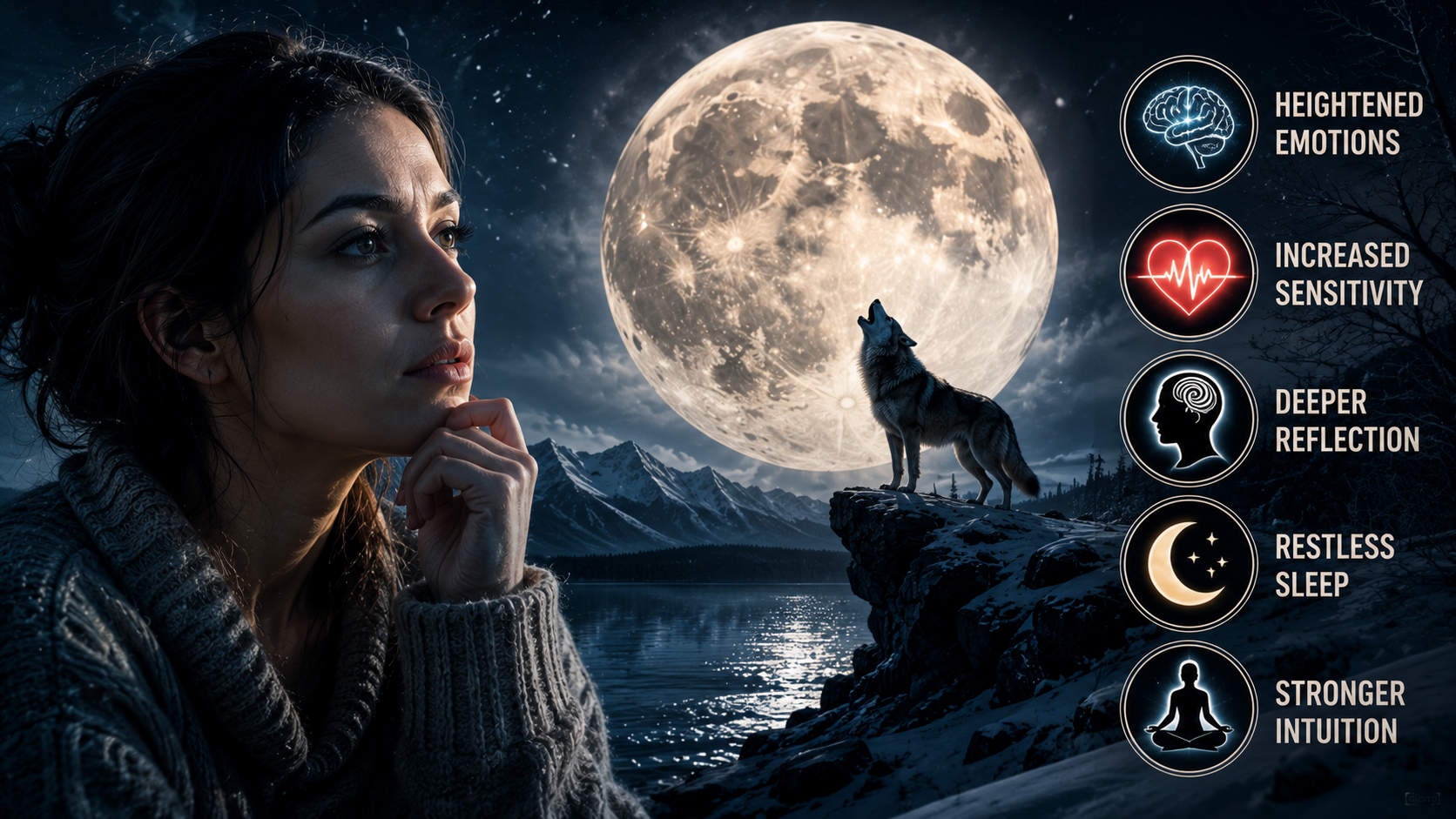
Throughout history, people have looked up at the night sky and felt something shift inside them. The moon, in particular, has long been associated with emotion, intuition, and cycles of change. Among its many seasonal phases, the January full moon—often called the Wolf Moon—has a special place in cultural tradition.
The term “Wolf Moon” is believed to come from early Native American and European naming traditions, where January nights were marked by the distant howling of wolves during long, cold winters. Over time, the name became associated not only with seasonal wildlife behavior but also with symbolic ideas of introspection, endurance, and emotional intensity.
While modern science does not support the idea that the moon directly controls human emotions, many people still report feeling different during full moons. Whether due to environmental factors such as light exposure, sleep disruption, or psychological expectation, the experience of emotional shifts during a full moon is widely discussed.
The January Wolf Moon, in particular, often coincides with the quiet, reflective energy of winter. Days are shorter, nights are longer, and people tend to spend more time indoors. This combination can create a heightened sense of awareness, introspection, and emotional sensitivity.
Here are five signs that the January Wolf Moon may be influencing your emotional state tonight.
1. You Feel More Emotionally Sensitive Than Usual
One of the most commonly reported experiences during a full moon is heightened emotional sensitivity.
People may find themselves reacting more strongly to situations that normally would not affect them as deeply. Conversations may feel more intense, memories may surface more vividly, and emotions may feel closer to the surface.
This heightened sensitivity can be subtle or very noticeable depending on the individual.
Some possible signs include:
- Feeling more easily moved by music or memories
- Reacting strongly to small frustrations
- Experiencing emotional waves without clear triggers
While there is no scientific proof that the moon directly causes emotional shifts, increased nighttime brightness and changes in sleep quality during full moons may play a role in altering mood regulation.
Additionally, psychological expectation can influence perception. When people believe a full moon is meaningful, they may become more aware of their emotional states.
2. Your Sleep Feels Lighter or More Interrupted
Another commonly reported effect during full moon nights is disrupted sleep.
Research has suggested that some individuals experience slightly reduced deep sleep or longer time to fall asleep during brighter lunar phases.
During the January Wolf Moon, this effect may feel more noticeable due to seasonal factors such as colder temperatures and longer nights spent indoors.
Signs of sleep disruption may include:
- Difficulty falling asleep
- Waking up more frequently during the night
- Feeling less rested in the morning
- Vivid or unusual dreams
Even small changes in sleep quality can influence emotional regulation the next day.
Poor or fragmented sleep is strongly linked to irritability, sensitivity, and reduced stress tolerance.
This means that even if the moon is not directly influencing emotions, it may indirectly contribute to emotional changes through its impact on sleep patterns.
3. You Experience Increased Introspection and Self-Reflection
The January Wolf Moon arrives during a naturally reflective time of year.
After the busy holiday season, many people find themselves in a quieter mental space. This period often encourages reflection on goals, relationships, and personal direction.
Under the glow of a full winter moon, this introspective tendency can feel even stronger.
You may notice:
- Thinking more about past decisions
- Re-evaluating personal goals
- Reflecting on relationships and life changes
- Feeling drawn to solitude or quiet environments
This kind of reflection is not necessarily emotional instability. In many cases, it is a natural psychological response to seasonal change and slower routines.
However, during a full moon, these thoughts can feel more emotionally charged or symbolic, as people interpret their inner experiences through the lens of lunar cycles.
The result is a sense of deeper awareness, even if nothing externally has changed.
4. Your Energy Feels Restless or Unsettled
Some people report feeling unusually restless during full moon nights.
This restlessness may not always be physical—it can also be mental or emotional.
You might feel:
- A sense of internal tension
- Difficulty relaxing or “switching off”
- A desire to stay awake later than usual
- Mild anxiety without a clear cause
There are several possible explanations for this sensation.
Increased nighttime brightness from a full moon can subtly influence circadian rhythms. Even small changes in light exposure may affect melatonin production, which plays a role in regulating sleep and relaxation.
Additionally, psychological association can influence perception. If someone expects the full moon to feel “intense,” they may become more aware of normal fluctuations in mood and energy.
During winter months, this effect can feel stronger because people already experience reduced daylight exposure, which affects overall energy balance.
5. You Feel a Stronger Connection to Nature and the Night Sky
One of the most positive emotional shifts associated with the January Wolf Moon is a heightened sense of connection to nature.
On clear winter nights, the full moon often appears brighter and more prominent in the sky. The crisp air, quiet surroundings, and stillness of winter landscapes can create a powerful sensory experience.
Many people report feeling:
- A sense of calm or awe when looking at the moon
- Increased appreciation for natural cycles
- A feeling of grounding or perspective
- Emotional clarity or peacefulness
This response is often linked to what psychologists call “awe experiences”—moments when people encounter something vast or beautiful that expands their sense of perspective.
The full moon, especially in winter, can evoke this feeling because it highlights both the beauty and scale of the natural world.
In these moments, emotional shifts are not necessarily intense or disruptive. Instead, they can feel calming, grounding, or even spiritually reflective.
Why the January Wolf Moon Feels Emotionally Different
Even though the moon itself does not directly control human emotions, several overlapping factors can explain why people feel differently during the January Wolf Moon.
These include:
- Seasonal changes in daylight exposure
- Post-holiday psychological transitions
- Colder weather encouraging indoor reflection
- Sleep pattern variations due to light exposure
- Cultural beliefs and lunar symbolism
When combined, these influences can create a powerful psychological experience that feels connected to the moon.
Human beings are highly responsive to environmental cues. When those cues align with meaningful symbols—like the full moon—they often become emotionally amplified.
The Psychology of Lunar Influence
The belief that the moon affects human behavior is ancient and widespread across cultures.
While scientific research does not support strong causal links between lunar phases and emotional behavior, psychology recognizes that perception plays a significant role in shaping experience.
This includes:
- Confirmation bias (noticing events that match expectations)
- Heightened self-awareness during symbolic events
- Environmental influences such as light and sleep changes
- Emotional association with cultural narratives
In other words, even if the moon is not directly influencing emotions, it may still feel like it is.
That feeling itself becomes part of the experience.
How to Navigate Emotional Shifts During the Wolf Moon
Whether or not you personally feel affected by lunar cycles, the January Wolf Moon can be a useful moment for reflection and grounding.
Here are a few simple ways to navigate emotional shifts:
- Prioritize restful sleep
- Spend time outdoors if weather allows
- Limit overstimulation from screens at night
- Journal thoughts or emotions
- Practice mindfulness or quiet reflection
These practices help stabilize emotional rhythms regardless of external influences.
Final Thoughts
The January Wolf Moon continues to capture human imagination because it blends natural beauty with emotional symbolism.
While there is no scientific evidence that the moon directly controls emotions, many people still experience noticeable shifts during this time due to a combination of environmental, psychological, and seasonal factors.
The five key signs include:
- Heightened emotional sensitivity
- Lighter or disrupted sleep
- Increased introspection
- Restless energy
- Stronger connection to nature
Whether these experiences are subtle or pronounced, they reflect a broader truth about human nature: we are deeply influenced by our environment, especially during moments of stillness and reflection.
The Wolf Moon does not change who we are—but it may help us notice what is already there.