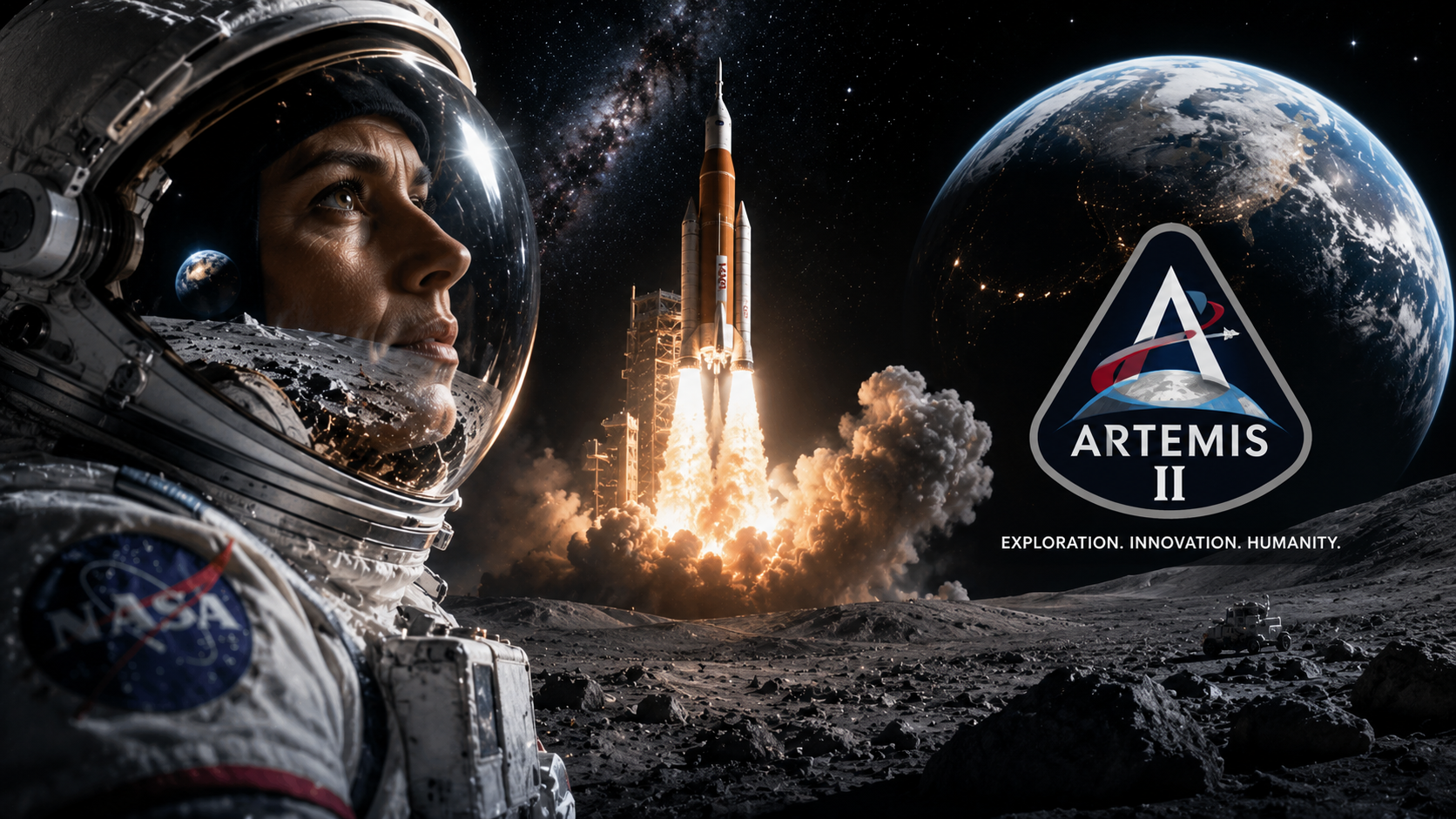
When most people hear about NASA’s Artemis II mission, they naturally focus on one thing: the Moon. After all, Artemis II will mark humanity’s first crewed journey beyond low-Earth orbit since the Apollo era, sending astronauts around the Moon for the first time in more than 50 years.
But reducing Artemis II to “just another Moon mission” misses the bigger picture.
The mission represents a major turning point in human spaceflight. It’s not only about revisiting a familiar destination—it’s about preparing for a future where humans live and work deeper in space than ever before. Artemis II will test new technologies, inspire a new generation, strengthen international cooperation, and lay the foundation for future missions to Mars and beyond.
In many ways, the Moon is only part of the story.
Here are 11 reasons why Artemis II is much more than a trip around Earth’s closest celestial neighbor.
1. It Marks Humanity’s Return to Deep Space
For decades, astronauts have operated primarily in low-Earth orbit aboard spacecraft such as the Space Shuttle and the International Space Station.
While these missions achieved extraordinary scientific goals, they remained relatively close to Earth.
Artemis II changes that.
The crew will travel hundreds of thousands of miles from home, venturing farther into space than any human mission since the Apollo program ended in 1972.
This return to deep-space exploration is significant because it reopens a chapter of human spaceflight that has remained largely dormant for generations.
The mission signals that humanity is once again looking beyond Earth’s immediate neighborhood.
2. It’s a Critical Test for Future Lunar Landings
Unlike later Artemis missions, Artemis II will not land on the Moon.
Its primary purpose is testing.
The flight will evaluate the performance of the Orion spacecraft, life-support systems, communications equipment, navigation technology, and crew operations under real deep-space conditions.
Think of it as a dress rehearsal for future lunar landings.
Every system must perform flawlessly before astronauts attempt more complex missions involving lunar surface operations.
By identifying challenges now, NASA can improve safety and reliability for future crews.
The success of Artemis II directly influences the missions that follow.
3. It Helps Prepare Humanity for Mars
The Moon is not the final destination.
One of the biggest goals of the Artemis program is learning how to support long-duration human exploration far from Earth.
Mars presents enormous challenges. Travel times are longer, communication delays are greater, and emergency returns are far more difficult.
Artemis II provides an opportunity to test many of the technologies and operational procedures that future Mars missions will require.
The experience gained from deep-space navigation, crew health monitoring, and spacecraft operations will contribute to eventual journeys to the Red Planet.
In that sense, Artemis II is part of a much larger roadmap for interplanetary exploration.
4. The Mission Will Test Human Performance Beyond Earth’s Orbit
Human bodies evolved under Earth’s gravity and protective atmosphere.
Space is a very different environment.
Astronauts on Artemis II will spend time outside the protective shield of low-Earth orbit, exposing them to conditions that are rarely experienced by modern crews.
Researchers will collect valuable data about physical health, psychological well-being, sleep patterns, workload management, and crew interactions.
These findings will help scientists better understand how humans function during deep-space missions.
Such information becomes increasingly important as future missions grow longer and more ambitious.
5. Artemis II Represents a New Generation of Spacecraft
The Apollo astronauts traveled in spacecraft designed with 1960s technology.
Artemis II will showcase what decades of technological advancement have made possible.
The Orion spacecraft incorporates modern computing systems, advanced safety features, improved life-support technology, and sophisticated navigation capabilities.
While inspired by the pioneering spirit of Apollo, Artemis II relies on a completely different technological foundation.
The mission demonstrates how far aerospace engineering has evolved over the past half-century.
It is not simply a repeat of past achievements but a significant step forward.
6. It Reinforces International Cooperation in Space
Space exploration increasingly involves global partnerships.
Artemis II reflects this trend through collaboration among multiple countries, agencies, and private-sector organizations.
International partners contribute technology, expertise, infrastructure, and scientific knowledge that support the broader Artemis program.
This cooperative approach offers several advantages.
It spreads costs, encourages innovation, and strengthens diplomatic relationships while advancing shared scientific goals.
The mission highlights how space exploration can unite nations around common objectives that transcend political boundaries.
7. It Inspires the Next Generation of Scientists and Engineers
Major space missions often have effects that extend far beyond science.
The Apollo missions inspired countless people to pursue careers in engineering, physics, mathematics, medicine, and technology.
Many experts believe Artemis II could have a similar impact.
Young people watching astronauts travel beyond Earth orbit may become the scientists, engineers, doctors, and innovators who shape the future.
Space exploration has a unique ability to capture public imagination.
By demonstrating what is possible, Artemis II encourages future generations to tackle ambitious challenges of their own.
8. It Advances Spaceflight Safety
Every crewed mission contributes valuable lessons about safety.
Artemis II will provide critical information about spacecraft performance during launch, deep-space travel, high-speed reentry, and recovery operations.
Engineers will closely monitor every aspect of the mission.
The data collected will help refine future systems, improve mission planning, and reduce risks for subsequent crews.
Many of the safety improvements that benefit future astronauts will originate from experiences gained during Artemis II.
Progress in spaceflight often depends on careful testing and continuous learning.
9. It Helps Build a Sustainable Lunar Presence
Unlike the Apollo program, which focused primarily on short-term exploration, the Artemis program aims to establish a long-term presence around and on the Moon.
Artemis II plays an important role in achieving that goal.
The mission helps validate the systems needed for future lunar operations, including habitats, logistics networks, communications infrastructure, and transportation technologies.
The objective is not merely to visit the Moon occasionally but to create the foundation for sustained exploration.
This shift represents a major evolution in how humanity approaches space travel.
10. The Mission Demonstrates the Value of Long-Term Vision
Large-scale exploration projects require patience.
The technologies, infrastructure, training programs, and partnerships supporting Artemis II have taken years to develop.
The mission serves as a reminder that meaningful achievements often result from long-term planning rather than short-term thinking.
Exploring deep space cannot be accomplished overnight.
It requires sustained investment, careful preparation, and commitment across multiple generations.
Artemis II embodies this philosophy, showing what can be achieved when ambitious goals are pursued consistently over time.
11. It Signals a New Era of Human Exploration
Perhaps the most important reason Artemis II matters is what it represents.
For much of human history, exploration involved crossing oceans, climbing mountains, and mapping unknown regions of Earth.
Today, the frontier has shifted beyond our planet.
Artemis II symbolizes humanity’s transition into a new era of exploration focused on the broader solar system.
The mission demonstrates that human curiosity remains as powerful as ever.
Rather than viewing space as an unreachable frontier, Artemis II treats it as the next destination for discovery, innovation, and expansion.
That shift in perspective may ultimately prove more significant than the mission itself.
Why the Moon Still Matters
Some people question why humanity continues investing in lunar exploration when so many challenges exist on Earth.
The answer lies partly in the Moon’s strategic importance.
The Moon serves as an ideal testing ground for technologies and systems needed for deeper exploration. It offers opportunities to study planetary science, develop new engineering solutions, and learn how humans can operate in harsh extraterrestrial environments.
Its relative proximity also makes it far safer than attempting immediate missions to Mars.
Lessons learned on and around the Moon will help reduce risks associated with future interplanetary travel.
In many ways, the Moon functions as a bridge between Earth and the rest of the solar system.
The Broader Impact of Artemis II
The influence of Artemis II extends beyond space agencies and astronauts.
Historically, investments in space exploration have produced technological innovations that eventually benefit everyday life. Advances in computing, communications, materials science, robotics, and medical technologies often emerge from aerospace research.
The Artemis program continues this tradition.
Developing solutions for deep-space exploration frequently generates new tools and technologies with applications on Earth.
As a result, missions like Artemis II contribute not only to scientific knowledge but also to broader technological progress.
Looking Ahead
Artemis II is only one step in a larger journey.
Future missions aim to land astronauts on the lunar surface, establish long-term infrastructure around the Moon, and eventually support human exploration of Mars.
Each mission builds upon the lessons of the previous one.
The success of Artemis II will help determine how quickly and effectively those future goals can be achieved.
Its importance lies not only in where it goes, but in what it enables.
Final Thoughts
At first glance, Artemis II may appear to be a simple mission around the Moon. In reality, it represents much more.
It marks humanity’s return to deep space, tests technologies for future exploration, advances international cooperation, improves astronaut safety, and helps prepare for eventual journeys to Mars.
Most importantly, Artemis II signals the beginning of a new chapter in human exploration.
The mission reminds us that exploration is not merely about reaching destinations. It is about expanding knowledge, overcoming challenges, and creating opportunities for future generations.
While the Moon may be the immediate destination, the true significance of Artemis II reaches far beyond lunar orbit. It represents a crucial step toward humanity’s future among the stars.