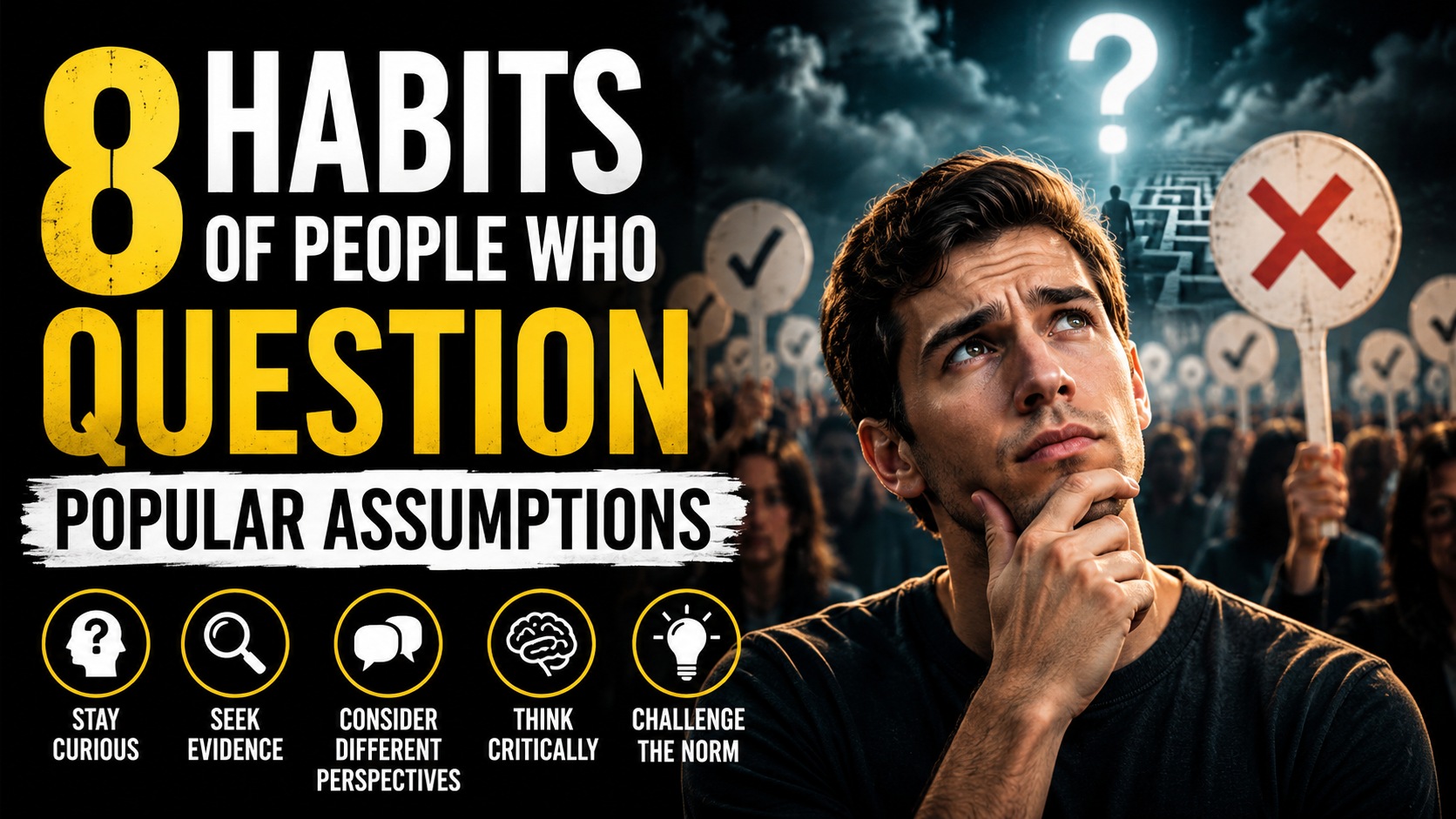
Every society operates on a collection of shared beliefs. Some are supported by evidence and experience, while others survive simply because they’ve been repeated for years. From everyday life advice to cultural expectations and common opinions, many ideas become accepted without much scrutiny.
Yet some people have a habit of stepping back and asking an important question:
“Is this actually true?”
These individuals aren’t necessarily rebellious or argumentative. Instead, they possess a natural curiosity that drives them to explore ideas more deeply. They understand that just because a belief is popular doesn’t automatically make it accurate.
Throughout history, many of the world’s greatest discoveries, inventions, and social changes began with someone questioning an assumption that everyone else accepted.
So what makes these people different?
Research into critical thinking, psychology, and decision-making reveals several common behaviors among individuals who regularly challenge conventional wisdom. Here are eight habits often shared by people who question popular assumptions.
1. They Ask Questions Most People Never Consider
Many people accept information at face value, especially when it comes from authority figures, experts, or large groups.
People who question assumptions tend to pause and ask additional questions.
They wonder:
- How do we know this is true?
- What evidence supports this idea?
- Has this belief ever been tested?
- Are there alternative explanations?
These questions aren’t intended to create conflict. Instead, they help uncover information that might otherwise remain hidden.
Curiosity is often the starting point of independent thinking. By asking thoughtful questions, these individuals gain a deeper understanding of the world around them.
Rather than accepting conclusions automatically, they explore how those conclusions were reached.
2. They Separate Facts From Opinions
One reason misinformation spreads so easily is that opinions are often presented as facts.
People who challenge assumptions actively distinguish between the two.
They understand that personal experiences can be valuable, but they also recognize that individual stories don’t always represent broader reality.
For example, someone might say, “This worked for me, so it must work for everyone.”
Critical thinkers recognize that one person’s experience may not apply universally.
Instead of relying solely on anecdotes, they look for patterns, data, expert analysis, and multiple sources of information.
This habit helps them make more informed decisions and avoid being influenced by emotional arguments alone.
3. They Are Comfortable Being Wrong
Many people become emotionally attached to their beliefs.
Once an opinion becomes part of someone’s identity, changing that opinion can feel uncomfortable.
People who regularly question assumptions tend to approach beliefs differently.
They view knowledge as something that evolves rather than something fixed.
When presented with strong evidence, they are often willing to revise their views.
This flexibility is one of the most powerful traits of independent thinkers.
Rather than seeing mistakes as failures, they view them as opportunities to learn.
Their goal isn’t to always be right. Their goal is to get closer to the truth.
4. They Seek Out Different Perspectives
Most people naturally gravitate toward information that confirms what they already believe.
Psychologists refer to this tendency as confirmation bias.
People who question conventional thinking actively resist this habit.
They intentionally expose themselves to different viewpoints, even when those perspectives challenge their existing opinions.
They may read articles from multiple sources, listen to opposing arguments, or engage in conversations with people who have different experiences.
This doesn’t mean they automatically accept every viewpoint.
Instead, they believe that understanding different perspectives leads to better decisions and a more complete understanding of complex issues.
Exposure to diverse ideas often reveals blind spots that would otherwise go unnoticed.
5. They Focus on Evidence Over Popularity
Popularity can create a powerful illusion of truth.
When large numbers of people believe something, it becomes easy to assume it must be correct.
History shows otherwise.
At various points in history, widely accepted beliefs about science, health, society, and human behavior were eventually proven incorrect.
People who question assumptions understand this reality.
Rather than asking, “How many people believe this?” they ask, “What evidence supports it?”
They know that facts don’t change based on public opinion.
This evidence-based approach helps them evaluate claims more objectively and reduces the influence of social pressure.
6. They Think Long-Term Instead of Following Trends
Popular assumptions often emerge from current trends, social movements, or short-term thinking.
Independent thinkers tend to look beyond immediate reactions.
They consider broader consequences and long-term outcomes.
Before accepting a popular idea, they ask questions such as:
- Will this still make sense in five years?
- What are the potential unintended consequences?
- What happens if everyone follows this advice?
Thinking long-term allows them to see issues from a wider perspective.
This habit often leads to better decision-making because it reduces impulsive reactions and encourages thoughtful analysis.
While trends come and go, sound reasoning tends to remain valuable over time.
7. They Stay Curious Throughout Life
One of the strongest characteristics shared by people who question assumptions is a commitment to lifelong learning.
They rarely believe they have all the answers.
Instead, they view knowledge as an ongoing journey.
Their curiosity motivates them to read books, explore new subjects, ask questions, and seek out experiences that broaden their understanding.
Research suggests that intellectual curiosity is linked to greater creativity, adaptability, and problem-solving ability.
Curious people are more likely to discover new information that challenges existing beliefs.
This continuous learning process helps them avoid becoming trapped by outdated assumptions.
The moment someone believes they know everything is often the moment they stop growing.
8. They Value Truth More Than Social Approval
Questioning widely accepted ideas isn’t always easy.
In some situations, challenging conventional wisdom can lead to criticism, disagreement, or social discomfort.
People who regularly question assumptions understand this risk.
However, they often place a higher value on truth and understanding than on simply fitting in.
This doesn’t mean they enjoy conflict or intentionally provoke others.
Rather, they recognize that progress often requires someone to challenge existing beliefs.
Many scientific breakthroughs, social reforms, and technological innovations began because individuals were willing to think differently.
The willingness to prioritize truth over popularity is one of the defining qualities of independent thinkers.
Why Questioning Assumptions Matters
Questioning assumptions isn’t about rejecting every idea or becoming skeptical of everything.
It’s about developing the ability to think critically and evaluate information carefully.
When people stop questioning assumptions, outdated beliefs can persist for generations.
When people ask thoughtful questions, society becomes more capable of adapting, improving, and discovering better solutions.
This process has driven human progress throughout history.
Scientific advancements, medical breakthroughs, and social improvements often emerged because someone challenged what everyone else accepted.
Healthy skepticism helps protect people from misinformation, poor decisions, and unnecessary limitations.
It encourages learning, innovation, and personal growth.
The Difference Between Skepticism and Cynicism
It’s important to recognize that questioning assumptions is not the same as being cynical.
Cynicism assumes the worst and distrusts everything.
Healthy skepticism remains open-minded.
A skeptic says:
“Let’s examine the evidence.”
A cynic says:
“Nothing can be trusted.”
The goal of questioning assumptions is not to reject ideas automatically. It is to understand them more deeply.
This balanced approach allows people to remain curious without becoming closed-minded.
Final Thoughts
Many of the ideas people accept every day go unquestioned simply because they are familiar.
Yet some of the most successful, innovative, and thoughtful individuals share a common habit: they pause, ask questions, and look beyond conventional wisdom.
They separate facts from opinions, seek evidence, welcome new perspectives, and remain open to changing their minds.
Most importantly, they understand that popular beliefs are not always accurate.
Questioning assumptions doesn’t mean rejecting everything. It means thinking carefully before accepting something as true.
In a world overflowing with information, that ability may be one of the most valuable skills anyone can develop.
The people who question popular assumptions are not necessarily the loudest voices in the room. Often, they are simply the most curious—and curiosity has a remarkable way of leading to deeper understanding, better decisions, and meaningful discoveries.







