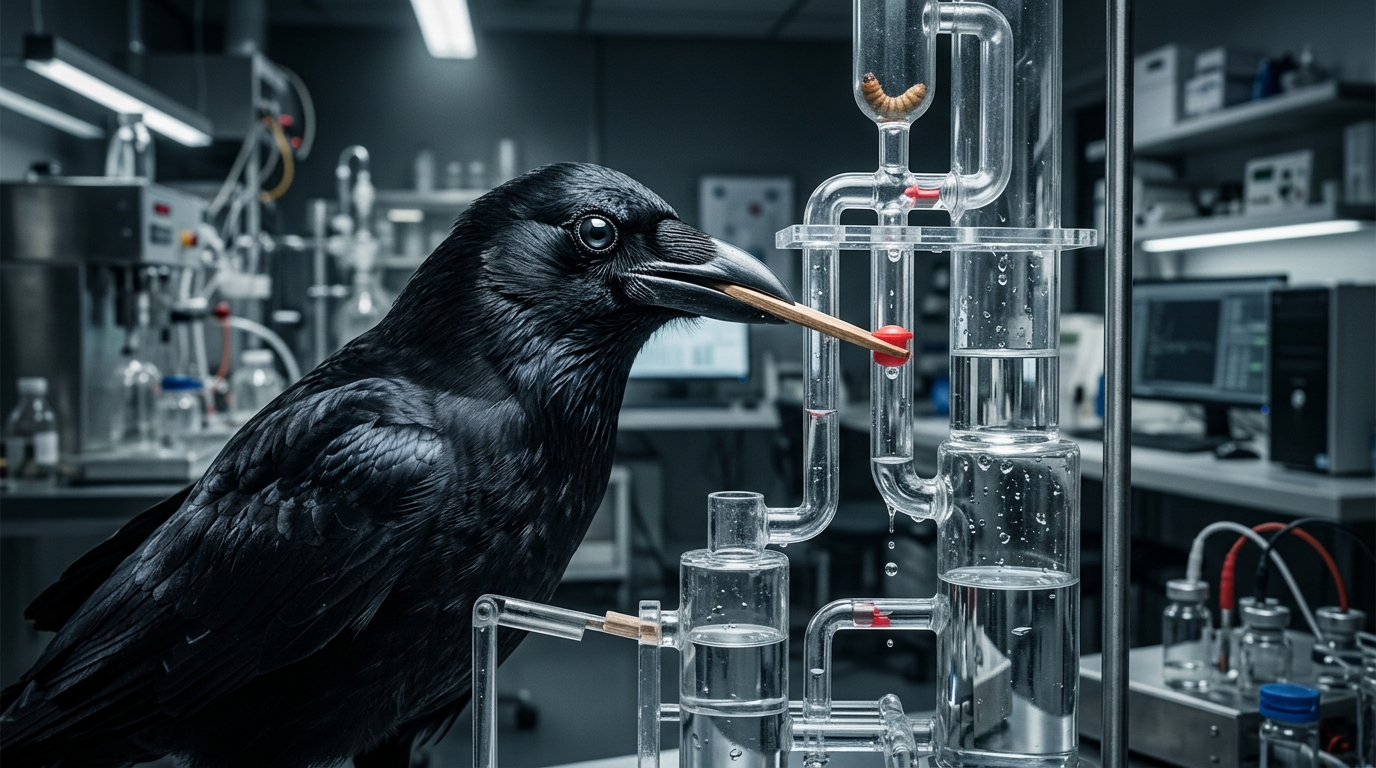
For generations, humans viewed intelligence as a trait that clearly separated people from the rest of the animal kingdom. Animals were often judged according to how closely their abilities resembled human thinking, leading to the belief that most species relied primarily on instinct rather than complex reasoning. However, modern research has dramatically changed that perspective.
Scientists studying animal behavior, cognition, and communication have uncovered remarkable evidence that intelligence takes many forms. From problem-solving crows and tool-using primates to dolphins with sophisticated social lives and octopuses capable of navigating complex challenges, the natural world is filled with examples that challenge traditional ideas about what it means to be intelligent.
Rather than existing on a simple scale with humans at the top, intelligence appears to have evolved in diverse ways to help different species survive in their unique environments. Here are 11 fascinating facts about animal intelligence that challenge common assumptions and reveal just how remarkable the minds of other creatures can be.
1. Intelligence Comes in Many Different Forms
One of the biggest misconceptions about intelligence is the idea that there is only one way to measure it.
Humans often evaluate intelligence using skills such as language, mathematics, or abstract reasoning. However, animals have evolved abilities that suit their specific ecological needs. A dolphin’s social intelligence, a crow’s problem-solving skills, and a bee’s navigational abilities are all forms of intelligence, even though they differ greatly from human cognition.
Scientists increasingly recognize that comparing every species to humans can overlook extraordinary adaptations.
The question is not whether animals think like humans, but how they think in ways that help them survive.
2. Crows Can Solve Complex Problems
Members of the crow family consistently surprise researchers with their cognitive abilities.
Studies have shown that some crows can solve multi-step puzzles, use tools to obtain food, and even modify objects to make them more effective. In certain experiments, crows have demonstrated the ability to understand cause and effect relationships that were once considered uniquely human.
Their problem-solving skills rival those of some primates.
These findings have forced scientists to rethink assumptions about the relationship between brain size and intelligence.
3. Octopuses Possess Remarkable Cognitive Abilities
Despite being separated from humans by hundreds of millions of years of evolution, octopuses display astonishing intelligence.
Researchers have observed octopuses opening containers, escaping enclosures, navigating mazes, and learning through experience. They also appear capable of recognizing individual humans in some situations.
Because octopuses evolved intelligence independently from mammals, they provide valuable insights into how complex cognition can emerge through different evolutionary pathways.
Their abilities demonstrate that intelligence is not limited to vertebrates.
4. Dolphins Have Sophisticated Social Lives
Dolphins are often celebrated for their intelligence, and research continues to support that reputation.
These marine mammals live in complex social groups and communicate using a variety of sounds and behaviors. Scientists have documented cooperation, coordinated hunting strategies, and even evidence of cultural transmission, where learned behaviors are passed between generations.
Some studies suggest dolphins may recognize themselves in mirrors, a trait associated with self-awareness.
Their social intelligence remains an active area of research.
5. Bees Can Learn and Remember
Many people assume that insects operate entirely through instinct.
However, research has revealed that bees are capable of learning, remembering, and adapting their behavior. They can associate colors and patterns with rewards, navigate long distances, and communicate information about food sources through sophisticated movements known as the “waggle dance.”
Considering the tiny size of their brains, these abilities are particularly impressive.
Bees demonstrate that intelligence does not necessarily require a large nervous system.
6. Elephants Display Strong Memory and Social Awareness
The phrase “an elephant never forgets” may contain more truth than many people realize.
Elephants possess impressive memories that help them navigate vast landscapes and remember important resources such as water sources. They also maintain complex social relationships and appear capable of recognizing numerous individuals over extended periods.
Researchers have documented behaviors suggesting empathy, cooperation, and even responses to the deaths of group members.
These observations highlight the emotional and cognitive complexity of elephant societies.
7. Some Animals Use Tools
Tool use was once considered one of the defining characteristics of human intelligence.
Today, scientists know that multiple species use tools in creative ways. Chimpanzees use sticks to extract insects, sea otters employ rocks to crack open shellfish, and certain birds use twigs to access hidden food.
Tool use requires an understanding of how objects can be manipulated to achieve specific goals.
The widespread occurrence of this behavior across unrelated species suggests that advanced problem-solving has evolved multiple times.
8. Animals Can Learn From One Another
Learning is not always an individual process.
Many species acquire knowledge by observing others. Young animals often learn important survival skills by watching parents or group members. In some cases, behaviors spread through populations in ways that resemble cultural traditions.
Researchers have documented examples of social learning in primates, birds, whales, dolphins, and numerous other animals.
This ability allows valuable information to be shared without each individual having to discover everything independently.
9. Communication Is More Complex Than Once Thought
Animal communication extends far beyond simple calls or signals.
Many species use combinations of sounds, body language, scent markers, and visual displays to convey information. Some communication systems contain enough complexity that researchers continue debating how closely they resemble language.
For example, whales produce elaborate vocalizations, while prairie dogs have alarm calls that appear capable of conveying specific details about potential threats.
The more scientists study communication, the more sophisticated it appears.
10. Intelligence Does Not Always Require a Large Brain
Brain size alone is not a reliable measure of intelligence.
Although humans possess large brains relative to body size, some animals achieve impressive cognitive feats with much smaller nervous systems. Birds, for instance, often perform tasks that rival those of mammals despite having very different brain structures.
Researchers now focus more on neural organization and function rather than size alone.
These findings challenge long-standing assumptions about the biological foundations of intelligence.
11. Humans Are Not the Only Species That Solve Problems Creatively
Perhaps the most significant lesson from modern research is that creativity and innovation are not uniquely human traits.
Animals frequently encounter new challenges and develop novel solutions. Whether it involves accessing food, navigating obstacles, or adapting to environmental changes, many species demonstrate flexibility in their thinking.
This capacity for innovation highlights the dynamic nature of animal cognition.
Far from being rigidly programmed by instinct, many animals actively respond to changing circumstances in surprisingly sophisticated ways.
Why Our Understanding of Animal Intelligence Has Changed
Advances in technology and research methods have transformed the study of animal cognition.
Scientists can now observe behavior in greater detail, conduct carefully controlled experiments, and analyze neurological processes more effectively than ever before. As a result, behaviors once dismissed as simple instinct are increasingly recognized as evidence of complex cognitive abilities.
This shift has expanded our understanding of intelligence itself.
Rather than asking which animals are intelligent, researchers now explore the many different ways intelligence can evolve.
The Difference Between Instinct and Intelligence
A common misconception is that instinct and intelligence are mutually exclusive.
In reality, most animals rely on a combination of inherited behaviors and learned experiences. Instinct provides a foundation for survival, while intelligence allows individuals to adapt when circumstances change.
For example, a bird may possess instinctive nest-building behaviors but still modify its approach based on available materials or environmental conditions.
The interaction between instinct and learning is one of the most fascinating areas of behavioral science.
What Animal Intelligence Teaches Us About Evolution
The diversity of cognitive abilities across species offers valuable insights into evolution.
Different environments create different challenges, and intelligence often evolves as a response to those challenges. Social living, tool use, complex communication, and environmental variability can all favor the development of advanced cognitive skills.
Because these pressures occur in many different contexts, intelligence has evolved multiple times throughout the history of life.
This explains why sophisticated cognition appears in animals as diverse as birds, mammals, and cephalopods.
Why These Discoveries Matter
Understanding animal intelligence has implications beyond scientific curiosity.
It influences conservation efforts, animal welfare policies, and our broader relationship with the natural world. Recognizing the cognitive complexity of animals encourages greater appreciation for the species that share our planet.
It also challenges humans to reconsider assumptions about our place within the animal kingdom.
The more we learn, the more interconnected life appears.
Final Thoughts
The study of animal intelligence has revealed a world far more complex than previous generations imagined. From problem-solving crows and tool-using octopuses to socially sophisticated dolphins and learning insects, countless species display abilities that challenge traditional definitions of intelligence.
The 11 facts explored here demonstrate that cognition takes many forms, each shaped by unique evolutionary pressures and ecological needs. Intelligence is not a single ladder with humans at the top but a diverse collection of adaptations that help animals navigate their environments.
As research continues, new discoveries will undoubtedly reshape our understanding even further. For now, one lesson is already clear: the animal kingdom is filled with minds that are far more capable, creative, and fascinating than many people once believed.







