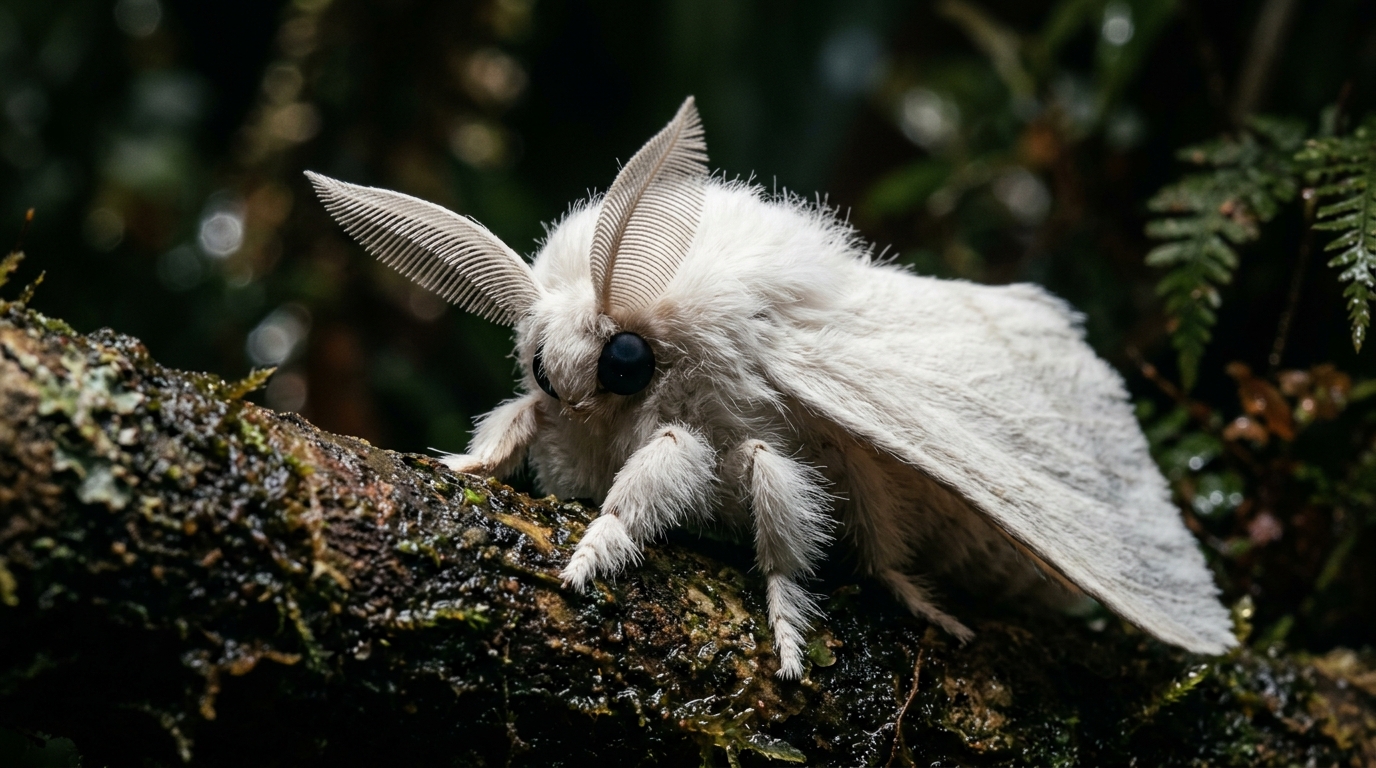
The natural world is filled with creatures that seem almost too strange to be real, but few have generated as much curiosity as the Venezuelan poodle moth. With its fluffy white appearance, oversized dark eyes, and furry body, this unusual insect looks more like a plush toy than a member of the moth family. Ever since photographs of the creature began circulating online, people have been captivated by its almost cartoon-like appearance.
What makes the Venezuelan poodle moth particularly intriguing is that scientists still have many questions about it. Unlike well-documented species that have been studied for decades, this mysterious insect remains relatively poorly understood. Its unusual features and limited scientific records have helped fuel ongoing fascination among researchers and wildlife enthusiasts alike.
While much remains unknown, the Venezuelan poodle moth has become an excellent example of how nature continues to surprise us. Here are eight reasons scientists remain fascinated by this remarkable insect.
1. Its Appearance Looks Unlike Almost Any Other Moth
The first thing that attracts attention is the moth’s extraordinary appearance.
Covered in thick, white fuzz, the insect resembles a tiny flying poodle, which inspired its popular nickname. Its dense hair-like scales, rounded body, and prominent eyes create a look that differs dramatically from the image most people have of a typical moth.
When photographs first appeared online, many viewers questioned whether the images were real.
Yet the unusual appearance highlights the incredible diversity found within the insect world.
Nature often produces forms that seem stranger than fiction.
2. It Was Discovered Relatively Recently
One reason the Venezuelan poodle moth continues to generate interest is its relatively recent appearance in public awareness.
The insect attracted widespread attention after photographs taken in Venezuela were shared online. Compared with many well-known species that have been documented for centuries, the poodle moth remains a newcomer in the eyes of the public.
Its emergence serves as a reminder that scientists are still discovering and documenting remarkable organisms around the globe.
Even in the modern era, nature retains countless mysteries.
3. Scientists Are Still Working to Understand It
Unlike famous species with extensive scientific literature, the Venezuelan poodle moth remains somewhat enigmatic.
Researchers continue investigating its classification, life history, ecological role, and evolutionary relationships. Limited observations mean that many aspects of its biology remain uncertain.
This lack of information makes the insect especially intriguing to scientists.
Every new observation has the potential to reveal important insights.
The unanswered questions are part of what makes the species so fascinating.
4. Its Furry Appearance May Serve Important Functions
The moth’s distinctive fuzz is more than just a visual curiosity.
In insects, hair-like structures and scales often perform valuable functions. Depending on the species, these features may contribute to insulation, camouflage, sensory perception, protection, or communication.
Researchers are interested in understanding how the Venezuelan poodle moth’s dense covering benefits the animal.
Studying such adaptations helps scientists better understand how species evolve in response to environmental challenges.
5. It Highlights the Diversity of Lepidoptera
The Venezuelan poodle moth belongs to the order Lepidoptera, which includes moths and butterflies.
This group contains more than 150,000 known species, displaying an astonishing variety of colors, shapes, and behaviors. While butterflies often receive more public attention, moths represent the majority of Lepidoptera diversity.
The poodle moth serves as a striking reminder of just how varied this group can be.
Its appearance challenges assumptions about what moths are supposed to look like.
6. It Demonstrates How Little We Still Know About Biodiversity
Many people assume that most large-scale biological discoveries have already been made.
In reality, scientists continue identifying new species and learning about organisms that remain poorly documented. Tropical ecosystems, in particular, contain enormous amounts of biodiversity that have yet to be fully explored.
The Venezuelan poodle moth illustrates how much remains unknown.
Even in an age of advanced technology and global communication, countless species still await deeper scientific study.
7. It Sparked Global Interest in Entomology
One of the most positive outcomes of the moth’s popularity has been increased public interest in insects.
Many people who would not normally pay attention to entomology became curious after seeing photographs of the unusual creature. As a result, conversations expanded to include insect diversity, conservation, and scientific discovery.
Charismatic species often serve as gateways to broader learning.
The Venezuelan poodle moth encouraged countless individuals to explore the fascinating world of insects.
8. It Reminds Us That Nature Is Full of Surprises
Perhaps the most important reason scientists are fascinated by the Venezuelan poodle moth is what it represents.
The insect serves as a powerful reminder that nature remains filled with unexpected discoveries. No matter how much humans learn about the natural world, there are always new species, behaviors, and adaptations waiting to be explored.
The poodle moth’s unusual appearance challenges assumptions and sparks curiosity.
Those qualities lie at the heart of scientific inquiry.
What Exactly Is the Venezuelan Poodle Moth?
The Venezuelan poodle moth is believed to be a member of the moth family, although aspects of its classification remain subjects of discussion and investigation.
The nickname comes entirely from its appearance rather than any relationship to actual poodles. Its thick covering of white scales creates a fluffy look rarely seen in insects.
Photographs of the moth were reportedly taken in Venezuela’s tropical environment, an area known for extraordinary biodiversity.
The region contains numerous species that continue to attract scientific interest.
Why Tropical Ecosystems Produce Unusual Species
Tropical habitats are among the most biologically diverse places on Earth.
Several factors contribute to this richness:
- Stable climates.
- Abundant vegetation.
- Complex ecological interactions.
- Long evolutionary histories.
- Numerous ecological niches.
These conditions create opportunities for species to evolve highly specialized traits.
The Venezuelan poodle moth may represent one example of this remarkable evolutionary diversity.
The Importance of Insect Research
Although insects are often overlooked, they play essential roles in ecosystems.
Many species contribute to:
- Pollination.
- Nutrient recycling.
- Soil health.
- Food webs.
- Population regulation.
Studying unusual insects can reveal important information about ecological relationships and evolutionary processes.
Every species has the potential to expand scientific understanding.
Why Unusual Animals Capture Public Attention
Humans are naturally drawn to animals that challenge expectations.
Creatures with distinctive appearances often become ambassadors for scientific curiosity. They encourage people to ask questions, seek information, and engage with the natural world.
The Venezuelan poodle moth achieved this effect on a global scale.
Its unusual appearance sparked wonder among people who might otherwise never have considered insect biology.
That curiosity has value in itself.
What Scientists Hope to Learn
Future research may help answer several important questions about the moth:
- Its precise classification.
- Life cycle and reproduction.
- Habitat requirements.
- Feeding behavior.
- Evolutionary history.
- Ecological role.
Each new discovery contributes to a broader understanding of biodiversity.
Researchers remain eager to learn more about this unusual species and the environment it inhabits.
The Broader Lesson of the Poodle Moth
The story of the Venezuelan poodle moth illustrates a larger truth about science.
Discovery is an ongoing process. Even today, researchers continue uncovering organisms that challenge assumptions and expand knowledge. Nature remains far more complex than most people realize.
Every mysterious species serves as a reminder that exploration is not limited to distant planets or deep oceans.
Extraordinary discoveries can sometimes be found in forests, mountains, and ecosystems much closer to home.
Final Thoughts
The Venezuelan poodle moth has earned its place as one of the most intriguing insects in recent memory. Its fluffy appearance, mysterious biology, and limited scientific documentation have combined to create a creature that fascinates both researchers and the public.
The eight reasons explored here reveal why interest in the moth remains strong. From its unusual physical traits and scientific mysteries to its role in promoting curiosity about biodiversity, the insect represents much more than a viral photograph.
Most importantly, it reminds us that nature still holds countless secrets. In a world where many people assume everything has already been discovered, the Venezuelan poodle moth stands as proof that wonder, mystery, and scientific exploration are still very much alive.