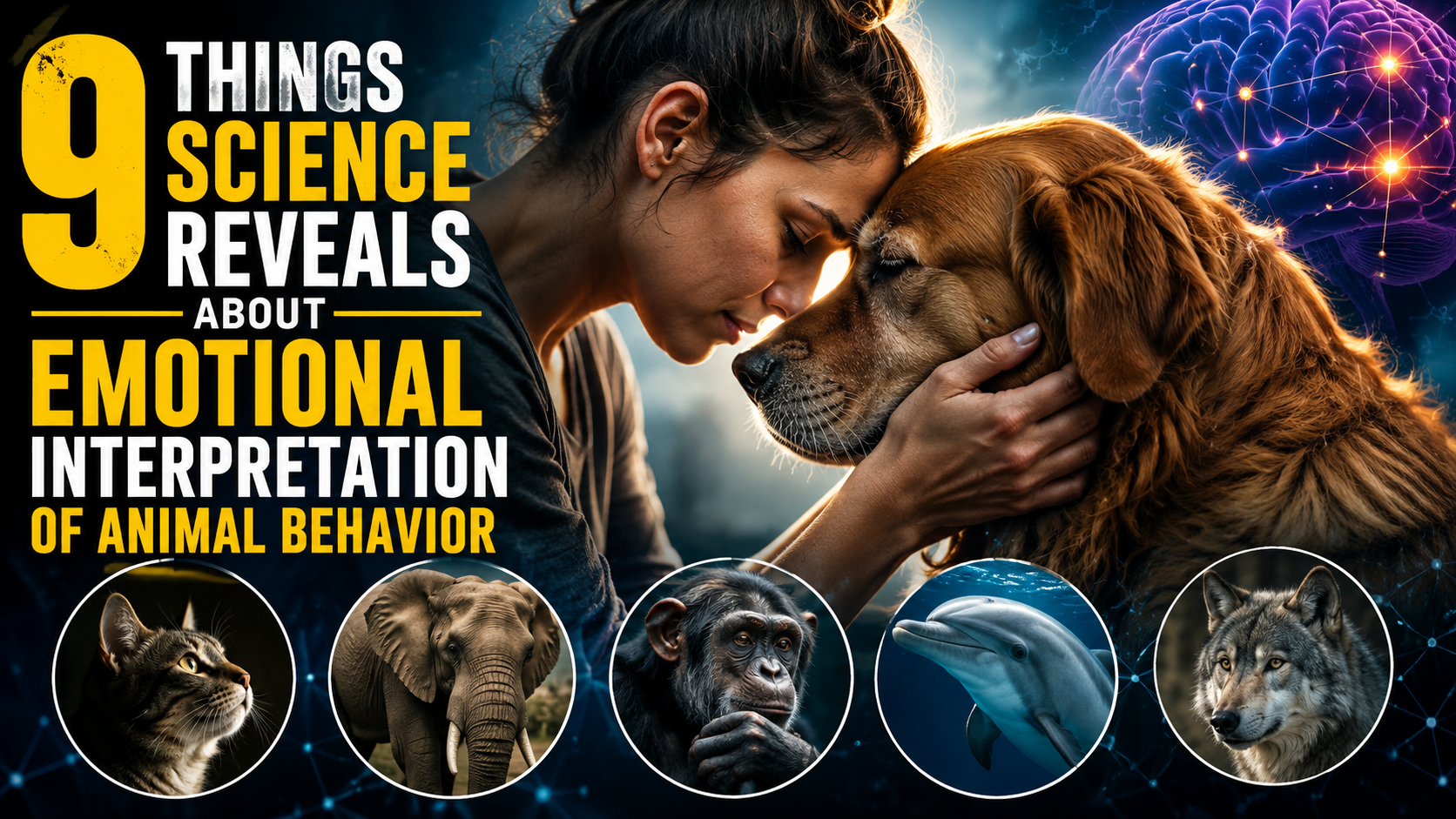
Humans have always shared a close relationship with animals. From domestic pets like dogs and cats to wildlife we observe in nature documentaries, we constantly try to understand what animals are feeling. Interestingly, science shows that this process is not always straightforward. Instead of simply “reading” animal emotions, our brains actively interpret, guess, and sometimes project emotions onto them.
Research in psychology, neuroscience, and animal behavior suggests that how we understand animals is shaped by biology, experience, and even cultural conditioning. Below are nine science-backed insights that reveal how humans interpret animal behavior emotionally—and why we often see more “emotion” than may actually be there.
1. The Human Brain Is Wired to Recognize Faces Everywhere
One of the strongest scientific explanations for emotional interpretation of animals is a phenomenon called pareidolia, where the brain detects familiar patterns—especially faces—even when they are not human.
This means when we look at animals, our brains automatically try to map human facial expressions onto them. A tilted head, relaxed eyes, or open mouth can easily be interpreted as happiness, sadness, or curiosity—even if the animal is simply in a neutral state.
This instinct helped early humans survive by quickly reading intentions in others, but today it also influences how we see animals.
2. We Naturally Anthropomorphize Animal Behavior
Anthropomorphism is the tendency to assign human emotions and intentions to non-human beings. Science shows this is extremely common when people interact with pets or observe animals closely.
For example, a dog lying quietly may be seen as “feeling guilty,” or a cat avoiding interaction may be interpreted as “being moody.” In reality, these behaviors often have simpler explanations related to comfort, instincts, or environmental conditions.
Still, anthropomorphism helps humans build emotional connections with animals, which can strengthen caregiving behavior.
3. Emotional Projection Helps Humans Build Empathy
Studies suggest that humans often project their own emotions onto animals as a way to understand them better. This psychological process allows people to relate to animals in a more personal and emotional way.
If a person is feeling calm and content, they may interpret a relaxed animal as “happy.” If they are stressed or anxious, they may see the same behavior as “sad” or “withdrawn.”
This emotional projection is not necessarily incorrect—it simply reflects how human perception is influenced by internal emotional states.
4. Mirror Neurons Play a Role in Emotional Interpretation
Neuroscience has identified mirror neurons in the brain that activate both when we perform an action and when we observe others performing it. These neurons are believed to play a role in empathy and emotional understanding.
When we see animals displaying certain behaviors—like whining, playing, or resting—our mirror neuron system helps us simulate what those actions might feel like. This leads to emotional interpretation, even when the animal’s internal state may not match our assumption.
5. Context Heavily Influences Emotional Interpretation
Science shows that context dramatically changes how humans interpret animal behavior. The same expression can be seen differently depending on the situation.
For example, a dog with its mouth open and tongue out may be seen as playful in a park but anxious in a loud or unfamiliar environment. Our brain uses surrounding cues to assign emotional meaning, even when the behavior itself remains unchanged.
This demonstrates that interpretation is not just about the animal—it is also about the environment and the observer.
6. Humans Are Biologically Drawn to Cute Features
Research in evolutionary psychology shows that humans are naturally attracted to “cute” features such as large eyes, rounded faces, and soft expressions. These traits activate caregiving instincts in the brain.
Many animals, especially domestic pets, display features that trigger these responses. As a result, people are more likely to interpret their behavior as emotionally expressive or human-like.
This biological response strengthens bonding between humans and animals.
7. Experience With Animals Improves Emotional Accuracy
Studies indicate that people who regularly interact with animals—such as pet owners, veterinarians, or animal trainers—tend to interpret animal behavior more accurately.
Experience helps individuals distinguish between true emotional cues and instinctual or learned behaviors. For example, they may recognize the difference between fear-based avoidance and simple disinterest.
This shows that emotional interpretation is a skill that improves with exposure and knowledge.
8. Cultural Beliefs Shape How We See Animal Emotions
Cultural background also plays a significant role in how humans interpret animal behavior. In some cultures, animals are seen as spiritual beings with deep emotional intelligence, while in others, they are viewed more practically.
These beliefs influence whether people are more likely to see animals as emotionally complex or behaviorally simple. Science suggests that cultural narratives can shape perception just as strongly as biology.
9. Emotional Interpretation Strengthens Human-Animal Bonds
Despite potential inaccuracies, interpreting animal emotions plays an important role in strengthening relationships between humans and animals. When people believe their pets are happy, sad, or affectionate, they are more likely to care for them attentively.
This emotional connection encourages responsible pet ownership, better welfare practices, and stronger empathy toward animals in general.
Even if interpretations are not always scientifically precise, they contribute positively to human-animal relationships.
Why Humans Naturally Interpret Animal Emotions
At the core, emotional interpretation of animals is a combination of evolution, brain structure, and social learning. Humans evolved as social creatures who needed to quickly understand others’ intentions. This ability has extended beyond human interactions and now applies to animals as well.
Our brains are constantly trying to make sense of the world using familiar emotional frameworks. Since animals share many physical and behavioral similarities with humans, it becomes natural to interpret their actions in emotional terms.
The Balance Between Science and Perception
Science encourages us to be aware of the difference between actual animal emotions and human interpretations of those emotions. While animals do experience feelings such as fear, joy, and stress, not every behavior directly translates into human-like emotional states.
Understanding this balance allows us to appreciate animals more deeply while avoiding misinterpretation.
Final Thoughts
The way humans interpret animal behavior is a fascinating mix of biology, psychology, and emotion. From mirror neurons and facial recognition systems to cultural influences and personal experience, many factors shape how we perceive animals.
While we may not always interpret animal emotions perfectly, our instinct to connect with them emotionally is a powerful part of what makes human-animal relationships so meaningful.
By learning more about these scientific insights, we can better understand both animals and ourselves—and build stronger, more compassionate connections with the living beings around us.







