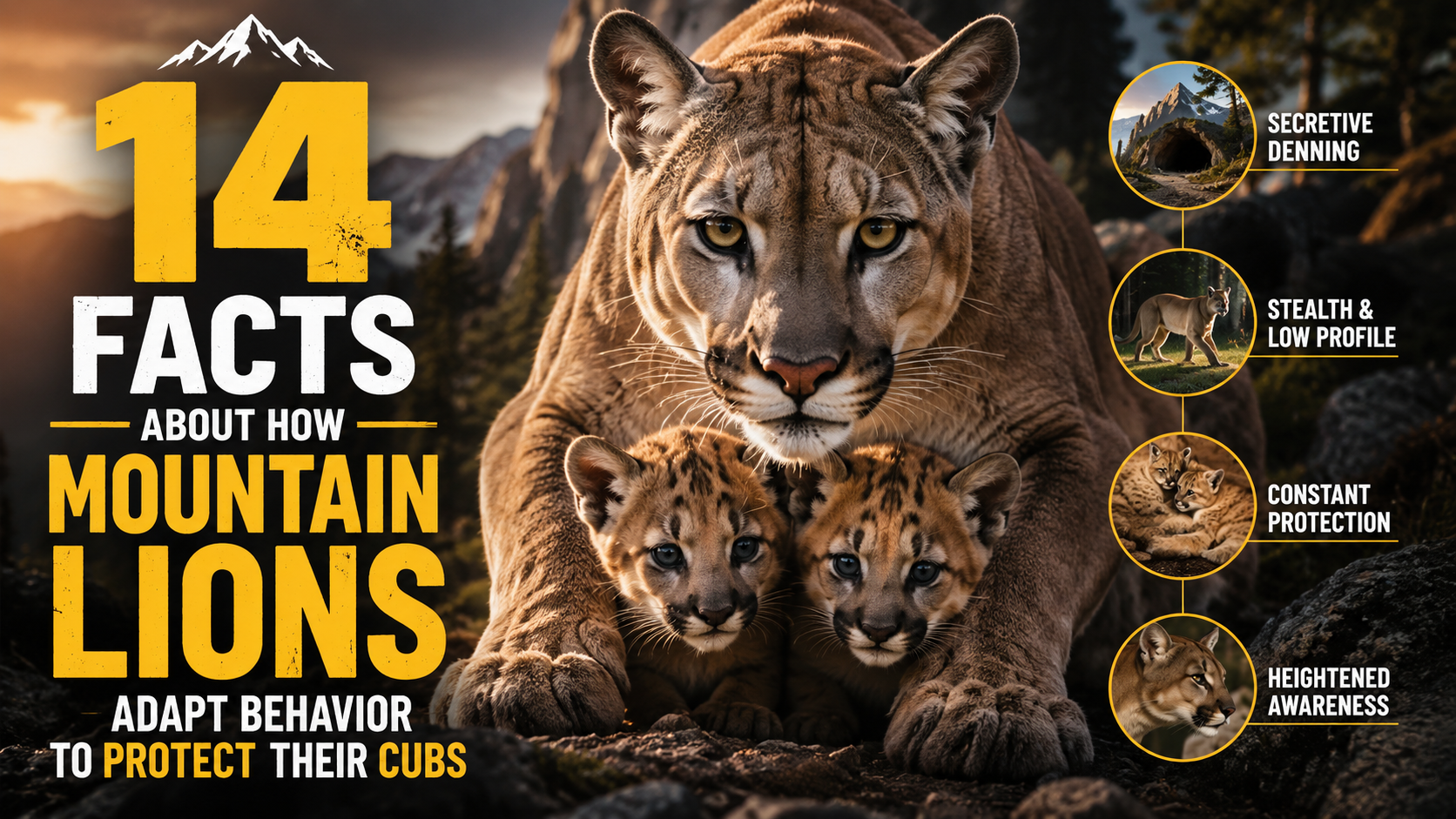
Mountain lions—also known as cougars or pumas—are among the most elusive and intelligent big cats in North America. While they are powerful predators, they are also highly devoted parents. When cubs are involved, their behavior changes dramatically in ways that prioritize protection, survival, and careful decision-making.
Unlike many animals that rely purely on instinctive reactions, mountain lions display a surprising level of behavioral flexibility. They adjust their hunting patterns, movement, and even communication style to reduce risk and keep their young safe.
Below are 14 detailed facts that explain how mountain lions adapt their behavior to protect their cubs in the wild.
1. They Become Extremely Secretive After Giving Birth
Female mountain lions immediately shift into a highly secretive lifestyle after having cubs. They choose remote dens—often caves, thick vegetation, or rocky outcrops—far away from human activity and larger predators.
This secrecy is essential because newborn cubs are completely dependent on their mother and extremely vulnerable in their early weeks.
2. Mothers Frequently Relocate Their Cubs
To avoid detection, mountain lion mothers often move their cubs from one den site to another. This behavior reduces the chances of predators or scavengers tracking them down.
The mother carries her cubs carefully by the neck, similar to domestic cats, ensuring they are not injured during relocation.
3. Hunting Patterns Become More Strategic
Once cubs are born, female mountain lions do not hunt randomly. Instead, they choose prey and hunting times that minimize risk and energy loss.
They may hunt more frequently but travel shorter distances, ensuring they can return quickly to their cubs.
4. They Reduce Vocal Communication
Mountain lions are generally silent animals, but mothers become even quieter when raising cubs. They avoid unnecessary vocalizations that could reveal their location.
Instead, communication with cubs happens through subtle body language and scent cues.
5. Territory Behavior Becomes More Defensive
A mother mountain lion becomes far more protective of her territory when cubs are present. She will actively avoid or confront intruders depending on the threat level.
Male mountain lions, in particular, can pose danger to cubs, so females take extra precautions to keep them away.
6. Cubs Are Hidden for Extended Periods
For the first few weeks of life, cubs are left alone for long stretches while the mother hunts. However, they are carefully hidden in dense, concealed areas.
This behavior may seem risky, but it actually reduces exposure by keeping the cubs out of sight while the mother searches for food.
7. Mothers Rely Heavily on Scent Control
Scent is one of the biggest risks for young cubs because predators can track them easily. Female mountain lions often take steps to mask or minimize scent trails leading to the den.
They may choose wind-protected areas or frequently change resting sites to reduce detection.
8. Increased Alertness and Sensory Awareness
During cub-rearing periods, mountain lions display heightened awareness of their surroundings. Their hearing and vision become more actively engaged, constantly scanning for danger.
Even while resting, mothers remain alert to subtle environmental changes.
9. Defensive Aggression Becomes More Likely
Normally solitary and avoidant, female mountain lions can become highly aggressive when cubs are threatened. They are known to stand their ground against much larger animals if necessary.
This protective aggression is a critical survival mechanism for their offspring.
10. Movement Becomes More Restricted
To avoid drawing attention, mothers significantly reduce long-distance travel. They operate within smaller, safer areas that they can monitor closely.
This reduced movement helps them maintain better control over their environment while raising cubs.
11. Teaching Begins Earlier Than Expected
As cubs grow, mothers gradually introduce them to survival skills such as stalking, hiding, and observing prey behavior.
This early learning process ensures cubs are better prepared for independence later in life.
12. Play Behavior Has a Survival Purpose
Although cub play may look purely playful, it actually serves an important developmental function. Through wrestling, chasing, and pouncing, cubs build coordination and hunting skills.
The mother often supervises these activities to ensure safety and learning.
13. Mothers Delay Independence Strategically
Mountain lion cubs typically stay with their mother for up to 18–24 months. This extended dependency period allows them to fully develop survival skills before living independently.
Mothers only separate from cubs when they are confident the young can survive alone.
14. Risk Assessment Becomes Constant
Perhaps the most important adaptation is continuous risk evaluation. A mother mountain lion is always assessing threats—from weather changes to predator presence and human activity.
Every decision she makes during this period is influenced by one goal: maximizing cub survival.
Why These Behaviors Matter in the Wild
Mountain lions live in challenging environments where survival depends on stealth, timing, and awareness. Raising cubs adds an extra layer of difficulty, forcing mothers to adjust nearly every aspect of their behavior.
These adaptations are not random—they are refined survival strategies shaped by evolution over thousands of years.
Without these behavioral shifts, cub survival rates would be significantly lower in the wild.
The Balance Between Power and Protection
What makes mountain lions especially fascinating is the contrast between their role as apex predators and their role as protective mothers. In one context, they are efficient hunters; in another, they are cautious, patient guardians.
This balance highlights the complexity of animal behavior and challenges the idea that predators act purely on aggression.
Human Encounters and Misunderstandings
Occasionally, humans may encounter mountain lions in the wild. During cub-rearing periods, these encounters can be particularly dangerous because mothers are far more defensive than usual.
Understanding their behavior helps reduce unnecessary conflict and promotes safer coexistence between humans and wildlife.
Final Thoughts
Mountain lions demonstrate remarkable behavioral flexibility when raising their cubs. From changing hunting strategies to increasing secrecy and defensive aggression, every adaptation serves a clear purpose: survival of the next generation.
These behaviors remind us that even the most powerful predators are deeply driven by care, caution, and instinctive responsibility.
In the end, the story of a mountain lion mother is not just about strength—it is about adaptation, intelligence, and the enduring commitment to protect life in a challenging natural world.