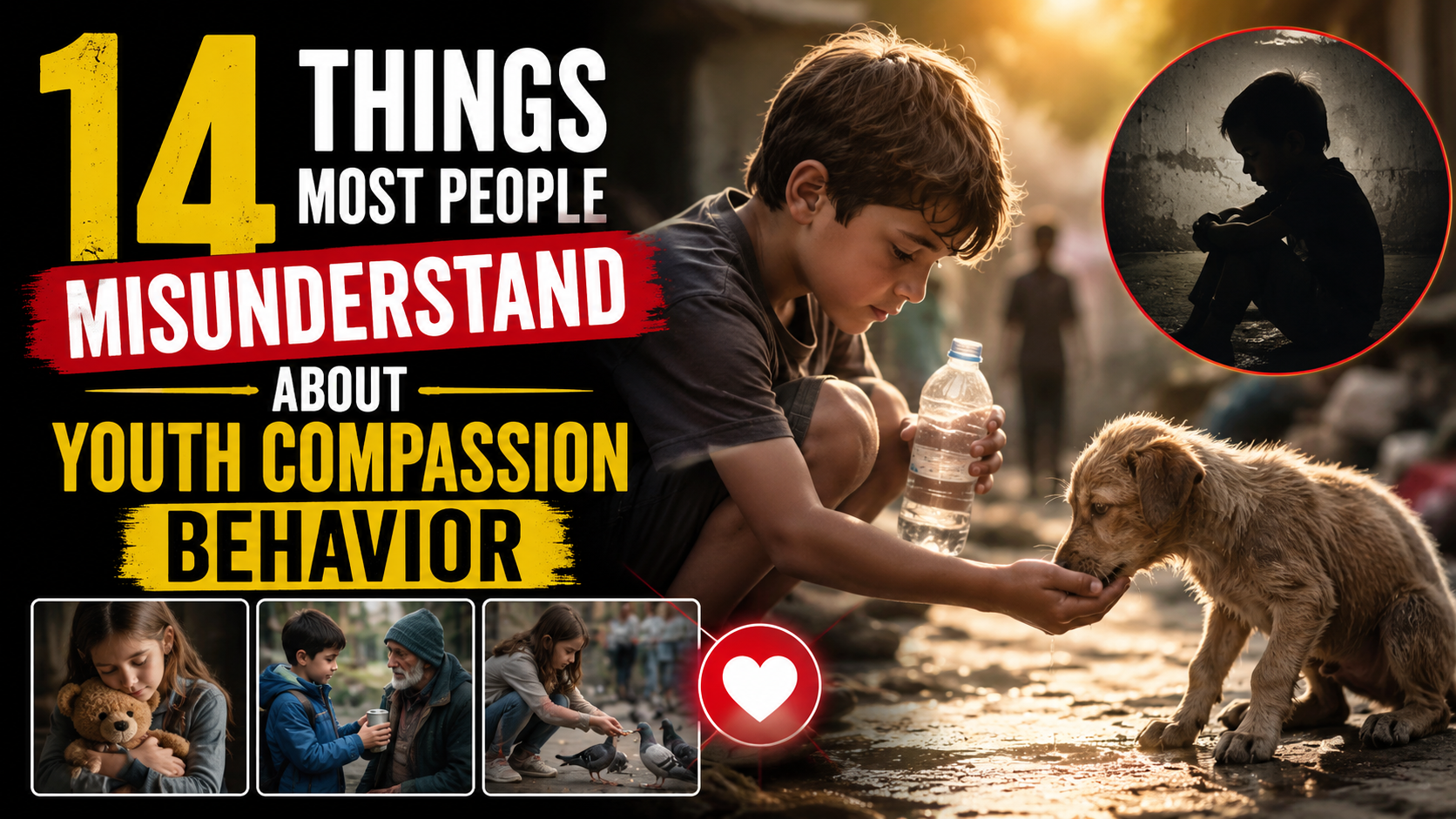
Compassion in young people is often misunderstood. Adults sometimes assume that children and teenagers act impulsively, inconsistently, or without deep emotional awareness. However, research in developmental psychology shows a very different picture. Young people are often far more emotionally sensitive, observant, and empathetic than they are given credit for.
The way youth express compassion may look different from adults, but that does not mean it is less meaningful. In fact, many compassionate behaviors in children and teens are shaped by strong emotional intuition, social learning, and early moral development.
Below are 14 common misunderstandings about youth compassion behavior—and what is actually going on beneath the surface.
1. Compassion in Youth Is Not “Inconsistent” — It Is Developing
Many people assume children are only sometimes compassionate. In reality, compassion in youth is still forming. Their emotional responses are developing alongside their cognitive skills.
What may look like inconsistency is often a natural stage of emotional growth, not a lack of empathy.
2. Kids Do Not Lack Empathy — They Express It Differently
Young people may not always show empathy in the same verbal or structured way adults do. Instead, they often express it through actions, gestures, or behavior rather than words.
Helping a friend, sharing food, or comforting an animal are all forms of emotional expression that reflect real empathy.
3. Emotional Reactions Are Often Stronger Than Adults Expect
Children and teenagers can experience emotions more intensely than adults in certain situations. Their brains are still developing regulation systems, which can make their compassionate reactions more immediate and visible.
This intensity is often mistaken for immaturity, when it is actually emotional openness.
4. Compassion Is Not Always Logical in Youth
Adults tend to associate compassion with rational decision-making. However, young people often act from instinctive emotional responses rather than structured reasoning.
This does not make their compassion less real—it simply reflects a different developmental stage.
5. Helping Behavior Can Appear Unplanned but Still Be Meaningful
When children help others suddenly or without planning, adults may dismiss it as impulsive. In reality, spontaneous helping behavior is one of the purest forms of compassion.
It often reflects immediate emotional connection rather than calculated decision-making.
6. Youth Are Highly Sensitive to Emotional Environments
Children and teens are strongly influenced by the emotional tone of their surroundings. A supportive environment often encourages kindness, while stress or negativity can suppress it.
Their compassion is deeply connected to what they observe and experience daily.
7. Animals Often Trigger Strong Compassion in Young People
Research shows that children frequently respond more strongly to animals in distress than adults do. This is due to innate caregiving instincts and reduced emotional conditioning.
Animals often become a “safe target” for expressing empathy.
8. Peer Influence Can Either Encourage or Suppress Kindness
Social groups play a major role in shaping youth behavior. In supportive peer environments, compassionate actions are more likely to be expressed openly.
However, in group settings where emotional expression is discouraged, kindness may be hidden or reduced.
9. Youth Compassion Is Often Underestimated Because It Is Quiet
Not all compassionate behavior is visible or dramatic. Many young people show care through small, quiet actions that go unnoticed by adults.
Simple acts like checking on someone, offering help, or sharing resources are meaningful expressions of empathy.
10. Emotional Learning Happens Through Observation
Children learn compassion by watching how adults behave. If kindness is modeled consistently, young people are more likely to develop strong empathetic habits.
This means youth compassion is often a reflection of their environment.
11. Teenagers Are Not “Less Compassionate” — They Are More Self-Conscious
As children grow into teenagers, social awareness increases. This can make them more hesitant to express compassion openly for fear of judgment.
The emotion is still there, but expression becomes more controlled.
12. Stress Can Temporarily Mask Compassionate Behavior
Under pressure or emotional stress, young people may appear less empathetic. However, this is often a temporary response to overwhelming feelings.
Once stress levels decrease, compassionate behavior typically returns.
13. Youth Compassion Often Appears in Protective Behavior
One of the strongest forms of empathy in young people is protection. They may stand up for friends, defend animals, or intervene in unfair situations.
This protective instinct is a powerful expression of emotional care.
14. Compassion in Youth Is a Foundation for Lifelong Emotional Development
Perhaps the most important truth is that compassion developed in youth forms the basis for adult empathy. Early emotional experiences shape how individuals relate to others later in life.
Encouraging and supporting compassionate behavior during childhood and adolescence is essential for long-term emotional well-being.
Why Youth Compassion Is Often Misunderstood
Many misunderstandings come from comparing young people directly to adults. However, emotional development is not linear. It evolves through stages influenced by biology, environment, and experience.
Children and teens are not “less compassionate”—they are simply learning how to express and manage complex emotions.
The Role of Environment in Shaping Kindness
Family dynamics, school culture, media exposure, and peer interactions all play a role in shaping youth behavior. A nurturing environment encourages empathy to grow naturally, while a negative environment may suppress it.
This highlights the importance of emotional education and positive role modeling.
Final Thoughts
Youth compassion behavior is far more complex and meaningful than it is often assumed to be. While it may appear inconsistent or subtle at times, it is rooted in genuine emotional awareness and developing empathy.
By understanding these 14 insights, we can better appreciate how young people express kindness and support their emotional growth in healthier ways.
Ultimately, compassion in youth is not something to be judged—it is something to be guided, encouraged, and understood.







