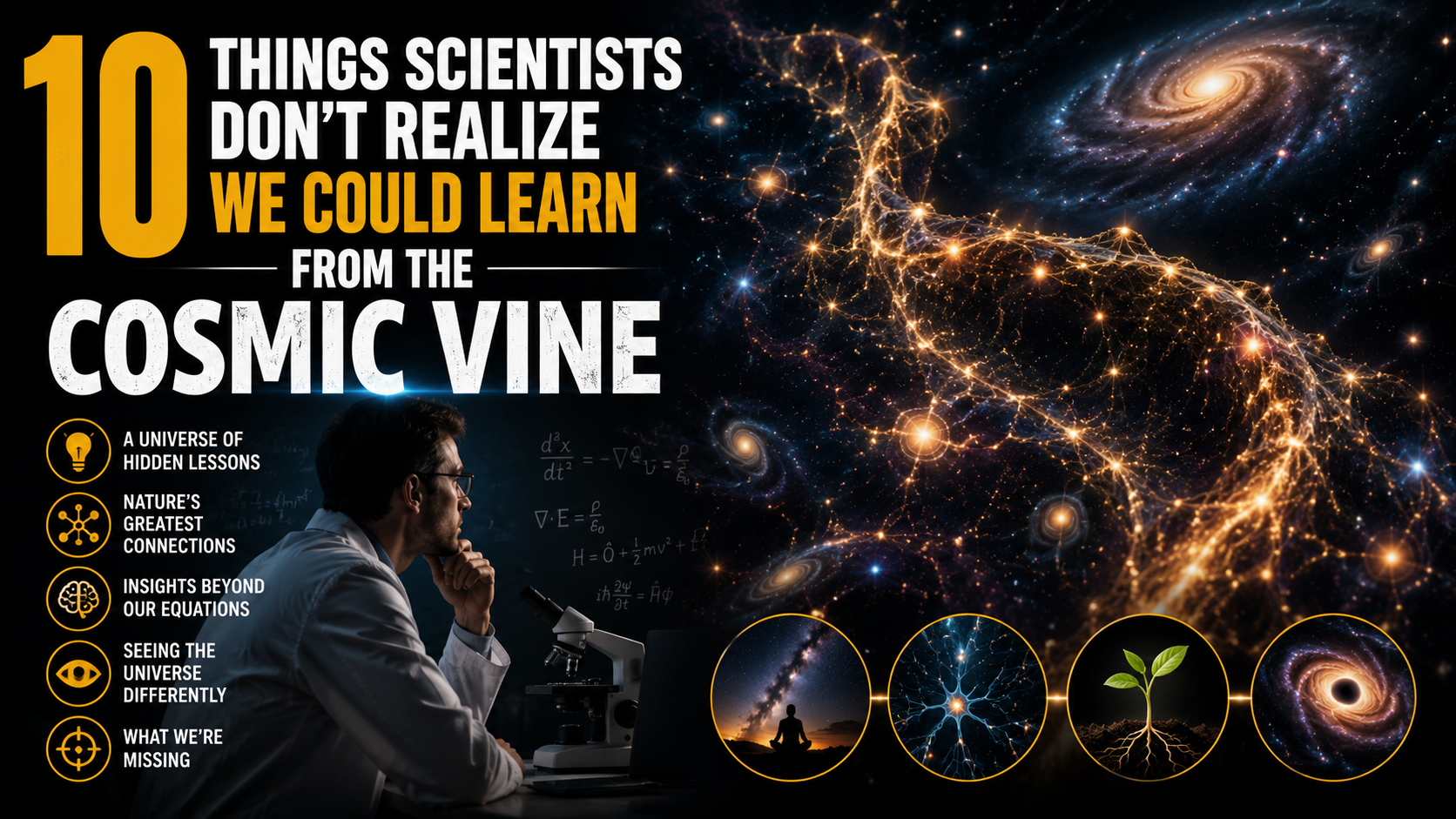
Every so often, space presents patterns that challenge how we think about structure, matter, and the universe itself. One of the most intriguing recent ideas discussed in astronomical circles is the so-called “Cosmic Vine”—a term used to describe large-scale filament-like structures that appear to connect galaxies across vast regions of space.
While not a single object, the concept of a cosmic vine refers to the immense web of gas, dark matter, and galaxies that forms a network across the universe. This structure is part of what scientists often call the cosmic web. However, the “vine” metaphor highlights how interconnected and organic this system appears, almost as if the universe is growing and branching like a living organism.
Although researchers have made significant progress in mapping these structures, there are still many aspects that remain uncertain or underexplored. Some possibilities are even more fascinating than current theories suggest.
Here are 10 things scientists may still be underestimating—or only beginning to understand—about the cosmic vine.
1. The Universe May Be More Interconnected Than We Think
One of the most striking implications of the cosmic vine concept is just how interconnected everything appears to be.
Galaxies are not randomly scattered across space. Instead, they form long filaments connected by dense clusters, resembling strands in a vast cosmic network.
This raises an important question: are these structures simply the result of gravity, or do they reflect deeper organizing principles that we have yet to fully understand?
The more we map the universe, the more interconnected it appears.
2. Dark Matter Could Be Structuring the Cosmic Vine
Dark matter remains one of the biggest mysteries in modern astrophysics.
Although we cannot see it directly, we know it exists because of its gravitational effects on visible matter.
Many scientists believe dark matter acts as the “scaffolding” for cosmic structures, guiding how galaxies form and align.
However, the cosmic vine perspective suggests we may still underestimate just how dominant dark matter is in shaping these large-scale patterns.
It may not just influence structure—it may define it entirely.
3. Galaxy Formation May Be More Coordinated Than Random
Traditional models often describe galaxy formation as a gradual, somewhat independent process driven by local conditions.
But the cosmic vine structure hints at a more coordinated system.
Galaxies appear to form along filaments where gas and dark matter are already concentrated, suggesting that location within the cosmic web strongly influences development.
This raises the possibility that galaxy formation is not purely isolated but part of a larger, structured process influenced by cosmic-scale environments.
4. These Filaments May Transport Matter Across Vast Distances
One of the most intriguing ideas about cosmic filaments is that they may act like highways for matter.
Gas, dust, and even galaxies can slowly move along these structures under the influence of gravity.
This means that matter is not static in the universe—it is constantly flowing along these invisible threads.
Over billions of years, this movement may play a significant role in how galaxies evolve and interact.
Yet the full extent of this cosmic transport system is still not fully understood.
5. Energy Distribution Across the Cosmic Web Is Still a Mystery
We understand a fair amount about visible matter in the universe, but energy distribution across the cosmic web remains poorly understood.
The cosmic vine may contain regions of varying energy density that influence how galaxies behave and evolve.
Some areas may be more active, while others remain relatively quiet.
Understanding how energy flows through these filaments could reveal new insights into cosmic evolution and the lifecycle of galaxies.
6. The Cosmic Vine Could Influence Time Perception on Large Scales
While this idea is still highly theoretical, some researchers speculate that large-scale gravitational structures could influence the flow of time itself.
Massive concentrations of matter can distort spacetime according to general relativity.
If cosmic filaments are large enough, they could create subtle variations in time flow across different regions of space.
Although these effects would be extremely small, they highlight just how complex the universe’s structure might be.
7. We May Be Underestimating the Role of Cosmic Feedback Loops
In astrophysics, feedback loops refer to processes where the output of a system influences its own behavior.
For example, star formation can generate energy that affects surrounding gas, which in turn influences future star formation.
Within the cosmic vine, such feedback processes may operate on much larger scales than currently modeled.
If true, this could mean that galaxy formation and evolution are part of a self-regulating cosmic system.
8. The Cosmic Web May Be More Dynamic Than Static
For many years, scientists imagined the large-scale structure of the universe as relatively stable over long periods.
However, newer observations suggest that the cosmic web is far more dynamic than previously thought.
Filaments may shift, grow, and evolve over time as gravitational forces reshape them.
This means the cosmic vine is not a fixed structure—it is constantly changing, even if those changes occur over billions of years.
9. There Could Be Unknown Forms of Matter Within the Filaments
The cosmic vine is primarily studied through visible matter and gravitational effects, but there may be components we have not yet identified.
Some regions of intergalactic space contain extremely low-density gas, and it is possible that unknown forms of matter or energy exist within these filaments.
While dark matter and dark energy already dominate theoretical discussions, the possibility remains that additional unknown components could be influencing cosmic structure.
This is one of the most open-ended and exciting areas of current research.
10. The Cosmic Vine May Help Explain the Universe’s Large-Scale Structure
Ultimately, the cosmic vine concept could hold the key to understanding how the universe is organized on its largest scales.
From galaxy clusters to superclusters and vast voids, everything seems to be arranged in a structured pattern rather than random distribution.
If scientists fully understand how these filaments form and evolve, they may be able to explain why the universe looks the way it does today.
This could also help refine models of cosmic evolution and improve our understanding of the universe’s origins.
Why the Cosmic Vine Matters in Modern Astronomy
The study of cosmic structures is not just about mapping space—it is about understanding the fundamental forces that shape reality.
The cosmic vine highlights how gravity, dark matter, and cosmic expansion work together to create a universe that is both structured and dynamic.
It challenges scientists to think beyond isolated galaxies and instead view the universe as a deeply interconnected system.
As technology improves and telescopes become more advanced, our understanding of these structures will continue to grow.
Final Thoughts
The cosmic vine is more than a poetic metaphor—it is a powerful way of visualizing the vast, interconnected web that defines our universe.
While much about it remains uncertain, it continues to push the boundaries of astrophysics and inspire new ways of thinking about space.
Each discovery brings us closer to understanding not just where galaxies are located, but how the entire universe is woven together.
And as research continues, the cosmic vine may reveal answers to some of the most profound questions in science: how structure emerges, how matter evolves, and how the universe itself continues to grow.







