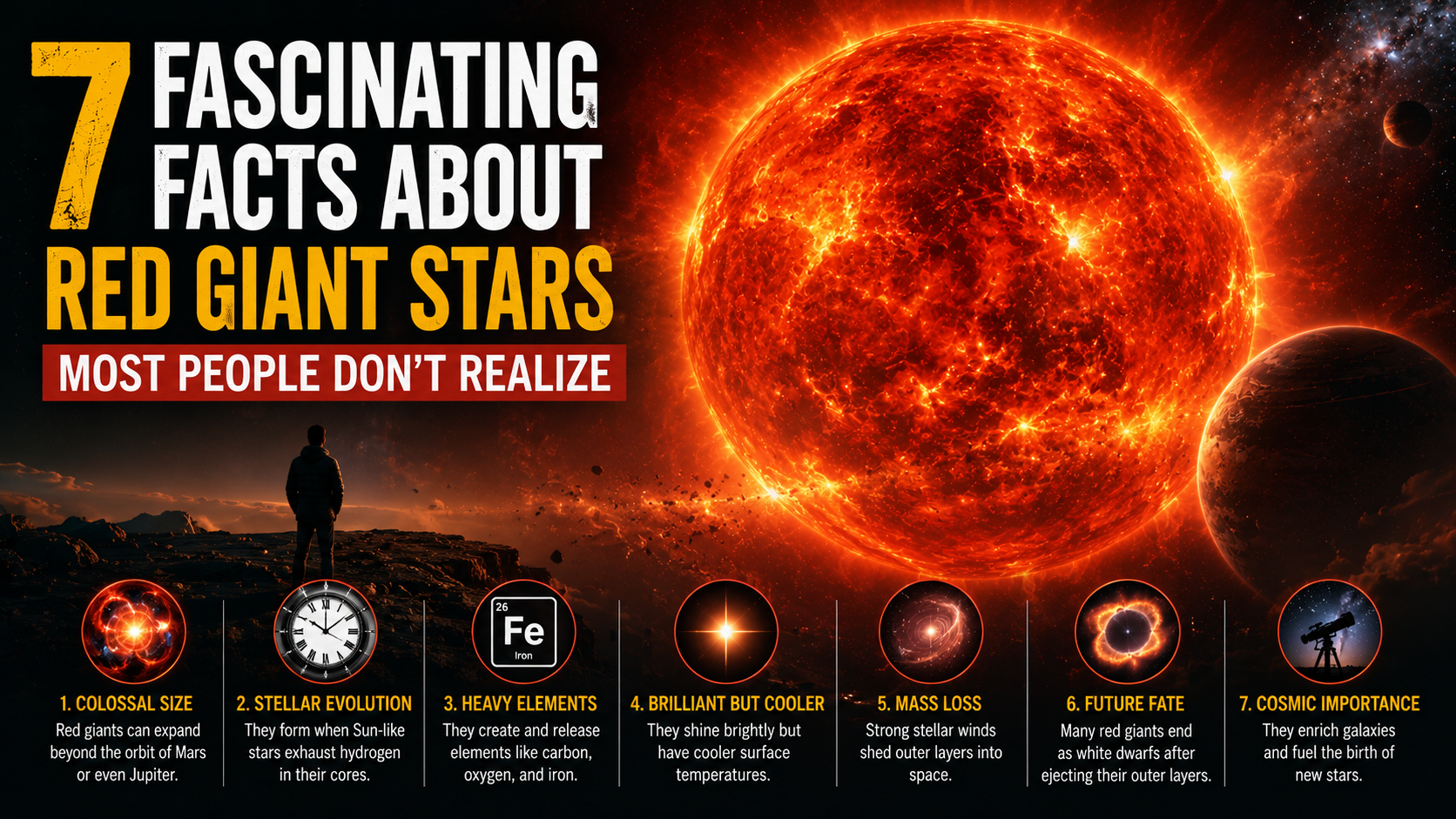
Red giant stars are among the most dramatic and visually striking objects in the universe. These enormous, glowing spheres represent a late stage in stellar evolution, when a star begins to run out of fuel and undergoes profound changes in size, temperature, and behavior.
While many people have heard the term “red giant,” few truly understand how unusual these stars are or what makes them so important in the life cycle of the cosmos. Far from being simple aging stars, red giants play a crucial role in shaping galaxies, creating heavy elements, and even influencing the formation of planets.
Here are seven fascinating facts about red giant stars that reveal just how extraordinary they really are.
1. Red Giants Begin Their Life as Sun-Like Stars
Despite their massive size and fiery appearance, red giants do not start out large at all.
Most red giant stars begin their lives much like our Sun—as relatively stable, medium-sized main-sequence stars. For billions of years, they burn hydrogen in their cores through nuclear fusion, producing the energy that keeps them shining steadily.
Over time, however, the hydrogen fuel in the core begins to run low. When this happens, the balance between gravity and internal pressure changes, triggering a transformation that marks the beginning of the red giant phase.
This means that even our own Sun is expected to become a red giant in the distant future, expanding dramatically as it exhausts its fuel supply.
2. They Expand to Incredible Sizes
One of the most astonishing characteristics of red giants is their size.
When a star enters the red giant phase, it can expand to dozens or even hundreds of times its original radius. In some extreme cases, red giants can grow so large that they would engulf the inner planets of their solar systems if placed in our own.
Despite this enormous expansion, their outer layers become less dense. This creates a strange contrast: a star that is physically huge but relatively diffuse compared to its earlier form.
This dramatic growth is driven by changes in the star’s core, which contracts while the outer layers expand outward.
3. Their Surface Temperatures Actually Drop
Although red giants appear bright and fiery, their surface temperatures are actually cooler than those of younger stars like the Sun.
The “red” in red giant refers to this cooler surface temperature, which typically ranges from about 3,000 to 5,000 degrees Celsius—cooler than the Sun’s roughly 5,500 degrees Celsius.
However, red giants remain extremely luminous because of their massive size. Even though each square meter of their surface emits less energy, the sheer surface area of the star produces an enormous total output of light.
This is why red giants can appear so bright in the night sky despite being cooler than smaller stars.
4. They Produce Heavier Elements Through Fusion
Red giant stars are not just passive aging objects—they are active sites of element creation.
During this phase, nuclear reactions inside the star begin to produce heavier elements such as helium, carbon, and oxygen. In more advanced stages, even heavier elements can form through complex fusion processes.
This makes red giants essential contributors to the chemical evolution of the universe.
When these stars eventually shed their outer layers or explode in later stages, they release these elements into space, where they can become part of new stars, planets, and even living organisms.
In a very real sense, red giants help build the raw materials for future worlds.
5. Their Outer Layers Are Highly Unstable
Red giants are far from stable stars. Their outer layers are often turbulent and unpredictable, with strong convection currents moving energy from the interior to the surface.
This instability can cause variations in brightness, pulsations, and even the gradual loss of material into space.
Some red giants shed their outer layers entirely, creating beautiful structures known as planetary nebulae.
These nebulae glow as they are illuminated by the remaining hot core of the star, producing some of the most visually stunning objects in the universe.
6. They Play a Key Role in Recycling Cosmic Material
One of the most important functions of red giant stars is their contribution to the cosmic recycling process.
As these stars age and lose mass, they release gas and dust back into space. This material becomes part of interstellar clouds, which later form new stars and planetary systems.
This cycle ensures that the universe is constantly renewing itself.
Without red giants and similar stellar processes, the raw ingredients needed for planet formation—and even life—would be far less abundant.
In this way, red giants are not just endpoints in stellar evolution but essential contributors to cosmic renewal.
7. Our Sun Will One Day Become a Red Giant
Perhaps the most fascinating and personal fact about red giants is that our own Sun is destined to become one.
In about five billion years, the Sun will begin to run out of hydrogen fuel in its core. As this happens, it will expand dramatically into a red giant, growing so large that it will likely engulf Mercury and Venus, and possibly Earth.
While this process will unfold far in the future, it highlights the dynamic and ever-changing nature of stars.
The transformation of the Sun into a red giant is a natural part of stellar evolution, reminding us that even seemingly permanent structures in the universe are constantly evolving.
Why Red Giants Matter in Astronomy
Red giants are not just interesting for their size or appearance—they are fundamental to understanding how the universe evolves.
They mark a critical phase in the life cycle of stars and play a central role in distributing elements throughout space. Without them, galaxies would lack many of the materials necessary for planets and life to form.
Astronomers study red giants to better understand stellar lifespans, chemical formation, and the long-term evolution of solar systems.
Each observation adds another piece to the puzzle of how the universe changes over time.
Final Thoughts
Red giant stars represent one of the most dramatic stages in the life of a star. From their enormous size and cooler temperatures to their role in creating and distributing elements, they are essential to the structure and evolution of the cosmos.
What makes them especially fascinating is not just their scale, but their connection to everything around us—including the future of our own Sun.
By studying red giants, we gain a deeper understanding of the life cycles that shape the universe and the ongoing processes that make new worlds possible.
In the end, these massive stars remind us that even the most stable-looking systems in the universe are constantly changing, evolving, and contributing to something far larger than themselves.







