Betelgeuse has long been one of the most mysterious and closely watched stars in the night sky. Located in the constellation Orion, this massive red supergiant has fascinated astronomers for centuries due to its brightness, irregular behavior, and dramatic changes in appearance.
In recent years, Betelgeuse became especially famous when it suddenly dimmed in 2019–2020, leading to widespread speculation that it might be about to explode as a supernova. While that dramatic outcome did not occur, the event revealed just how difficult it is to interpret the signals coming from this distant star.
For decades, astronomers have studied Betelgeuse’s fluctuations, sometimes drawing conclusions that later turned out to be incomplete or misleading. The reason is not a lack of expertise, but rather the extreme complexity of the star itself and the limitations of observational tools.
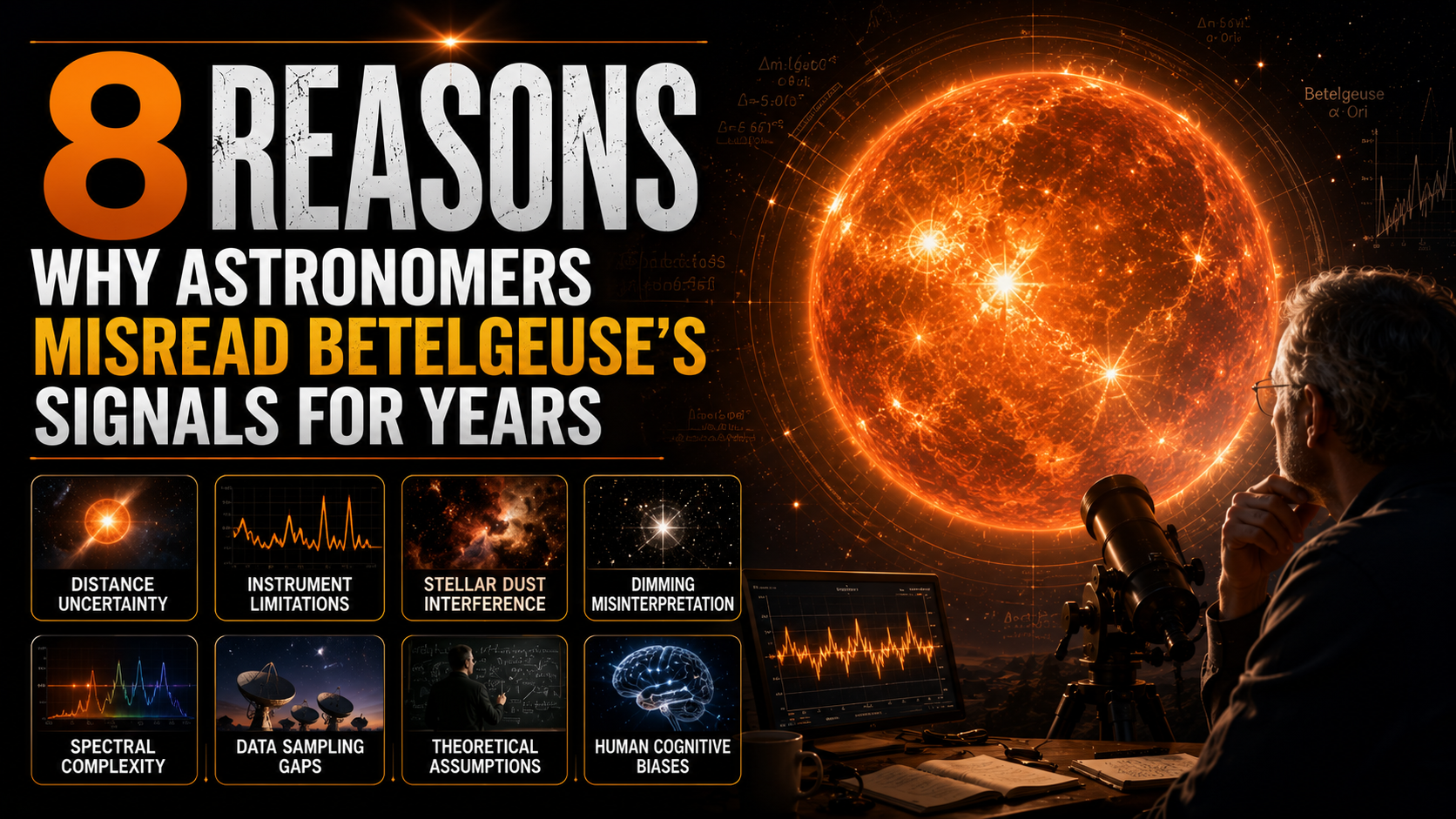
Here are eight key reasons why scientists have misread Betelgeuse’s signals over the years—and what those challenges reveal about studying distant stars.
1. Betelgeuse Is Extremely Unstable by Nature
One of the main challenges in understanding Betelgeuse is its inherent instability.
As a red supergiant, it is nearing the end of its life cycle, which means its internal structure is highly turbulent. It expands and contracts in irregular cycles, producing unpredictable changes in brightness.
This natural instability makes it difficult to distinguish between normal behavior and unusual events.
What may look like a significant signal is often just part of the star’s chaotic internal rhythm.
2. Multiple Pulsation Cycles Overlap
Betelgeuse does not have just one pattern of pulsation—it has several overlapping cycles happening at the same time.
These cycles vary in length, with some lasting hundreds of days and others stretching across several years.
When these cycles combine, they create complex brightness patterns that can easily be misinterpreted.
To observers, this overlapping behavior can make the star appear to brighten or dim in ways that seem unusual, when in reality it is following multiple natural rhythms.
3. Dust Clouds Can Block Its Light
Another major factor in Betelgeuse’s changing appearance is the presence of surrounding dust.
The star ejects material into space through strong stellar winds. Over time, this material can form dust clouds around it.
These clouds can temporarily block or scatter the star’s light, causing it to appear dimmer from Earth.
During the famous 2019–2020 dimming event, scientists initially believed the star might be collapsing internally, when in fact much of the change was caused by a dust cloud passing in front of it.
4. Limited Distance Makes Fine Detail Hard to Observe
Even though Betelgeuse is one of the closest red supergiants to Earth, it is still about 500–700 light-years away.
At this distance, even the most powerful telescopes struggle to resolve fine surface details consistently.
This limitation means astronomers must rely on indirect measurements, such as light curves and spectral analysis, rather than direct imaging of surface activity.
As a result, interpretations often depend on incomplete data sets.
5. Early Models Were Too Simplistic
For many years, scientists used relatively simple models to explain Betelgeuse’s behavior.
These models assumed more uniform patterns of pulsation and energy output than actually exist.
As observational technology improved, it became clear that the star’s internal structure is far more complex than early theories suggested.
This gap between simplified models and real behavior led to misinterpretations of certain signals, especially during periods of unusual brightness changes.
6. The Star’s Surface Is Highly Chaotic
Unlike stars like the Sun, which have relatively stable surface patterns, Betelgeuse has a highly chaotic surface.
It features enormous convective cells—massive regions where hot gas rises and cool gas sinks. These cells can be larger than entire planetary orbits in some cases.
As these cells shift and evolve, they create uneven brightness across the star’s surface.
This unevenness can mimic larger-scale changes, leading astronomers to misread surface activity as more significant global changes.
7. Instrument Limitations Affected Early Observations
Older telescopes and early observational methods lacked the precision needed to fully understand Betelgeuse’s complex behavior.
Even today, certain measurements require advanced interferometry or space-based instruments to capture accurate data.
In the past, limited resolution meant that subtle variations in brightness or structure were often missed or misinterpreted.
As technology improved, many earlier assumptions had to be revised, showing just how dependent astronomy is on observational tools.
8. Human Expectation Influenced Interpretation
One often-overlooked factor in scientific interpretation is human expectation.
Because Betelgeuse is expected to eventually explode as a supernova, any unusual change in brightness tends to be viewed through that lens.
This expectation can bias initial interpretations, making natural variability seem more dramatic than it actually is.
When the star dimmed suddenly in 2019, many quickly assumed an imminent explosion—even though later evidence pointed to more ordinary processes like dust formation and pulsation cycles.
This highlights how scientific interpretation must constantly guard against assumption-based thinking.
The 2019–2020 Dimming Event: A Turning Point
The recent dimming of Betelgeuse was one of the most closely watched astronomical events in modern history.
At its peak, the star lost a significant portion of its brightness, leading to widespread speculation about an impending supernova.
However, follow-up studies showed that the dimming was caused primarily by a combination of surface cooling and a large dust cloud.
This discovery helped refine scientific understanding of red supergiant behavior and highlighted the importance of multi-layered observation.
Why Betelgeuse Is So Difficult to Understand
Betelgeuse represents a perfect storm of observational challenges: extreme size, unpredictable behavior, overlapping cycles, and surrounding material that interferes with its light.
It is a reminder that even relatively nearby stars can be incredibly complex and difficult to interpret accurately.
Studying Betelgeuse pushes astronomers to refine models, improve instruments, and reconsider assumptions about stellar evolution.
What We Learn From These Misinterpretations
Rather than being failures, the misreadings of Betelgeuse’s signals have helped advance astronomy.
Each correction improves our understanding of how red supergiants behave and how stars evolve in their final stages.
These lessons also emphasize the importance of patience in science. Some phenomena cannot be understood fully without long-term observation and improved technology.
Final Thoughts
Betelgeuse continues to be one of the most fascinating stars in the night sky, not because it is fully understood, but because it constantly challenges what we think we know.
The misinterpretations of its signals over the years are not setbacks—they are part of the scientific process.
As tools and models continue to improve, astronomers will gain an even clearer picture of this massive star’s behavior.
And when Betelgeuse eventually does reach the end of its life, it will likely become one of the most spectacular astronomical events ever recorded.
Until then, it remains a powerful reminder that the universe is far more complex—and far more unpredictable—than it first appears.