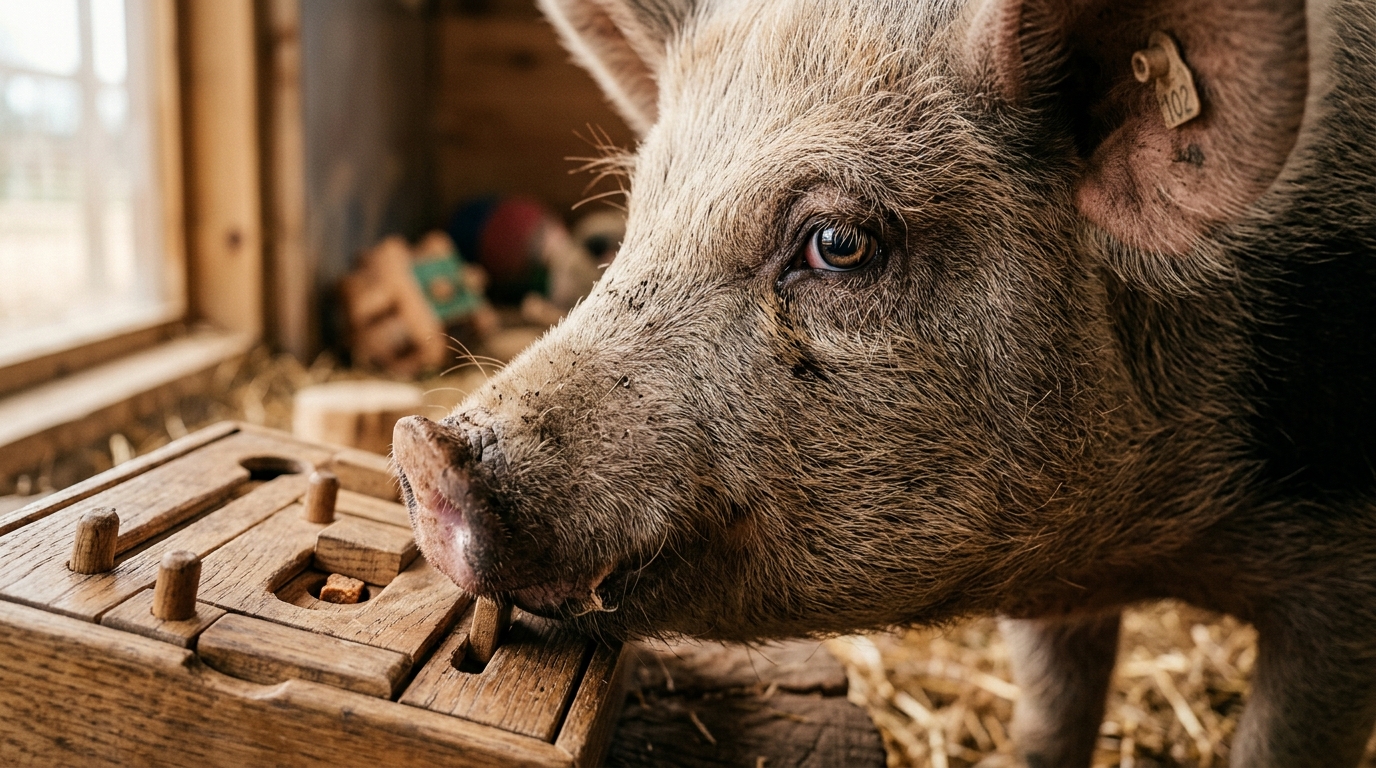
When people think of highly intelligent animals, dolphins, chimpanzees, and elephants often come to mind. Pigs, however, are rarely included in those conversations. Yet scientists who study animal behavior have long known that pigs possess remarkable cognitive abilities that rival some of the smartest creatures on Earth.
Far from being simple farm animals, pigs demonstrate impressive problem-solving skills, emotional awareness, social intelligence, and learning abilities. Research continues to reveal just how complex their minds truly are, challenging many common misconceptions about these fascinating animals.
Here are 12 things most people don’t know about pig intelligence.
1. Pigs Are Among the Smartest Animals on the Planet
Numerous studies have shown that pigs rank among the most intelligent non-human animals.
Researchers have found that pigs can learn complex tasks, remember solutions to problems, and adapt to new situations. Some scientists even compare certain aspects of pig intelligence to that of dogs, primates, and young children.
Their cognitive abilities often surprise people who are unfamiliar with the research.
2. They Learn New Skills Quickly
Pigs are fast learners.
Whether navigating obstacles, responding to commands, or solving puzzles, they often master tasks after relatively few repetitions. Their ability to learn through observation and experience demonstrates a high level of mental flexibility.
This quick learning ability is one reason pigs have become valuable subjects in behavioral studies.
3. They Have Excellent Long-Term Memory
Memory plays an important role in animal intelligence, and pigs excel in this area.
Studies suggest that pigs can remember locations, recognize objects, and recall learned behaviors for extended periods. This strong memory helps them navigate environments and solve challenges more efficiently.
Their ability to retain information is one of the hallmarks of advanced cognition.
4. Pigs Can Solve Puzzles
Researchers have designed experiments that require pigs to manipulate objects, open compartments, or perform sequences of actions to obtain rewards.
Many pigs successfully solve these puzzles and often improve their performance over time. This demonstrates not only learning ability but also an understanding of cause and effect.
Problem-solving is considered one of the key indicators of intelligence in animals.
5. They Understand Social Relationships
Pigs are highly social animals that live within complex social groups.
They recognize individual members of their group and adjust their behavior based on social interactions. Scientists have observed pigs forming relationships, establishing hierarchies, and communicating with one another in sophisticated ways.
Social intelligence is a major component of overall cognitive ability.
6. They Communicate Through a Variety of Sounds
Pigs are surprisingly vocal.
Researchers have identified numerous distinct vocalizations used to express emotions, signal warnings, communicate with offspring, and interact with other pigs. Different sounds often carry different meanings depending on context.
Their communication system is far more complex than many people realize.
7. Pigs Can Recognize Themselves in Certain Situations
Some studies suggest pigs may possess a level of self-awareness.
In experiments involving mirrors, pigs have demonstrated an ability to use reflections to locate hidden objects. While scientists continue debating the extent of this ability, the findings indicate a sophisticated level of spatial understanding.
Such behaviors are often associated with advanced cognition.
8. They Experience a Wide Range of Emotions
Intelligence is closely connected to emotional complexity.
Research indicates that pigs can experience emotions such as excitement, fear, contentment, stress, and even optimism or pessimism under certain conditions. Their emotional responses influence how they interact with their environment and other animals.
Understanding these emotional capacities has become an important area of animal welfare research.
9. They Can Learn From One Another
Pigs do not rely solely on trial and error.
Studies have shown that they can observe other pigs completing tasks and then use that information themselves. This form of social learning allows knowledge to spread through groups and demonstrates impressive cognitive flexibility.
Learning from others is a trait shared by many intelligent species.
10. They Possess Strong Spatial Awareness
Finding food, navigating environments, and remembering locations require spatial intelligence.
Pigs perform well in tests involving navigation and memory of physical spaces. They can remember where resources are located and often develop efficient routes through familiar environments.
These abilities help them adapt successfully to changing conditions.
11. They Enjoy Mental Stimulation
Like many intelligent animals, pigs benefit from activities that challenge their minds.
Researchers and animal caretakers have observed that pigs engage enthusiastically with puzzles, toys, and exploratory tasks. Providing opportunities for mental enrichment often improves their well-being and encourages natural behaviors.
Their curiosity is another sign of advanced cognitive functioning.
12. Scientists Are Still Discovering New Abilities
Despite decades of research, pig intelligence remains an active field of study.
Advances in animal cognition research continue to reveal new insights into how pigs think, learn, communicate, and interact with the world. Many scientists believe there is still much to discover about the full extent of their mental capabilities.
Each new study adds to our understanding of these surprisingly sophisticated animals.
Why Pig Intelligence Matters
Understanding pig intelligence is important for several reasons. It helps scientists learn more about animal cognition, social behavior, and emotional complexity. It also encourages a more accurate view of animals that are often underestimated.
As research progresses, many assumptions about the differences between human and animal intelligence are being reconsidered. Pigs provide a valuable example of how complex cognitive abilities can evolve in a wide range of species.
Their intelligence also highlights the importance of providing environments that support both physical and mental well-being.
What Makes Pigs So Adaptable?
One reason pigs have been so successful as a species is their ability to adapt.
Their strong memory, learning capacity, curiosity, and social awareness allow them to respond effectively to changing conditions. Whether living in the wild or under human care, pigs demonstrate a remarkable ability to solve problems and adjust their behavior when faced with new challenges.
These traits have contributed to their survival across diverse habitats and environments.
Final Thoughts
Pigs are far more intelligent than many people realize. From solving puzzles and remembering complex information to understanding social relationships and learning from one another, they display a range of cognitive abilities that place them among the animal kingdom’s most impressive thinkers.
As scientists continue exploring the mysteries of animal intelligence, pigs are helping reshape our understanding of cognition, emotion, and behavior. Their remarkable mental abilities serve as a reminder that intelligence comes in many forms—and that some of the most fascinating minds in nature may be found in places we least expect.
The next time you see a pig, remember that behind those curious eyes is an animal capable of learning, reasoning, remembering, and interacting with the world in ways that continue to amaze researchers around the globe.