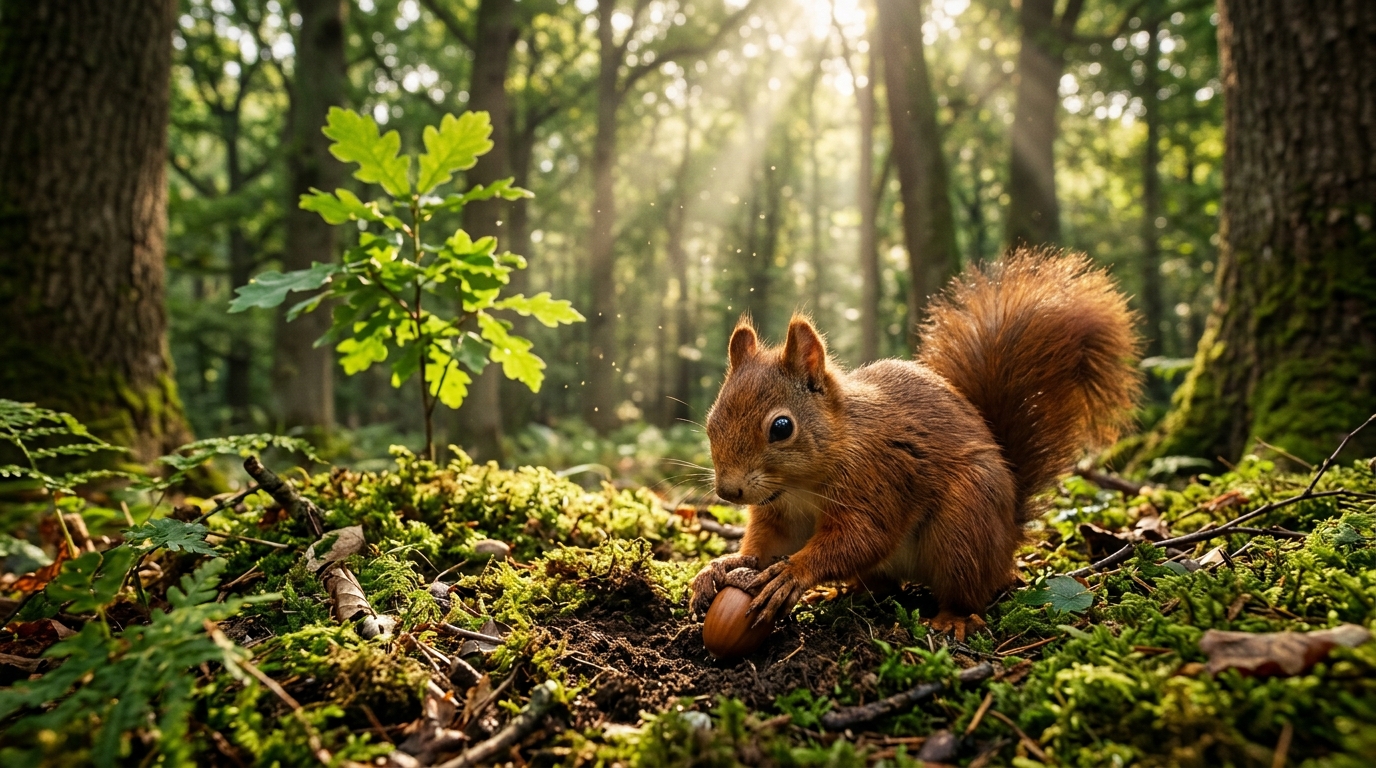
Squirrels are often seen darting through trees, burying acorns, or scurrying across parks in search of food. While many people view them as playful backyard visitors, these energetic rodents play a far greater role in nature than most realize. In fact, scientists consider squirrels to be some of the most influential animals in many forest ecosystems.
From planting future forests to supporting biodiversity, squirrels contribute to the health and survival of countless plant and animal species. Their daily activities help shape the landscapes around them in ways that often go unnoticed.
Here are 13 reasons squirrels may be the forest’s most important helpers.
1. They Accidentally Plant Thousands of Trees
Perhaps the most famous contribution squirrels make is their habit of burying nuts and seeds.
To prepare for leaner seasons, squirrels hide food in numerous locations. However, they do not recover every stash. Forgotten acorns, walnuts, and other seeds often germinate, eventually growing into new trees.
Many forests owe part of their regeneration to these accidental gardeners.
2. They Help Forests Expand
Because squirrels carry seeds away from parent trees before burying them, they help plants spread into new areas.
This natural seed dispersal reduces competition between young seedlings and mature trees while increasing the chances of successful growth. Over time, squirrel activity can influence the composition and distribution of entire forests.
3. They Improve Plant Diversity
Squirrels do not rely on a single type of food.
By collecting and dispersing a wide variety of seeds, they contribute to greater plant diversity. A diverse forest is generally more resilient to disease, pests, and environmental changes, making squirrel behavior beneficial on a large ecological scale.
4. They Create Food Sources for Other Wildlife
Not all buried seeds become trees.
Many cached nuts and seeds are discovered by birds, mice, insects, and other animals. In this way, squirrels indirectly support numerous species by creating food resources throughout the forest.
Their hidden caches often become valuable meals for wildlife during periods of scarcity.
5. They Help Maintain Healthy Forest Ecosystems
Healthy forests depend on constant renewal.
By dispersing seeds and promoting plant growth, squirrels contribute to the natural regeneration process that keeps ecosystems functioning over time. Without seed dispersers, many tree species would struggle to spread effectively.
6. Their Nests Provide Shelter for Other Animals
Squirrels build nests, known as dreys, from leaves, twigs, and other materials high in trees.
When these nests are abandoned, they may be used by birds, small mammals, and other creatures seeking shelter. In this way, squirrels help create habitats that benefit a variety of forest residents.
7. They Play an Important Role in Food Webs
Squirrels occupy a key position within forest food chains.
They serve as prey for hawks, owls, foxes, bobcats, snakes, and other predators. Their presence helps sustain populations of these animals, contributing to ecological balance throughout the forest.
A healthy squirrel population often supports a healthy predator population.
8. They Help Fungi Spread
Many squirrel species consume mushrooms and fungi.
As they travel through the forest, they help disperse fungal spores through their waste. This process assists fungi in reproducing and spreading to new locations.
Because fungi play crucial roles in nutrient cycling and tree health, squirrel activity indirectly benefits entire ecosystems.
9. They Contribute to Soil Health
When squirrels dig holes to bury food, they disturb the soil in small but meaningful ways.
This digging can improve soil aeration, assist water penetration, and create favorable conditions for seed germination. Over time, these countless small actions contribute to healthier forest floors.
10. They Help Forests Recover After Disturbances
Natural disturbances such as storms, fires, and disease outbreaks can damage forests.
Seed dispersers become especially important during recovery periods. By spreading seeds into newly opened areas, squirrels help accelerate regrowth and ecological restoration.
Their role becomes even more valuable when forests face environmental stress.
11. They Influence Which Trees Thrive
Not all seeds are treated equally by squirrels.
Some species of nuts are preferred over others, and squirrels often select particular storage locations. These choices can affect which tree species successfully establish themselves in different parts of the forest.
As a result, squirrels subtly shape the future structure of woodland ecosystems.
12. They Support Biodiversity
Biodiversity depends on interactions between many species.
Through seed dispersal, habitat creation, soil disturbance, fungal distribution, and their role in food webs, squirrels contribute to conditions that support a wide variety of plants and animals.
Their ecological impact extends far beyond their small size.
13. They Are Nature’s Unintentional Conservationists
Squirrels are not consciously trying to help forests grow, yet their behavior has profound environmental benefits.
Every forgotten acorn and every buried seed represents a potential future tree. Over generations, these actions help sustain forests that provide habitat, clean air, carbon storage, and countless other ecological services.
In many ways, squirrels act as some of nature’s most effective and persistent conservation workers.
Why Squirrels Matter More Than People Realize
Because squirrels are common in many regions, people often overlook their importance. Yet ecological research continues to demonstrate that even small animals can have enormous effects on the environments they inhabit.
Forests are complex systems where every species plays a role. Squirrels serve as gardeners, seed dispersers, prey animals, habitat builders, and contributors to nutrient cycling—all at the same time.
Without them, many forest ecosystems would look very different.
Small Animals, Big Impact
The story of squirrels highlights an important lesson in ecology: influence is not determined by size.
While large animals often receive the most attention, many of the processes that sustain ecosystems depend on smaller creatures carrying out everyday activities. Squirrels may spend their days gathering food and avoiding predators, but those simple behaviors help shape entire landscapes.
Their impact demonstrates how interconnected nature truly is.
Final Thoughts
Squirrels are far more than energetic animals racing through treetops. Through seed dispersal, forest regeneration, habitat creation, and support for countless other species, they play an essential role in maintaining healthy ecosystems.
Every buried acorn has the potential to become a towering oak. Every forgotten seed can contribute to the next generation of forest growth. These seemingly ordinary actions make squirrels some of the most important helpers in the natural world.
The next time you see a squirrel digging a hole or carrying a nut, remember that you may be watching one of nature’s most effective forest caretakers at work—quietly helping shape the woodlands of tomorrow.







