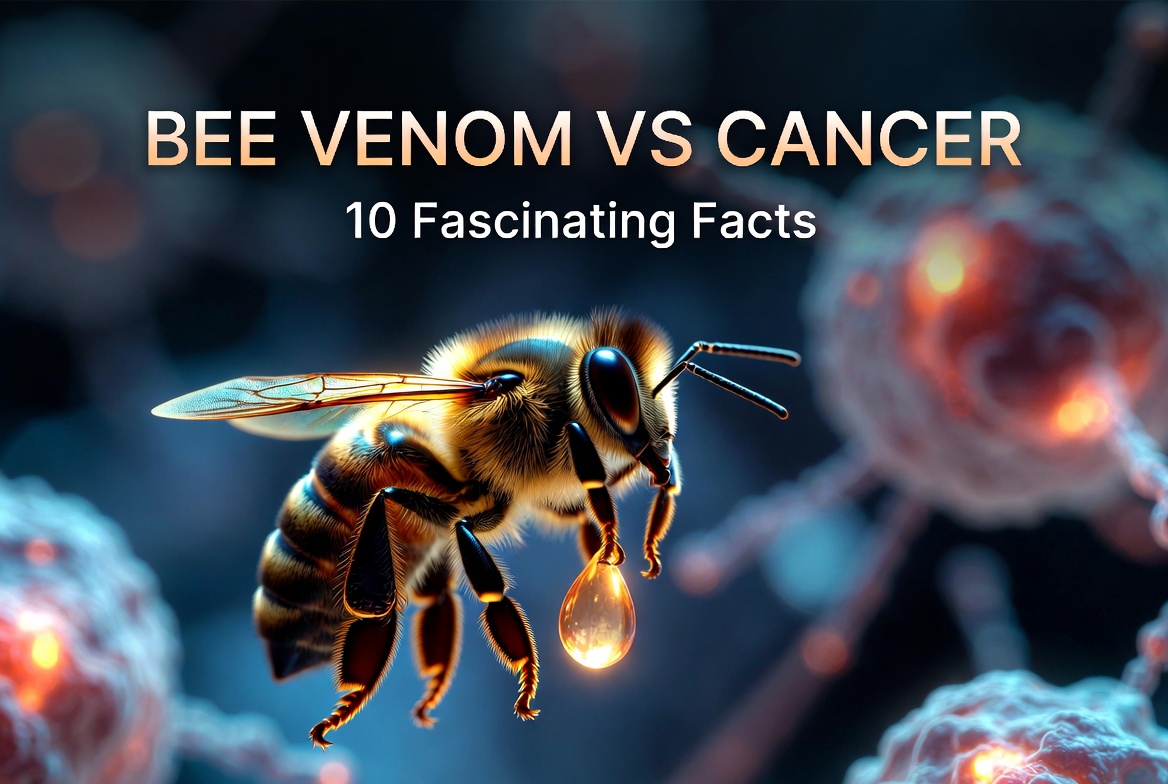
For centuries, bee venom has been known for its powerful effects on the human body. While most people associate a bee sting with pain, swelling, and irritation, scientists are discovering that some of the compounds hidden inside bee venom may hold remarkable medical potential. One compound in particular, called melittin, has attracted worldwide attention because of its ability to attack certain cancer cells in laboratory studies.
Researchers are exploring whether this naturally occurring substance could someday play a role in future cancer treatments. Although the science is still developing and much more testing is required, early findings have sparked excitement among medical researchers and cancer specialists alike.
Here are ten fascinating facts about the bee venom compound that is changing how scientists think about cancer research.
1. Melittin Is the Main Active Ingredient in Bee Venom
Bee venom contains a complex mixture of proteins, enzymes, and peptides, but melittin stands out as its most abundant and biologically active component. It makes up roughly half of the dry weight of honeybee venom and is largely responsible for the pain associated with a bee sting.
What makes melittin particularly interesting is its ability to interact with cell membranes. Scientists discovered that it can puncture or disrupt the protective outer layer surrounding cells. This unique property has made it a major focus of research into cancer treatment and drug development.
Because cancer cells often have different membrane characteristics than healthy cells, researchers believe melittin may be able to target tumors in ways that conventional treatments cannot.
2. It Has Shown the Ability to Destroy Cancer Cells in Laboratory Studies
One of the most exciting discoveries involving melittin is its ability to kill cancer cells under controlled laboratory conditions.
Researchers have observed that melittin can rapidly break down the membranes of certain cancer cells, causing them to die. Studies involving breast cancer, melanoma, leukemia, and other cancer types have produced encouraging results.
In some experiments, cancer cells exposed to melittin were destroyed within a relatively short period of time. Scientists believe the compound acts like a microscopic drill, creating holes in the cell membrane and disrupting essential cellular functions.
While these findings are promising, it is important to remember that laboratory results do not automatically translate into successful treatments for humans. Much more research is required before any conclusions can be drawn about clinical use.
3. Melittin May Interfere With Cancer Growth Signals
Cancer cells rely on a variety of biological signals to grow, divide, and spread throughout the body. One reason researchers are interested in melittin is that it appears capable of interfering with some of these signaling pathways.
Certain studies suggest that melittin can disrupt proteins and molecular systems that cancer cells use to survive. By blocking these signals, the compound may slow tumor growth and reduce the ability of cancer cells to multiply.
Scientists are especially interested in understanding how melittin interacts with pathways linked to aggressive cancers. If researchers can identify exactly how these mechanisms work, they may be able to design more targeted therapies based on the compound.
4. Researchers Are Exploring Ways to Deliver It Safely
Despite its potential, bee venom presents a major challenge: it can damage healthy cells as well as cancerous ones.
Directly injecting melittin into the body could cause serious side effects because the compound does not naturally distinguish between harmful and healthy tissues. As a result, one of the biggest goals in current research is finding safe delivery methods.
Scientists are investigating advanced technologies such as nanoparticles, microscopic carriers, and specialized drug delivery systems. These approaches aim to transport melittin directly to tumors while minimizing harm to surrounding tissues.
If successful, these delivery systems could dramatically increase the medical usefulness of the compound and reduce potential risks.
5. Nanotechnology Is Helping Unlock Its Potential
The combination of melittin and nanotechnology has become one of the most exciting areas of cancer research.
Nanoparticles can act like tiny vehicles, carrying melittin through the bloodstream and releasing it only when it reaches a specific target. This strategy could help protect healthy cells while concentrating the treatment where it is needed most.
Researchers have already developed experimental nanoparticle systems that appear capable of delivering melittin more precisely. Some studies have shown improved tumor targeting and reduced toxicity compared with using the compound alone.
Although these technologies remain largely experimental, they represent a significant step toward turning laboratory discoveries into practical medical treatments.
6. It May Work Alongside Existing Cancer Therapies
Scientists are not only studying melittin as a standalone treatment. They are also investigating whether it can enhance the effectiveness of existing cancer therapies.
Some research suggests that melittin could make cancer cells more vulnerable to chemotherapy, radiation, or immunotherapy. By weakening cancer cells first, the compound may help other treatments achieve better results.
Combination therapies are often used in oncology because cancer can adapt and develop resistance to a single treatment approach. If melittin proves effective as part of a multi-treatment strategy, it could become a valuable addition to future cancer care.
The possibility of using a natural compound to strengthen current therapies is one reason researchers continue to study its effects.
7. Honeybees Have Become Unexpected Contributors to Medical Research
Honeybees play an essential role in pollinating crops and supporting ecosystems, but their contribution to science may be just as important.
The study of bee venom has opened new doors in fields ranging from immunology to cancer research. Scientists continue to analyze the many compounds found in venom, searching for molecules that could inspire new medicines.
Nature has already provided several important medical breakthroughs. Many modern drugs originated from plants, microorganisms, and animal-derived compounds. Bee venom may eventually join that list if researchers can successfully harness its therapeutic properties.
This growing field of study highlights how even familiar creatures can hold surprising scientific secrets.
8. Melittin Is Being Studied for More Than Cancer
Although cancer research receives much of the attention, melittin’s potential applications extend beyond oncology.
Researchers have investigated its antimicrobial, antiviral, and anti-inflammatory properties. Some studies suggest it may help combat certain bacteria, viruses, and inflammatory conditions.
Scientists are also examining whether modified forms of melittin could be used in treatments for infectious diseases and immune-related disorders.
The compound’s broad range of biological effects makes it a valuable subject for ongoing medical research. Understanding how it interacts with the body could lead to innovations in multiple areas of healthcare.
9. Human Trials Are the Critical Next Step
Many promising cancer discoveries achieve impressive results in laboratory settings but fail during human testing. This is why clinical trials are considered the gold standard for determining whether a treatment is truly effective and safe.
Researchers must carefully evaluate dosage, side effects, long-term outcomes, and interactions with other treatments before melittin-based therapies can become widely available.
Clinical trials involve years of rigorous testing and regulatory review. While preliminary studies have generated excitement, experts caution against viewing melittin as a proven cancer cure at this stage.
The path from laboratory discovery to approved treatment is often long and complex, but each study provides valuable information that helps move the science forward.
10. It Demonstrates the Power of Looking to Nature for Solutions
Perhaps the most inspiring aspect of melittin research is what it reveals about the natural world.
Many scientific breakthroughs have originated from unexpected sources. Compounds found in plants, fungi, marine organisms, and animals have transformed medicine over the years. Bee venom serves as another reminder that nature remains one of humanity’s greatest laboratories.
Researchers continue to uncover molecules with extraordinary properties hidden in ordinary environments. The discovery that a component of bee venom may have anti-cancer capabilities illustrates how curiosity and scientific investigation can turn natural substances into potential medical innovations.
Even if melittin never becomes a mainstream cancer treatment, the knowledge gained from studying it is already expanding our understanding of biology and disease.
The Future of Bee Venom Research
The growing interest in melittin reflects a broader trend in modern medicine: combining natural compounds with advanced technology to create more effective treatments.
Scientists are working to answer several key questions. Can melittin be delivered safely to tumors? Can its cancer-fighting abilities be enhanced while reducing side effects? Could it become part of combination therapies that improve patient outcomes?
The answers remain uncertain, but progress continues at a steady pace. Advances in nanotechnology, molecular biology, and precision medicine are giving researchers new tools to explore these possibilities.
What is clear is that bee venom research has moved far beyond simple curiosity. It has become a serious scientific field with the potential to influence future medical treatments.
Conclusion
Melittin, the powerful peptide found in bee venom, has emerged as one of the most intriguing subjects in cancer research. Laboratory studies have shown its ability to destroy cancer cells, interfere with tumor growth mechanisms, and potentially enhance other treatments. At the same time, scientists are developing innovative delivery systems designed to make its use safer and more effective.
While much work remains before melittin-based therapies could reach hospitals and clinics, the research conducted so far offers a glimpse into an exciting area of medical science. The journey from bee sting to potential cancer treatment demonstrates how nature continues to inspire some of the most groundbreaking discoveries in modern medicine.
As researchers continue their investigations, melittin serves as a powerful reminder that solutions to some of humanity’s greatest health challenges may sometimes come from the most unexpected places.