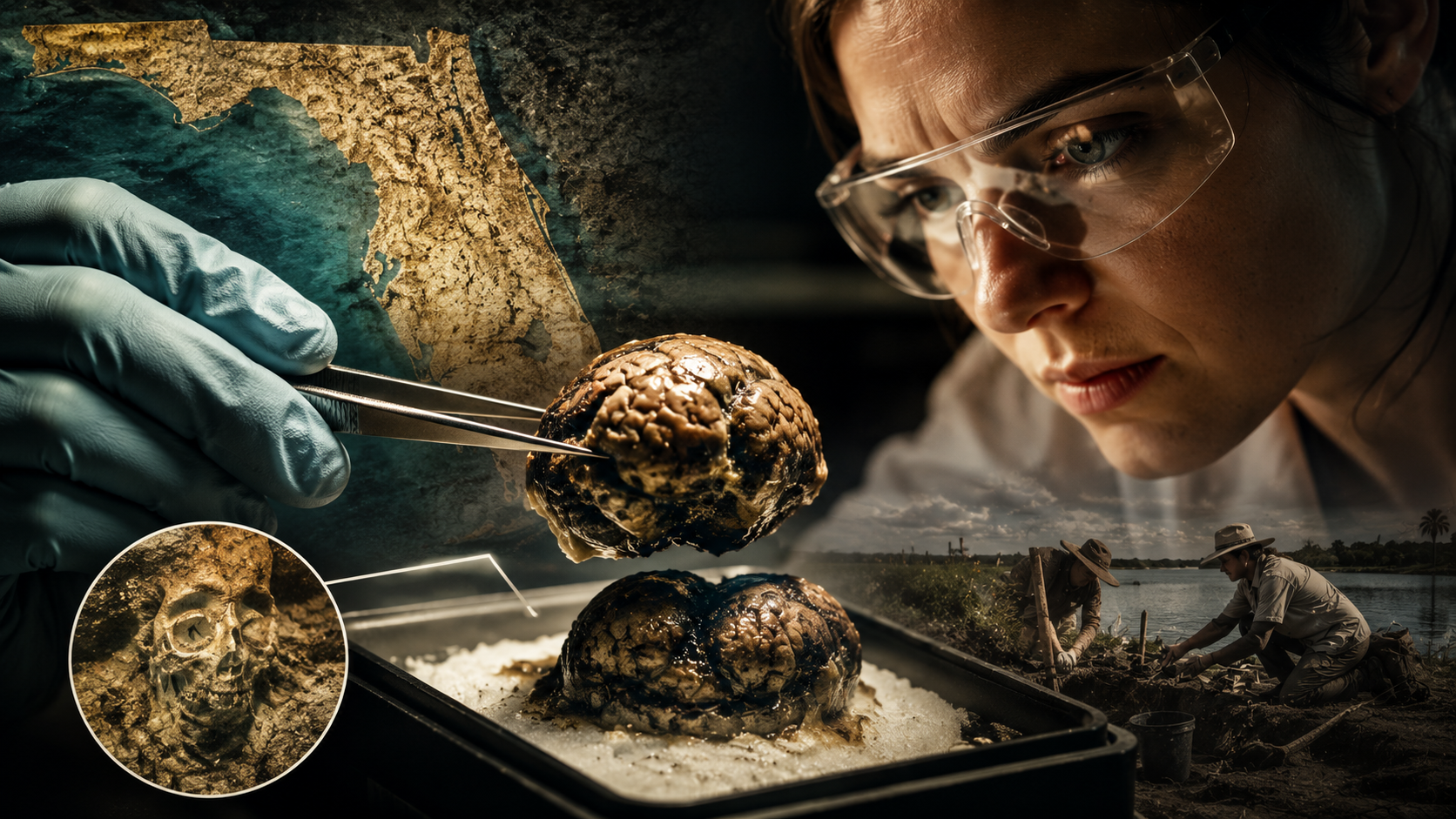
Archaeology is full of unexpected discoveries, but few findings are as unusual or scientifically valuable as the preservation of ancient human brain tissue. In Florida, researchers uncovered remains estimated to be around 7,000 years old where brain structures were remarkably preserved under rare environmental conditions.
Unlike bones, which are commonly found in archaeological sites, soft tissues like brains typically decay quickly after death. That makes these discoveries extremely rare and scientifically significant. In a handful of cases, however, unique combinations of soil chemistry, moisture levels, and oxygen deprivation have allowed brain material to survive far longer than expected.
These ancient remains offer a rare glimpse into early human life in North America, as well as insights into burial practices, environmental conditions, and biological preservation processes.
Here are 10 surprising discoveries from Florida’s 7,000-year-old preserved brains.
1. Soft Tissue Can Survive Under Rare Environmental Conditions
One of the most important discoveries is that brain tissue can survive for thousands of years under specific environmental circumstances.
In Florida’s case, wet, low-oxygen soils played a key role in slowing decomposition.
This type of preservation is extremely rare and only occurs in select archaeological environments around the world.
It challenges the assumption that only bones can survive long-term burial.
2. The Brain’s Structure Can Remain Visibly Intact
In some of the preserved samples, researchers found that brain structures were still recognizable.
While not soft or functional, the general shape and composition of the brain tissue could still be studied.
This allows scientists to examine neurological preservation in ways previously thought impossible.
Such findings open new doors for bioarchaeological research.
3. Chemical Changes Help “Mummify” Brain Tissue
One of the key reasons for preservation is chemical transformation over time.
As organic matter breaks down, minerals in the surrounding environment can replace soft tissues in a process similar to natural mummification.
This slow chemical replacement helps stabilize delicate structures like brain matter.
It is a rare and accidental form of natural preservation.
4. Ancient Burial Sites Reveal Early Human Activity in Florida
These discoveries also provide insight into some of the earliest known human populations in the region.
The 7,000-year timeline places these remains in a period when early communities were adapting to changing climates and coastal environments.
Artifacts and burial contexts help researchers understand how these groups lived and interacted with their surroundings.
The preserved brains are part of a larger archaeological puzzle.
5. Preservation Conditions Were Highly Specific
Not every burial site produces such extraordinary preservation.
In Florida, a combination of waterlogged soil, low oxygen levels, and stable temperatures created the right conditions.
Even small changes in these factors would have resulted in complete decomposition.
This makes each discovery extremely rare and scientifically valuable.
6. These Findings Help Scientists Study Brain Decomposition
One of the most important scientific contributions of these remains is the study of how brains decompose over time.
By analyzing what remains and what disappears, researchers gain insights into biological decay processes.
This can also help forensic science, particularly in understanding decomposition in different environments.
Ancient remains become a laboratory for modern science.
7. They Offer Clues About Burial Practices
The positioning and condition of the remains suggest that burial practices may have played a role in preservation.
Some bodies appear to have been placed in specific environmental settings that unintentionally favored tissue survival.
While it is unlikely that ancient people understood preservation chemistry, their burial choices still influenced the outcome.
This provides indirect insight into cultural behaviors.
8. Brain Preservation Is Extremely Rare in Archaeology
Across the world, preserved ancient brains are exceptionally uncommon.
Most soft tissues decay rapidly after death, leaving only skeletal remains.
The Florida discoveries therefore represent a rare scientific opportunity.
Each preserved sample is treated as an invaluable source of data.
9. The Findings Challenge Traditional Views of Decay
These discoveries force scientists to rethink what is possible in archaeological preservation.
They demonstrate that under the right conditions, even the most delicate biological structures can survive for millennia.
This challenges long-standing assumptions about how quickly organic material breaks down.
It also expands the boundaries of archaeological science.
10. They Provide a Window Into Early Human Life
Perhaps the most meaningful aspect of these findings is what they reveal about ancient humans.
While the brains themselves do not contain usable memory or thought, they are part of individuals who lived thousands of years ago.
Combined with other archaeological evidence, they help reconstruct early human life in Florida.
They serve as a direct, physical link to the distant past.
Why These Discoveries Matter
The preserved brains found in Florida are more than scientific curiosities—they are important clues about human history, environmental conditions, and biological preservation.
They demonstrate how rare natural processes can protect fragile organic material far longer than expected.
They also highlight the importance of continued archaeological exploration in regions with unique environmental conditions.
Every discovery adds a new layer to our understanding of the ancient world.
Final Thoughts
Florida’s 7,000-year-old preserved brains represent one of the most extraordinary archaeological findings in recent memory.
From rare preservation conditions to insights into early human life, these remains continue to challenge scientific assumptions and expand our understanding of the past.
While much about these ancient individuals remains unknown, their preserved remains offer a powerful reminder of how fragile—and yet how enduring—human history can be when shaped by the right environmental forces.







