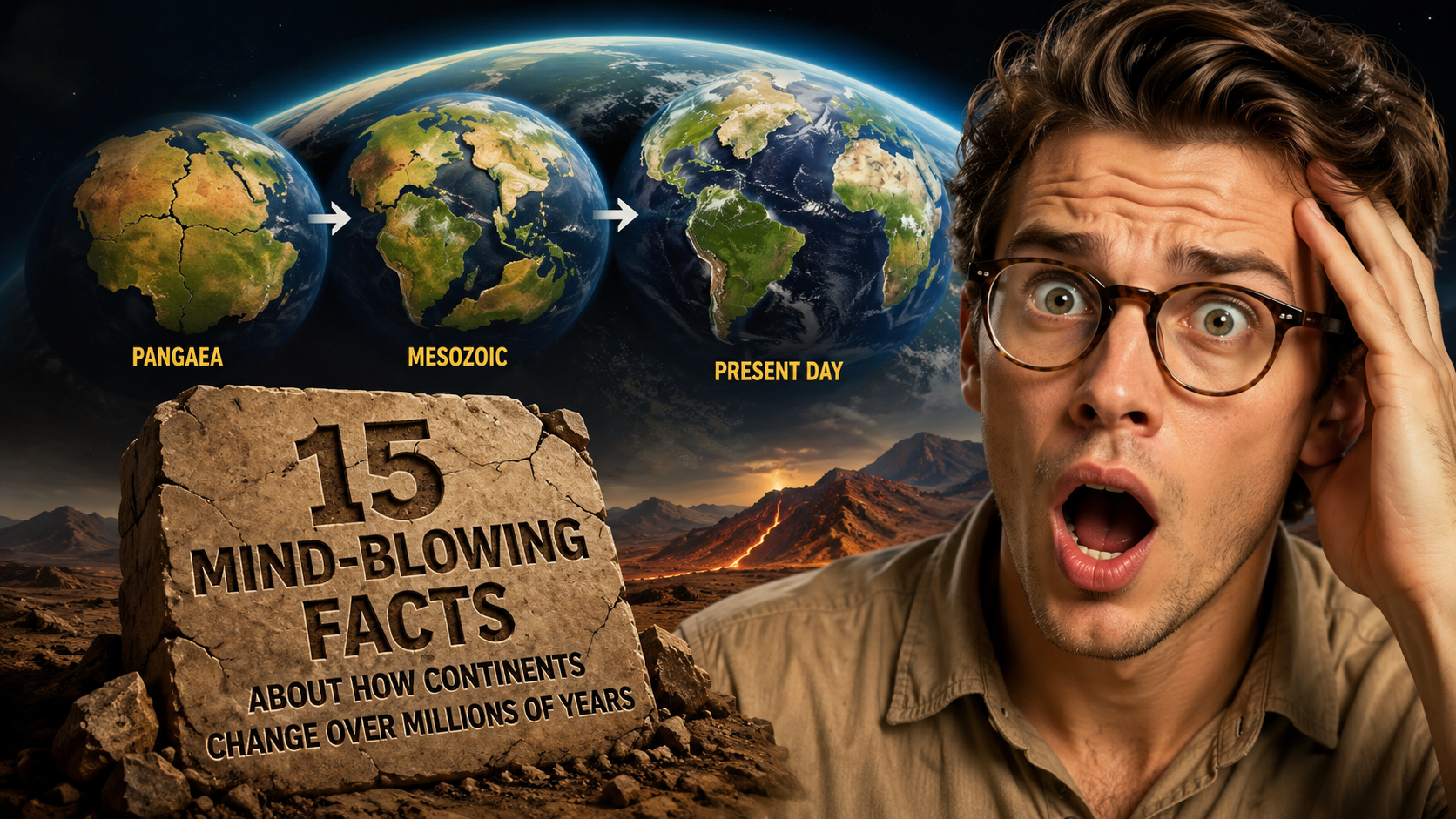
When we look at a map of the world, it’s easy to assume that the continents have always been where they are today. After all, mountains, coastlines, and oceans seem permanent from a human perspective. But on the timescale of Earth’s history, our planet’s surface is anything but fixed.
The continents are constantly moving, colliding, breaking apart, and reshaping themselves. These changes happen so slowly that we don’t notice them during our lifetimes, yet over millions of years they can completely transform the face of the Earth. Entire oceans can disappear, mountain ranges can rise and erode away, and landmasses can drift thousands of miles from their original locations.
Here are fifteen mind-blowing facts about how continents change over millions of years.
1. The Continents Are Always Moving
Although they appear stationary, Earth’s continents are in constant motion.
The planet’s outer shell is divided into massive sections called tectonic plates. These plates slowly move atop a partially molten layer deep within the Earth. Most continents travel at about the same speed that human fingernails grow—just a few centimeters per year.
The movement is incredibly slow, but over millions of years, those tiny shifts add up to enormous changes.
2. All the Continents Were Once Joined Together
Around 335 million years ago, nearly all of Earth’s landmasses formed a gigantic supercontinent known as Pangaea.
Imagine being able to walk from what is now North America to Africa without crossing an ocean. That’s essentially what the world looked like during this period.
Pangaea eventually broke apart, and its fragments slowly drifted into the positions we recognize today.
3. The Atlantic Ocean Is Still Expanding
The Atlantic Ocean did not always exist.
It began forming when Pangaea started to split apart about 200 million years ago. Magma rising along the Mid-Atlantic Ridge created new oceanic crust and gradually pushed the continents apart.
Today, the Atlantic continues to widen by several centimeters each year, meaning North America and Europe are slowly drifting farther apart.
4. Some Oceans Have Completely Disappeared
While new oceans can form, old ones can vanish.
Throughout Earth’s history, entire oceans have opened and later closed as tectonic plates moved. Ancient oceans that once covered vast regions of the planet no longer exist because their oceanic crust was eventually pulled beneath continental plates.
The oceans we know today are simply the latest chapter in a constantly changing geological story.
5. Continents Can Collide and Create Massive Mountains
When continental plates collide, neither easily sinks beneath the other.
Instead, the crust crumples and folds upward, creating enormous mountain ranges. The Himalayas, for example, formed when the Indian plate collided with the Eurasian plate.
This process is still occurring today, and the Himalayas continue to rise, even as erosion gradually wears them down.
6. India Was Once an Isolated Island Continent
Millions of years ago, India was separated from Asia and surrounded by ocean.
After breaking away from an ancient southern supercontinent, it raced northward at unusually high speeds for a tectonic plate. Eventually, it collided with Asia, dramatically altering the landscape and giving rise to some of Earth’s highest mountains.
Its remarkable journey is one of the most extraordinary examples of continental movement ever discovered.
7. Continents Can Break Apart Again
Continents do not remain intact forever.
Internal forces can stretch and fracture the crust, creating rifts that gradually widen over millions of years. Eventually, seawater may flood these rifts and form entirely new oceans.
Scientists believe this process may already be underway in parts of East Africa, where the continent is slowly splitting apart.
8. Earth’s Continents Have Repeatedly Formed Supercontinents
Pangaea was not the only supercontinent in Earth’s history.
Geologists have found evidence suggesting that several supercontinents existed long before Pangaea formed. These ancient landmasses assembled and fragmented in repeating cycles over hundreds of millions of years.
The arrangement of continents that we see today is simply one temporary stage in a much longer process.
9. Future Continents Will Look Completely Different
The continents will not remain where they are indefinitely.
Millions of years from now, Africa may collide more extensively with Europe, Australia will continue moving northward, and the Atlantic Ocean may undergo dramatic changes.
Some scientists even predict that a new supercontinent could eventually emerge. Future maps of Earth may be almost unrecognizable compared with today’s geography.
10. Continents Influence Global Climate
The arrangement of continents can significantly affect climate.
Large mountain ranges alter wind patterns, while ocean gateways influence the movement of currents that transport heat around the globe.
As continents shift positions, they can contribute to major climate changes that affect ecosystems and life across the planet.
11. Continents Carry Clues About Ancient Life
The movement of continents has helped scientists understand Earth’s biological history.
Similar fossils found on continents now separated by vast oceans provided early evidence that the landmasses were once connected.
Ancient plants and animals left behind clues that allowed researchers to reconstruct Earth’s changing geography long before modern technologies existed.
12. Continents Can Drift Across Climate Zones
As landmasses move, they can pass through entirely different environmental conditions.
A region that was once near the equator may eventually drift closer to the poles. This means places that are now temperate may once have experienced tropical climates, and areas that are currently warm may someday become much colder.
The continents themselves are travelers on a geological timescale.
13. Earth’s Surface Is Constantly Being Recycled
The crust beneath the oceans is continually created and destroyed.
New oceanic crust forms at mid-ocean ridges, while older sections sink back into Earth’s interior through subduction zones. This process continuously reshapes the planet’s surface and drives continental movement.
Earth’s outer layer is not a static shell but a dynamic system in perpetual transformation.
14. Continental Movement Can Trigger Major Geological Events
As tectonic plates interact, they generate powerful forces capable of producing earthquakes and volcanic activity.
Some of the world’s most active geological regions exist where plates collide, separate, or slide past one another. Over millions of years, these processes can reshape coastlines, create islands, and dramatically alter entire landscapes.
The continents are active participants in Earth’s ongoing geological evolution.
15. Human Civilization Exists During a Brief Snapshot of Earth’s History
Perhaps the most mind-blowing fact of all is the timescale involved.
Modern humans have existed for only a tiny fraction of Earth’s history. Civilizations have risen and fallen while the continents moved only imperceptibly.
Yet if we could accelerate time and watch the planet over hundreds of millions of years, we would see oceans opening and closing, mountains appearing and disappearing, and continents slowly drifting across the globe like enormous rafts.
What appears permanent to us is actually part of an ever-changing planetary dance.
Final Thoughts
The continents may seem fixed and unchanging, but geology tells a very different story. Earth’s surface is dynamic, restless, and constantly evolving. Over millions of years, landmasses merge and split apart, mountains rise and wear away, and oceans are born and destroyed.
These immense transformations remind us that our world is not a finished product. Instead, it is a planet in motion, continually reshaping itself on timescales that stretch far beyond human experience. The map we know today is merely a temporary arrangement in Earth’s long and extraordinary geological journey.