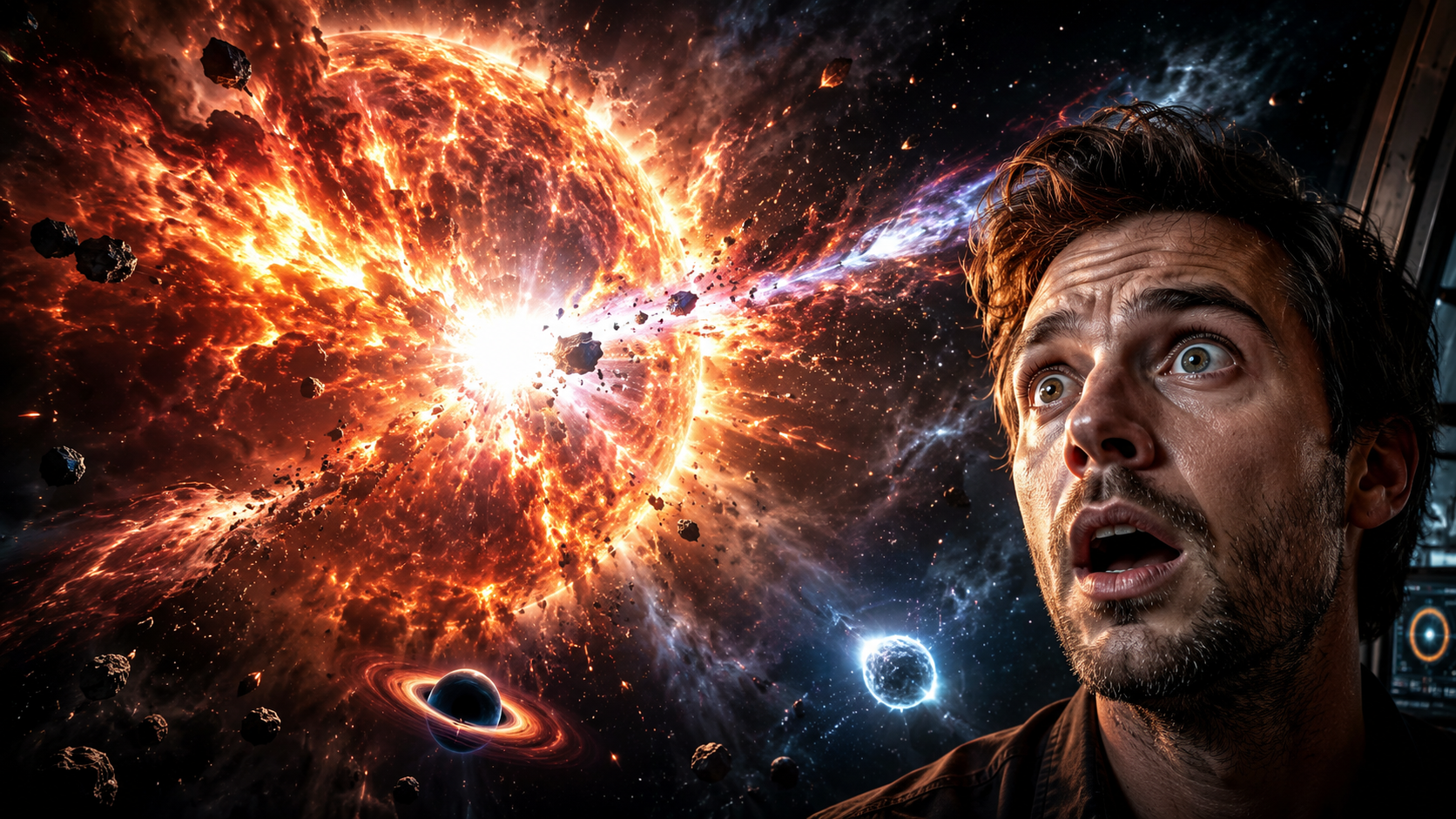
Stars may seem eternal, shining steadily in the night sky year after year, but even the most brilliant stars have finite lifespans. Like living things, stars are born, evolve, and eventually die. For the most massive stars in the universe, however, the ending is anything but quiet.
When giant stars exhaust their nuclear fuel, they undergo some of the most dramatic and violent transformations in the cosmos. Their deaths can create spectacular explosions, forge the elements necessary for life, and leave behind some of the strangest objects known to science.
Here are ten surprising facts about what happens when massive stars reach their end.
1. Massive Stars Live Surprisingly Short Lives
It may seem logical that larger stars would live longer because they contain more material. In reality, the opposite is true.
Massive stars burn through their fuel at extraordinary rates. While stars like our Sun can shine for around 10 billion years, some giant stars survive for only a few million years before exhausting their energy supplies.
In cosmic terms, these stellar giants live fast and die young.
2. Their Cores Become Factories for Heavy Elements
Throughout their lives, massive stars continually fuse lighter elements into heavier ones.
They begin by converting hydrogen into helium. Later, they can produce carbon, oxygen, neon, silicon, and other elements through successive stages of nuclear fusion.
Eventually, many massive stars develop layered interiors resembling cosmic onions, with different elements forming in shells around the core.
3. Iron Marks the Beginning of the End
For many massive stars, the final turning point comes when iron accumulates in the core.
Unlike lighter elements, iron does not release energy when fused. Once the core becomes dominated by iron, the star loses its ability to generate the pressure needed to support itself against gravity.
At this stage, the star’s collapse becomes inevitable.
4. The Core Can Collapse in Seconds
The final collapse of a massive star happens astonishingly quickly.
After billions or millions of years of evolution, the core can suddenly implode in a matter of seconds. Gravity becomes so overwhelming that matter is compressed to extraordinary densities.
This rapid collapse triggers events that rank among the most powerful phenomena in the universe.
5. The Star May Explode as a Supernova
Following the collapse, many massive stars experience a spectacular explosion known as a supernova.
During a supernova, the star releases an immense amount of energy and ejects enormous quantities of material into space. For a brief period, a single exploding star can outshine an entire galaxy.
These explosions are so powerful that they can be observed across vast cosmic distances.
6. The Ingredients for Life Are Scattered Across Space
One of the most remarkable consequences of a supernova is the distribution of heavy elements.
Massive stars create many of the elements necessary for rocky planets and living organisms. Their explosive deaths spread these materials throughout space, enriching interstellar clouds that may later form new stars and planets.
The calcium in our bones, the oxygen we breathe, and the iron in our blood all owe their existence to ancient generations of stars.
In a very real sense, we are made from the remains of long-dead stellar giants.
7. Some Stars Become Neutron Stars
Not every massive star is completely destroyed.
In some cases, the collapsing core survives and becomes a neutron star. These objects pack enormous amounts of mass into spheres only about 20 kilometers (12 miles) across.
Neutron stars are so dense that a teaspoon of their material would weigh billions of tons on Earth.
They are among the most extreme objects ever discovered.
8. Others Collapse Into Black Holes
The most massive stars may leave behind something even more extraordinary.
If the remaining core is sufficiently massive, gravity can compress it beyond the point where not even light can escape. The result is a black hole.
Although black holes themselves are invisible, their effects on nearby matter can reveal their presence. They represent some of the universe’s most mysterious and fascinating objects.
9. Their Deaths Can Trigger the Birth of New Stars
The end of one generation of stars often helps create the next.
Shock waves from supernova explosions can compress nearby clouds of gas and dust, encouraging new regions of star formation. The material expelled by dying stars also becomes part of these future stellar nurseries.
This process creates a cosmic cycle of birth, death, and renewal that has been unfolding for billions of years.
10. The Death of Massive Stars Shapes the Evolution of Galaxies
The influence of massive stars extends far beyond their own lifetimes.
Their intense radiation, powerful stellar winds, and explosive endings help regulate the movement of gas within galaxies. By distributing heavy elements and affecting future star formation, they play a major role in shaping galactic evolution.
Without the dramatic deaths of massive stars, galaxies would look very different, and many of the ingredients necessary for planets and life might never have become widespread.
Final Thoughts
The deaths of massive stars are among the most astonishing events in the universe. In only seconds, stars that have existed for millions of years can collapse, explode, and transform their surroundings in extraordinary ways. Their endings create neutron stars and black holes, forge the elements that make planets and life possible, and help generate entirely new generations of stars.
Far from being merely cosmic catastrophes, the deaths of massive stars are essential chapters in the story of the universe. They remind us that destruction and creation are often deeply connected and that the atoms within our own bodies were forged in stellar furnaces that burned long before our Solar System ever existed.







