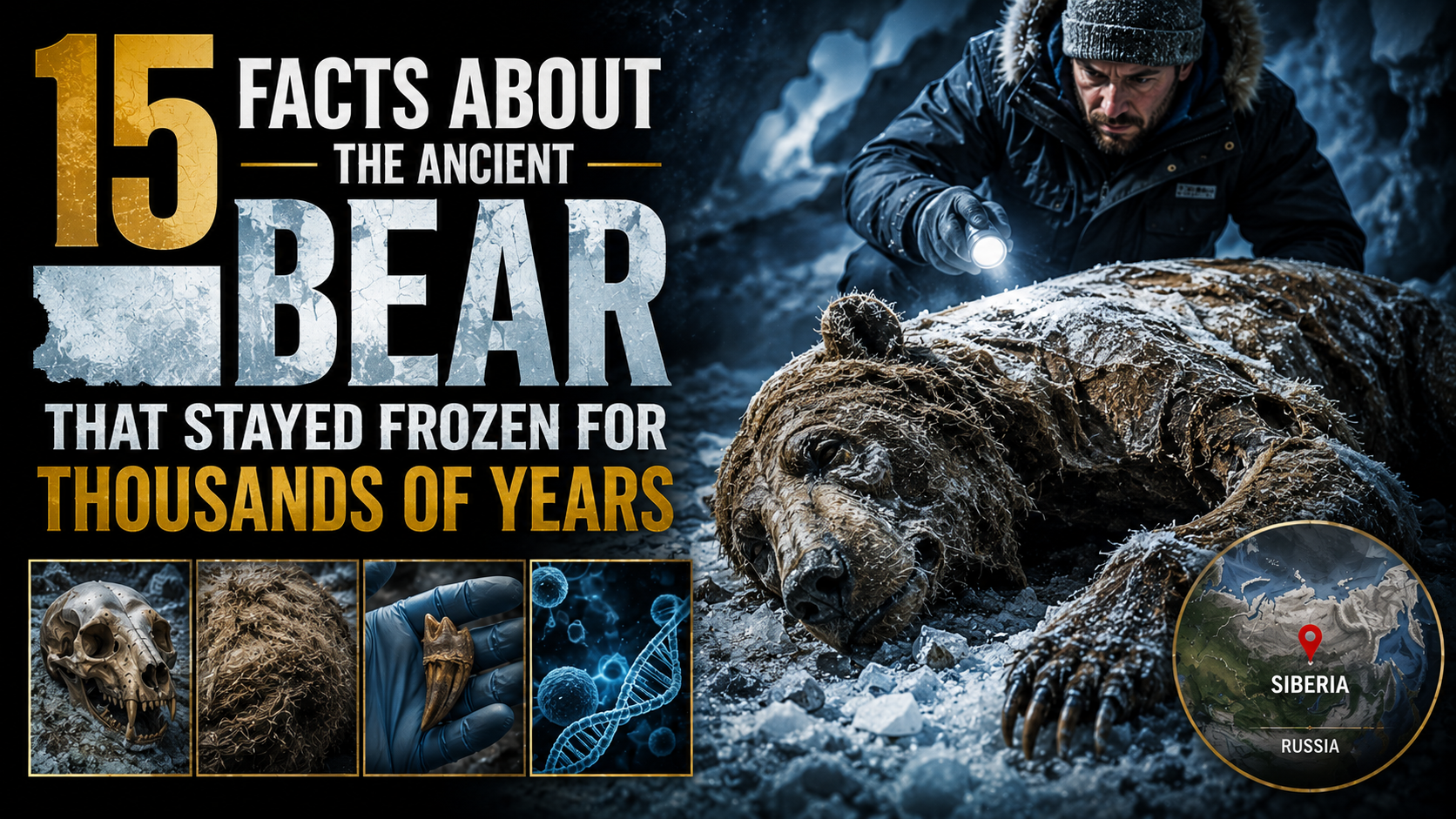
Across the frozen landscapes of the Arctic and Siberia, some of the most extraordinary scientific discoveries of our time have emerged from melting ice. Among them is the ancient bear preserved in permafrost for thousands of years—a remarkable specimen that offers an almost complete snapshot of Ice Age wildlife.
Unlike typical fossils, which are usually limited to bones and fragments, this frozen bear retains much of its original anatomy. Soft tissues, fur, and even internal structures have been preserved in astonishing detail thanks to stable, sub-zero conditions.
This discovery is not just rare—it is a scientific treasure. It allows researchers to study an extinct or ancient population in ways that were previously impossible, offering new insights into evolution, climate change, and prehistoric ecosystems.
Here are 15 fascinating facts about the ancient bear that stayed frozen for thousands of years.
1. The Bear Was Preserved in Permafrost for Millennia
The key to this discovery is permafrost—permanently frozen ground that can preserve organic material for thousands of years.
In this case, freezing temperatures essentially halted decomposition immediately after death.
This created a natural time capsule that protected the bear’s remains.
2. Its Fur and Soft Tissue Were Still Intact
One of the most remarkable features of the specimen is the survival of soft tissue.
Unlike most ancient remains, this bear still had fur attached to parts of its body.
This level of preservation is extremely rare in paleontology.
It provides valuable information about Ice Age animal adaptation.
3. The Bear Likely Belonged to an Extinct Population
Scientific analysis suggests the bear may not match modern species exactly.
Instead, it could belong to an extinct lineage of Ice Age bears.
This helps researchers understand how bear species evolved over time.
It also highlights biodiversity changes linked to climate shifts.
4. Its Environment Was Extremely Cold and Harsh
The conditions that preserved the bear also reveal its habitat.
Ice Age environments were dominated by freezing temperatures, limited vegetation, and long winters.
Animals living in these regions had to adapt to extreme survival challenges.
The bear’s existence reflects this harsh ecosystem.
5. The Body Shows No Clear Signs of Predation
Researchers have examined the remains for evidence of attack.
So far, there are no obvious bite marks or injuries caused by predators.
This suggests the bear may have died from environmental causes such as starvation, illness, or sudden cold conditions.
Understanding its cause of death helps reconstruct Ice Age survival pressures.
6. Its Skeleton Is Exceptionally Well-Preserved
The bones of the bear remain largely intact and undistorted.
This allows scientists to study its structure in great detail.
Such preservation helps reconstruct its movement, strength, and hunting behavior.
It also enables comparison with modern bear species.
7. Ancient DNA May Still Be Recoverable
One of the most exciting possibilities is DNA extraction.
If genetic material is intact, it could reveal evolutionary relationships.
This may help determine how closely it is related to modern bears.
Ancient DNA studies are transforming how scientists understand extinct species.
8. The Bear’s Size Provides Evolutionary Clues
Preliminary measurements suggest differences in size compared to modern bears.
These differences may reflect adaptation to Ice Age environments.
Larger bodies often help animals conserve heat in colder climates.
This supports known principles of evolutionary biology.
9. Its Discovery Was Likely Accidental
Many permafrost discoveries occur by chance.
Melting ice, erosion, or human activity often exposes remains unexpectedly.
This bear was likely uncovered under similar circumstances.
Such accidental finds are common in Arctic research zones.
10. The Fur Color May Offer Environmental Insight
Preserved fur can sometimes retain pigmentation.
If analyzed, it may reveal camouflage strategies used during the Ice Age.
Darker or lighter coats can indicate adaptation to snow-covered landscapes.
This adds another layer to understanding survival strategies.
11. The Digestive System May Still Contain Evidence
In rare cases, permafrost preservation includes internal contents.
If present, stomach remains could reveal diet composition.
This would help scientists identify prey species or vegetation consumed.
Such findings provide direct evidence of ecosystem interactions.
12. The Bear Helps Scientists Study Ice Age Climate
Every Ice Age specimen contributes to climate research.
By understanding animal adaptation, researchers learn about environmental conditions.
The bear’s features may reflect temperature, vegetation, and seasonal changes.
It serves as a biological record of ancient climate patterns.
13. It Highlights the Fragility of Permafrost Discoveries
While permafrost preserves remains for thousands of years, it is now melting rapidly.
This puts discoveries like the bear at risk of degradation.
Scientists must act quickly to study and preserve such findings.
Climate change is directly impacting archaeological preservation.
14. The Discovery Expands Knowledge of Arctic Ecosystems
The bear is part of a larger Ice Age ecosystem that included predators, prey, and diverse plant life.
Studying it helps reconstruct food chains and environmental interactions.
It also reveals how species coexisted in extreme environments.
This contributes to a more complete picture of prehistoric life.
15. It Connects Modern Science to Ancient Life
Perhaps the most powerful aspect of the discovery is its emotional impact.
Seeing a once-living creature preserved so perfectly creates a direct connection to the distant past.
It reminds us that Earth’s history is vast, dynamic, and still being uncovered.
Each frozen discovery brings humanity closer to understanding its natural heritage.
Why This Frozen Bear Matters
The ancient bear preserved in permafrost is more than just a scientific curiosity.
It is a window into a lost world shaped by extreme climate conditions and evolutionary pressures.
From DNA research to environmental reconstruction, its significance spans multiple scientific fields.
It also underscores how fragile ancient remains are in the face of modern environmental change.
Final Thoughts
The discovery of an ancient bear frozen for thousands of years is one of the most remarkable examples of natural preservation ever recorded.
Its fur, bones, and possible genetic material offer a rare opportunity to study life from an entirely different era.
As scientists continue to analyze such findings, each detail helps piece together the story of Earth’s Ice Age past.
In the end, this frozen bear is not just a relic—it is a message from a world long gone, preserved in ice and waiting to be understood.







