The Terracotta Army of China remains one of the most extraordinary archaeological discoveries in human history. Hidden beneath the soil near Xi’an for more than 2,000 years, thousands of life-sized clay soldiers were created to accompany China’s first emperor, Qin Shi Huang, into the afterlife.
But beyond the famous warriors, archaeologists have also uncovered something equally fascinating: ancient chariots buried nearby. These wooden and bronze structures provide a deeper understanding of military strategy, craftsmanship, and imperial power during the Qin Dynasty.
Although many of these chariots were discovered in fragmented form, careful reconstruction and analysis have revealed astonishing details about how they were built and used.
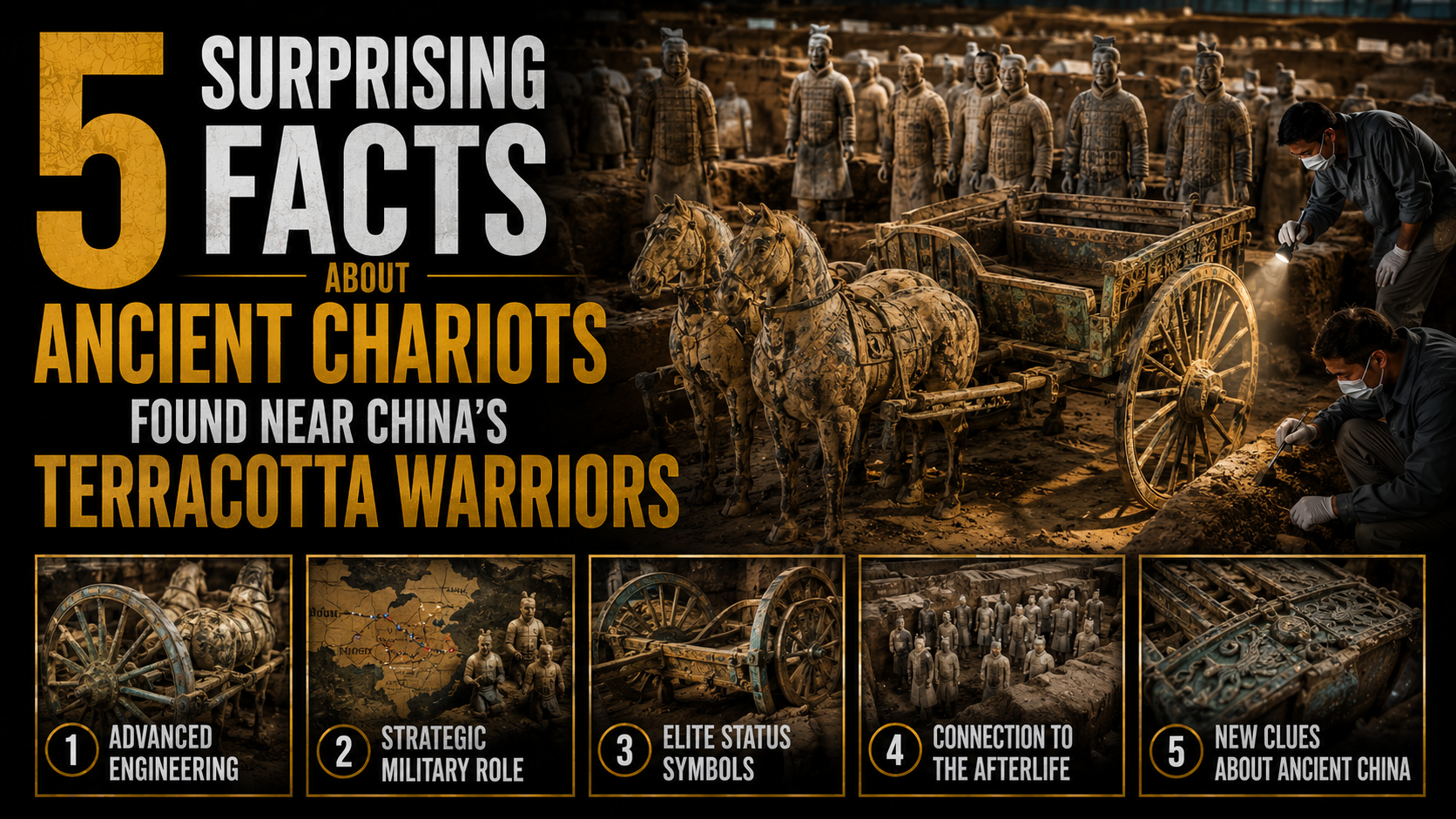
Here are five surprising facts about the ancient chariots found near China’s Terracotta Warriors.
1. The Chariots Were Built With Remarkable Engineering Precision
One of the most impressive discoveries is the level of engineering involved in constructing these chariots.
Despite being over two millennia old, their design shows careful measurement and balanced structure.
The wheels, axles, and frames were crafted to support speed and stability in battle.
This demonstrates advanced mechanical understanding for the time period.
2. Many Chariots Were Designed for Elite Military Commanders
Not all chariots served the same purpose.
Some were clearly built for high-ranking officers or members of the imperial court.
These chariots featured more elaborate decorations, stronger materials, and greater attention to detail.
This reflects a clear military hierarchy within the Qin Dynasty.
3. Bronze Components Reveal Advanced Metallurgical Skills
While the wooden parts have mostly decayed, many bronze fittings remain intact.
These include axle caps, fittings, and decorative elements.
The precision of the bronze casting indicates highly developed metalworking techniques.
It also shows the Qin Dynasty’s ability to mass-produce standardized military equipment.
4. The Chariots Were Likely Part of a Larger Burial Strategy
The placement of chariots alongside the Terracotta Army suggests a carefully planned funerary system.
These objects were intended to serve the emperor in the afterlife, symbolizing military strength and protection.
Chariots, soldiers, and weapons together formed a symbolic underground army.
This reflects ancient beliefs about continuity between life and death.
5. Reconstruction Has Revealed Their True Complexity
At first, many chariots were discovered in collapsed or fragmented states.
However, modern archaeological reconstruction has allowed experts to rebuild their original structure.
This process revealed intricate joinery techniques and sophisticated design features.
It also confirmed that these were not simple vehicles but highly engineered war machines.
Why These Chariots Matter
The discovery of chariots near the Terracotta Warriors adds an entirely new dimension to our understanding of the Qin Dynasty.
They show that the emperor’s vision extended beyond soldiers to an entire military system prepared for eternity.
Each chariot represents both technological achievement and symbolic power.
Together, they help historians reconstruct the scale and ambition of ancient China’s first unified empire.
The Role of Chariots in Ancient Chinese Warfare
Chariots played a crucial role in early Chinese military strategy.
They were used for mobility, command coordination, and battlefield dominance.
Their presence near the Terracotta Army confirms their importance in imperial warfare.
Over time, however, chariots were eventually replaced by cavalry units.
Preservation Challenges and Archaeological Work
Like many ancient wooden structures, chariots are highly vulnerable to decay.
Once exposed to air, materials can deteriorate quickly if not properly preserved.
Archaeologists must carefully stabilize and reconstruct each piece.
This delicate work ensures that future generations can study these ancient artifacts.
Final Thoughts
The ancient chariots discovered near China’s Terracotta Warriors offer a powerful glimpse into the military sophistication of the Qin Dynasty.
From advanced engineering to symbolic burial practices, each chariot tells part of a larger story about power, technology, and belief in the afterlife.
While the Terracotta Army often takes center stage, these chariots remind us that the emperor’s vision was far more complex and far-reaching.
In the end, they are not just artifacts of war—they are echoes of an empire designed to last forever.







