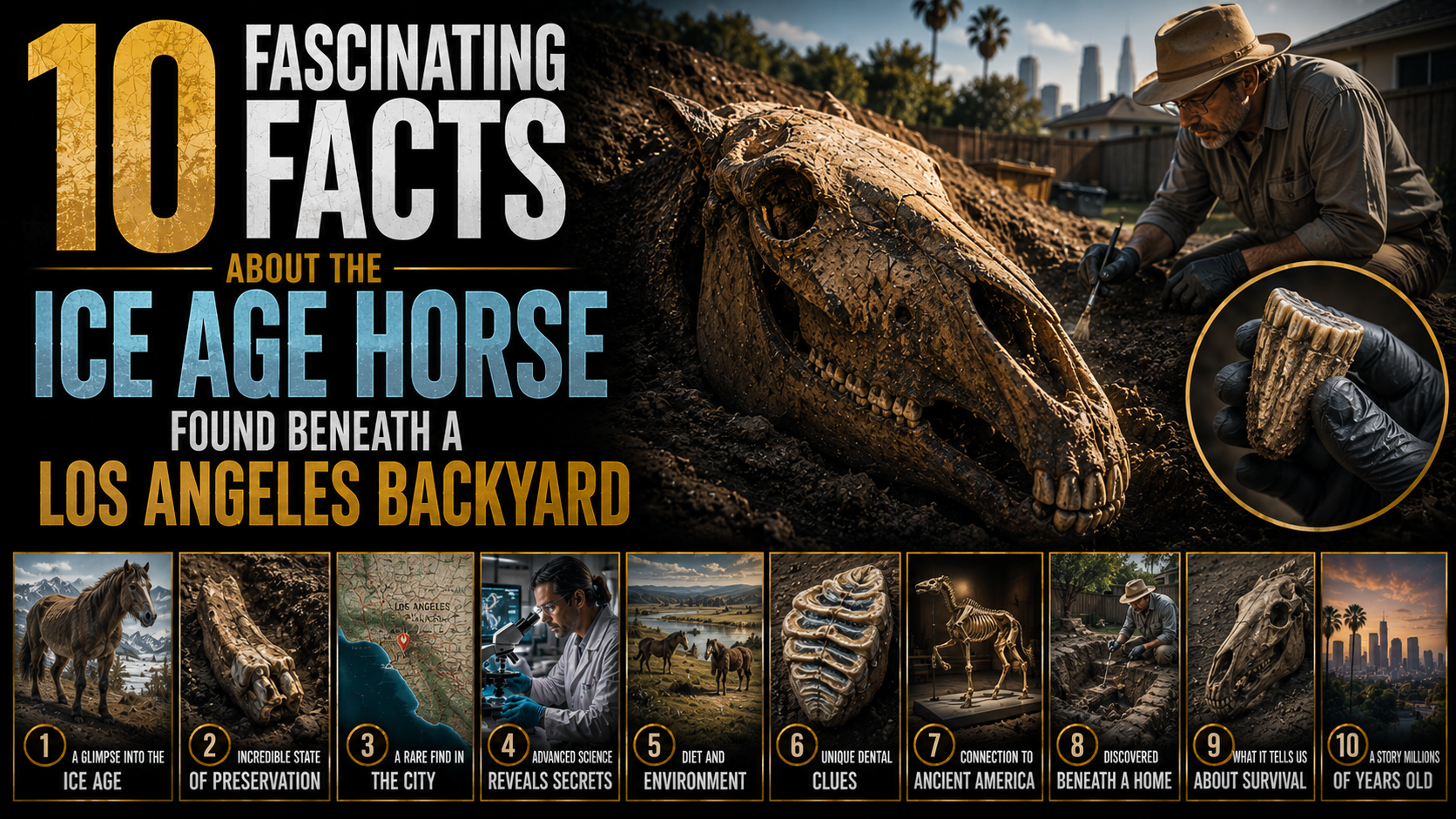
Los Angeles is a city known for film studios, busy freeways, and modern skylines—but beneath its urban surface lies a far older world. Occasionally, construction projects and excavations reveal traces of prehistoric life, offering unexpected glimpses into Southern California’s distant past.
One of the most remarkable discoveries in recent years was the remains of an Ice Age horse found beneath a residential backyard. Long before neighborhoods and streets existed, this region was home to large mammals that roamed grasslands and ancient landscapes.
The discovery has fascinated archaeologists and the public alike, not just because of what it is, but because of where it was found. It serves as a powerful reminder that beneath modern cities lies a hidden prehistoric world waiting to be uncovered.
Here are 10 fascinating facts about the Ice Age horse discovered beneath a Los Angeles backyard.
1. The Horse Lived During the Late Ice Age
The remains date back to the Pleistocene epoch, commonly known as the Ice Age.
During this time, Los Angeles looked very different, with cooler temperatures and open grasslands.
Large mammals such as horses, camels, and mastodons roamed the region.
This horse was part of that now-extinct ecosystem.
2. It Was Likely a Prehistoric Species, Not Modern Horses
The Ice Age horse was not identical to modern domesticated horses.
Instead, it belonged to an ancient North American species that later went extinct.
These horses were well adapted to wild environments and changing climates.
They disappeared from the continent thousands of years ago before being reintroduced later by Europeans.
3. The Discovery Happened Entirely by Accident
The remains were uncovered during routine digging in a residential backyard.
No one expected to find prehistoric fossils in such an ordinary setting.
Accidental discoveries like this are common in fossil-rich regions like Southern California.
They often provide valuable scientific material that would otherwise remain hidden.
4. The Skeleton Was Surprisingly Well Preserved
Despite being buried for thousands of years, parts of the skeleton remained intact.
Bones were preserved due to stable soil conditions and limited environmental disturbance.
This allowed researchers to study the structure in detail.
Well-preserved fossils like this are relatively rare in urban areas.
5. The Horse Lived in a Very Different Environment
During the Ice Age, Los Angeles was not the dense urban environment it is today.
Instead, it featured open plains, wetlands, and scattered woodlands.
This environment supported large herds of grazing animals.
The horse would have moved across vast landscapes in search of food and water.
6. It Likely Shared Its Habitat With Other Mega-Fauna
The Ice Age ecosystem included many large animals.
Alongside horses, species such as saber-toothed cats, dire wolves, and mammoths roamed the region.
These animals formed complex predator-prey relationships.
The horse was part of this dynamic prehistoric food web.
7. Fossil Evidence Helps Reconstruct Ancient Climate
The presence of Ice Age horses in Los Angeles helps scientists understand past climate conditions.
These animals required grass-rich environments and stable water sources.
Their existence indicates that the region once supported far more vegetation than today.
Fossils like this are important indicators of environmental change over time.
8. The Discovery Highlights How Fossils Can Survive in Urban Areas
Many people assume fossils are only found in remote deserts or mountains.
However, urban areas built on ancient sediment layers often contain hidden remains.
Los Angeles sits on geological formations rich in prehistoric deposits.
This makes accidental fossil discoveries relatively common during construction projects.
9. The Find Contributes to Ongoing Paleontological Research
Each fossil discovery adds new information to the scientific record.
Even partial skeletons can help refine understanding of species evolution and migration.
The Ice Age horse adds data about how ancient horses adapted to North American environments.
It also helps researchers compare extinct species with modern relatives.
10. It Reveals How Deep Time Exists Beneath Modern Cities
Perhaps the most striking realization is how ancient life lies beneath everyday surroundings.
Beneath homes, streets, and buildings are layers of Earth that contain millions of years of history.
The discovery of an Ice Age horse in a backyard brings this reality into focus.
It shows that modern life is built directly on top of prehistoric landscapes.
Why This Discovery Matters
The Ice Age horse found in Los Angeles is more than just an isolated fossil—it is a connection between past and present.
It helps scientists understand the ecosystems that existed long before human settlement.
It also demonstrates how much remains hidden beneath modern infrastructure.
Every discovery like this expands our knowledge of Earth’s deep history.
The Role of Fossils in Urban Archaeology
Urban fossil discoveries are increasingly important in paleontology.
As cities expand, construction often uncovers ancient remains buried for millennia.
These finds require quick scientific response to preserve valuable information.
They also highlight the importance of collaboration between builders and researchers.
Final Thoughts
The Ice Age horse discovered beneath a Los Angeles backyard is a powerful reminder that history does not end—it is layered.
From ancient grasslands to modern neighborhoods, the same ground holds countless stories waiting to be uncovered.
This fossil not only reveals what once lived in Southern California but also shows how dramatically the world has changed over time.
In the end, it reminds us that beneath every modern surface lies a much older world, quietly preserved in stone and soil.







