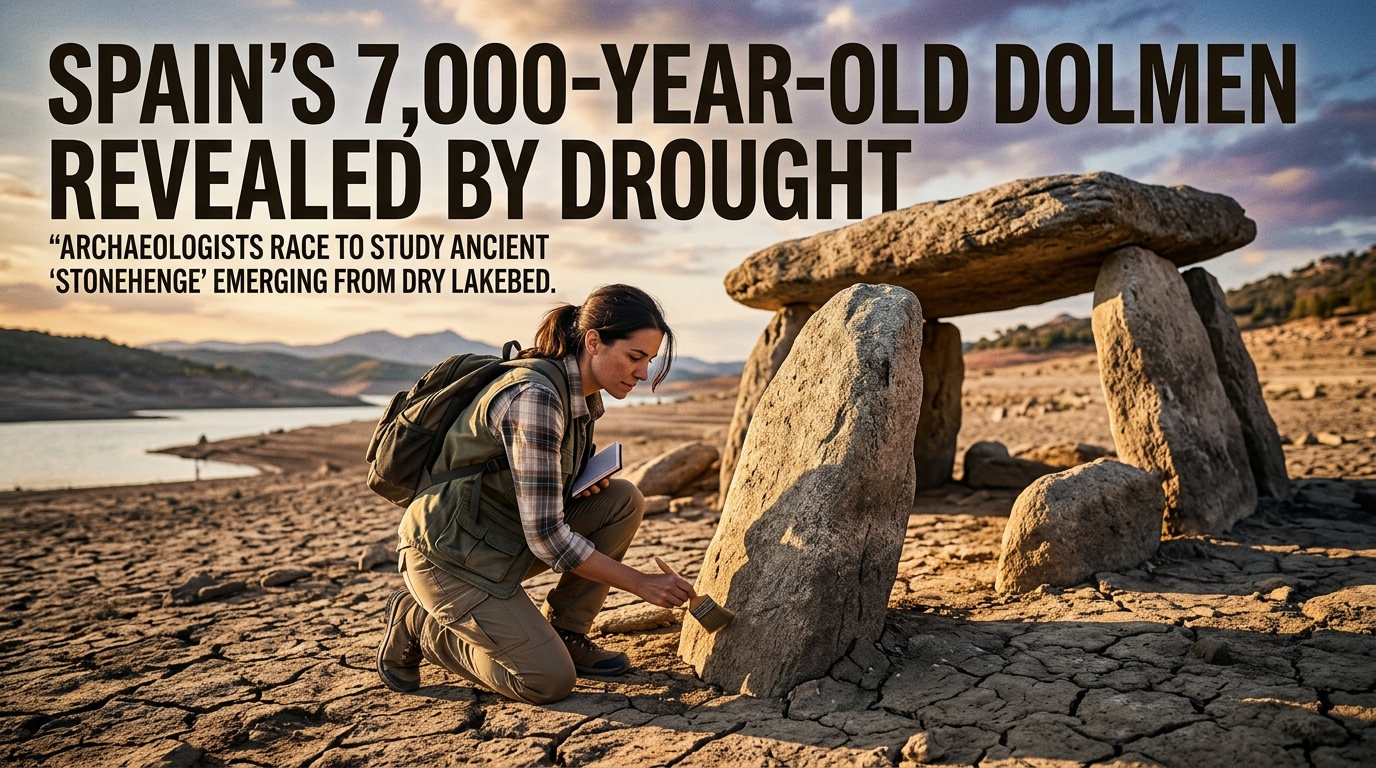
When most people think about droughts, they picture dry riverbeds, damaged crops, and water shortages. Yet, on rare occasions, severe drought conditions can reveal something extraordinary from the distant past. That is exactly what happened in Spain when receding waters exposed an ancient megalithic monument that had remained hidden for decades.
The structure, known as the Dolmen of Guadalperal, has captivated archaeologists, historians, and curious travelers worldwide. Often referred to as Spain’s “Stonehenge,” this mysterious monument is believed to be around 7,000 years old and predates many of the world’s most famous ancient structures.
Its sudden reappearance has sparked renewed interest in prehistoric Europe and raised important questions about humanity’s earliest societies. Here are ten fascinating facts about this remarkable monument and why its emergence has become one of archaeology’s most intriguing recent discoveries.
1. The Monument Is More Than 7,000 Years Old
The Dolmen of Guadalperal is estimated to have been built between 5,000 and 3,000 BCE, making it approximately 7,000 years old. This means the monument existed long before the Roman Empire, ancient Greece, and even before the construction of Egypt’s most famous pyramids.
Its incredible age places it among Europe’s oldest known megalithic structures. The people who built it lived during the Neolithic period, a time when communities were transitioning from hunting and gathering to farming and establishing permanent settlements.
The fact that people living thousands of years ago could transport and arrange enormous stones into a carefully designed structure demonstrates a remarkable level of planning, cooperation, and engineering ability.
2. It Is Often Called Spain’s Stonehenge
Because of its circular arrangement of massive stones, the Dolmen of Guadalperal is frequently compared to England’s famous Stonehenge. Although the two monuments differ in design and purpose, they share several characteristics that make the comparison understandable.
Both structures consist of large standing stones arranged in a deliberate pattern. Both date back to prehistoric times and continue to puzzle researchers today. And both appear to have held significant cultural or ceremonial importance for the communities that built them.
However, unlike Stonehenge, Spain’s ancient monument spent decades hidden beneath water, making its reappearance all the more dramatic.
3. It Was Hidden Underwater for More Than Fifty Years
One of the most surprising aspects of the Dolmen of Guadalperal is that it disappeared beneath a reservoir in the 1960s.
During the dictatorship of Francisco Franco, the Spanish government constructed the Valdecañas Reservoir as part of a hydroelectric development project. Several villages and historical sites were submerged to create the reservoir, including the ancient stone monument.
Archaeologists had already documented the site before the flooding, but once the waters rose, the dolmen became inaccessible and largely vanished from public attention.
For decades, it remained hidden beneath the surface, only occasionally becoming partially visible during exceptionally dry periods.
4. Severe Drought Brought It Back Into View
Spain has experienced several periods of extreme drought in recent years, causing water levels in reservoirs across the country to drop dramatically. As the waters of the Valdecañas Reservoir receded, something astonishing began to emerge.
One by one, the ancient stones of the Dolmen of Guadalperal became visible again.
The sight of the monument rising from the dry lakebed immediately captured international attention. Photographs of the stone circle spread across social media and news outlets, with many people amazed that an entire prehistoric monument had been concealed underwater for so long.
Ironically, a modern environmental crisis ended up revealing a priceless piece of humanity’s distant past.
5. The Monument May Have Served as a Burial Site
Researchers believe the Dolmen of Guadalperal was likely used as a burial chamber.
The structure originally featured a large oval chamber constructed from upright stones and connected to an entrance corridor. Similar megalithic monuments across Europe were often used to bury important members of prehistoric communities.
Burial sites like these were not merely graves. They also functioned as ceremonial spaces where communities honored their ancestors and performed rituals connected to death and remembrance.
Although centuries of environmental changes and periods underwater have made archaeological investigations challenging, the monument’s design strongly suggests it held great spiritual significance.
6. The Stones Contain Mysterious Ancient Carvings
Some of the monument’s stones feature intriguing engravings that continue to puzzle researchers.
One particularly notable carving resembles a winding shape that may represent a river, a snake, or even a symbolic map of the surrounding landscape. Because no written records exist from the people who built the monument, interpreting these carvings remains extremely difficult.
Ancient societies often used symbols to communicate ideas, mark sacred places, or record important events. The engravings found at Guadalperal may have carried religious, geographical, or ceremonial meaning.
Their true purpose remains one of the monument’s greatest mysteries.
7. Building It Required Remarkable Engineering Skills
Creating a monument like the Dolmen of Guadalperal would have been an extraordinary achievement for Neolithic communities.
The stones used in the structure weigh several tons each. Moving them without modern machinery would have required tremendous effort and organization.
Researchers believe large groups of people probably worked together to transport the stones using wooden rollers, ropes, and carefully coordinated labor. The builders also needed knowledge of stability, placement, and design to ensure the structure remained standing.
The monument serves as a reminder that prehistoric people possessed far more sophisticated engineering abilities than many once assumed.
8. It Offers Valuable Clues About Europe’s Early Civilizations
The reappearance of the dolmen has provided researchers with another opportunity to study one of Europe’s ancient societies.
Monuments like Guadalperal reveal that Neolithic communities were capable of organizing large projects, developing complex belief systems, and maintaining social structures that encouraged cooperation on a significant scale.
Archaeologists increasingly recognize that prehistoric societies were not primitive groups simply struggling to survive. Instead, many possessed advanced cultural traditions, spiritual beliefs, and impressive architectural knowledge.
Every stone at the site contributes another piece to the puzzle of understanding how Europe’s earliest settled communities lived and what they valued.
9. Climate Change Is Accidentally Revealing Ancient Sites Worldwide
The story of the Dolmen of Guadalperal is part of a much larger global phenomenon.
As climate change contributes to droughts, melting glaciers, and changing landscapes, archaeological discoveries are emerging in unexpected places around the world.
Ancient villages have appeared beneath shrinking lakes. Human artifacts have emerged from melting ice. Long-forgotten structures have resurfaced as rivers and reservoirs recede.
While these discoveries offer remarkable opportunities for research, they also serve as reminders of the environmental challenges facing modern society. The same conditions that reveal ancient treasures often threaten ecosystems, agriculture, and communities.
The appearance of Spain’s hidden monument illustrates the complex relationship between environmental change and historical discovery.
10. The Monument’s Future Remains Uncertain
Despite renewed interest, the future of the Dolmen of Guadalperal remains a matter of debate.
Some experts argue that the monument should be relocated to higher ground where it can be preserved and studied more effectively. Others believe moving the stones could damage the site’s historical integrity and separate it from its original landscape.
Leaving it in place also presents risks. If water levels rise again, the monument may once more disappear beneath the reservoir, potentially causing additional deterioration.
The challenge highlights an increasingly important question facing archaeologists worldwide: how should humanity preserve ancient sites that are threatened by modern environmental and developmental pressures?
Why This Ancient Monument Continues to Fascinate the World
The re-emergence of the Dolmen of Guadalperal has captured imaginations because it connects two vastly different worlds. On one hand, it is a relic of people who lived thousands of years ago, long before written history. On the other, its discovery was made possible by modern environmental changes that are reshaping our planet.
The monument reminds us that countless pieces of human history remain hidden beneath forests, deserts, lakes, and oceans. Every archaeological discovery has the potential to rewrite what we know about our ancestors and reveal how sophisticated ancient societies truly were.
Spain’s “Stonehenge” stands as both an archaeological wonder and a powerful symbol of humanity’s enduring curiosity about the past. After surviving approximately seven millennia, disappearing beneath water for more than half a century, and unexpectedly returning to the surface, the Dolmen of Guadalperal continues to tell a remarkable story—one of ingenuity, mystery, resilience, and the timeless human desire to leave something lasting behind.







