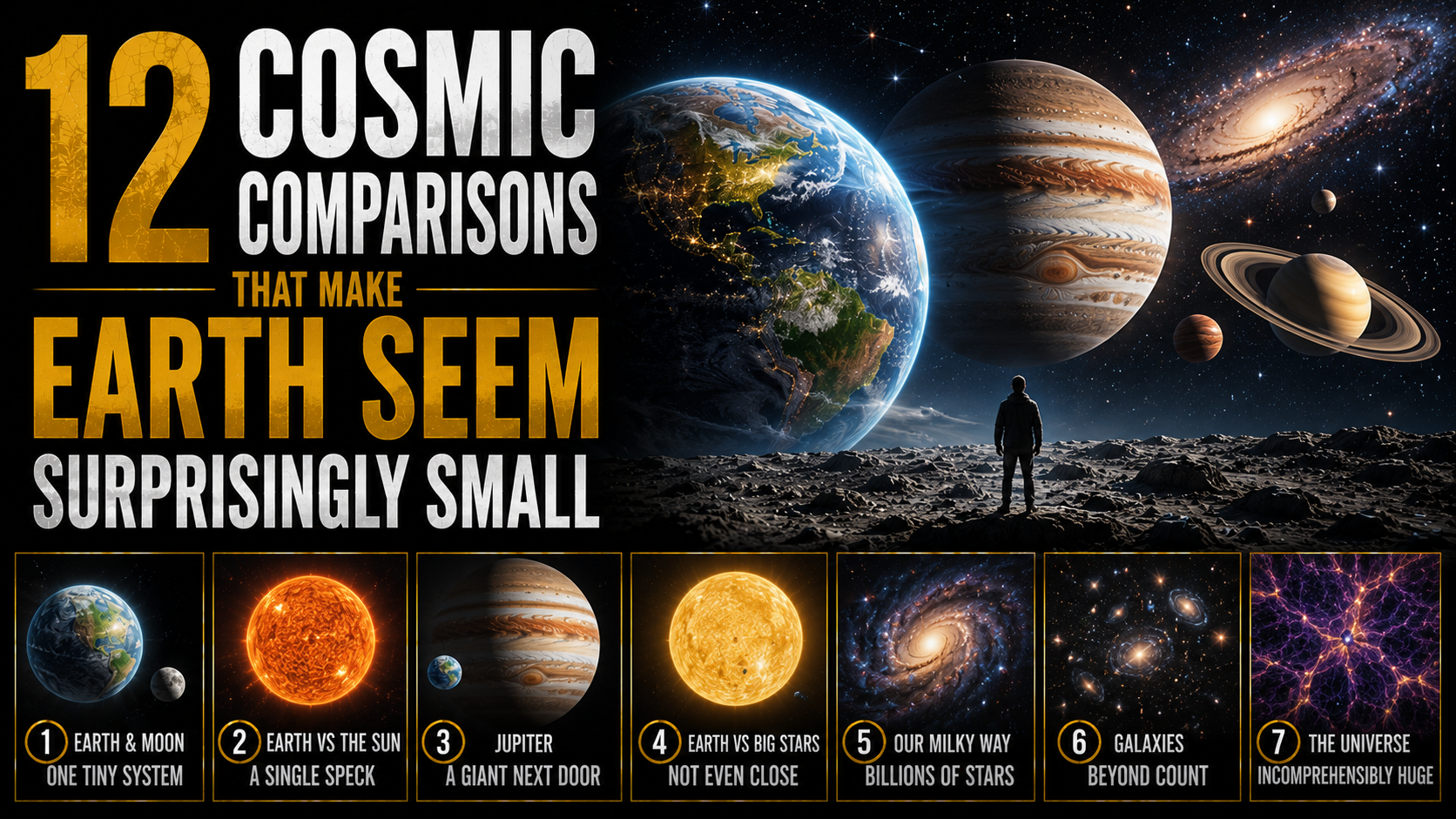
Earth feels vast in everyday life—mountains stretch high, oceans run deep, and continents span thousands of kilometers. Yet when we zoom out into the scale of the universe, our planet shrinks into something far more modest than we typically imagine.
Astronomers often use comparisons to help make the universe easier to understand. When Earth is measured against planets, stars, and galaxies, it quickly becomes clear that it is just a tiny part of an enormous cosmic structure.
Here are 12 cosmic comparisons that put Earth’s size into a humbling perspective.
1. Earth vs. the Sun: A Tiny Speck in a Giant Star
The Sun contains about 99.8% of the mass in our entire solar system.
More than one million Earths could fit inside it.
Compared to the Sun, our planet is just a small rocky fragment orbiting a massive energy source.
This comparison alone shows how small Earth is on a stellar scale.
2. Earth vs. Jupiter: The Solar System’s Giant Planet
Jupiter is the largest planet in our solar system.
Its volume is so large that around 1,300 Earths could fit inside it.
Even though it is “just a planet,” Jupiter dwarfs Earth in size and mass.
This contrast highlights how varied planetary sizes can be.
3. Earth vs. Saturn: Rings of Enormous Scale
Saturn is another gas giant far larger than Earth.
Over 760 Earths could fit inside Saturn’s volume.
Its iconic rings stretch thousands of kilometers, extending its visual presence even further.
Saturn reinforces how small Earth is among planetary neighbors.
4. Earth vs. Neptune: A Distant Ice Giant
Neptune, the farthest major planet from the Sun, is also much larger than Earth.
Around 57 Earths could fit within it.
Despite its distance and cold environment, it still dominates Earth in size.
Even the outer solar system is home to massive worlds.
5. Earth vs. the Largest Known Stars
Some stars are so large that they defy imagination.
Red supergiants like Betelgeuse or UY Scuti are hundreds to thousands of times larger than the Sun.
If placed in our solar system, their surfaces could extend beyond Jupiter or even Saturn.
In comparison, Earth becomes microscopic.
6. Earth vs. the Solar System Itself
The solar system stretches far beyond the orbit of Neptune.
It includes the Kuiper Belt and potentially the Oort Cloud, which may extend trillions of kilometers.
Within this vast region, Earth occupies an incredibly small orbital path.
It is one planet among countless icy and rocky bodies.
7. Earth vs. the Milky Way Galaxy
Our galaxy contains an estimated 100 to 400 billion stars.
Each of those stars could have its own planetary system.
Against this backdrop, Earth is one of trillions of possible worlds.
Its physical size becomes insignificant at galactic scale.
8. Earth vs. the Sun’s Orbit Around the Galaxy
The Sun itself orbits the center of the Milky Way.
This journey takes about 225–250 million years to complete.
Earth travels along with the Sun, making it part of a massive cosmic motion system.
Our planet is just a passenger on a galactic orbit.
9. Earth vs. the Observable Universe
The observable universe spans about 93 billion light-years in diameter.
It contains billions of galaxies, each with billions of stars.
Earth is one tiny point within this unimaginable expanse.
Its scale is almost impossible to grasp in human terms.
10. Earth vs. Other Potential Earth-Like Planets
Astronomers have discovered thousands of exoplanets.
Some are similar in size or even larger than Earth.
Many orbit stars far beyond our solar system.
This suggests Earth is not unique in size or structure.
11. Earth vs. Black Holes
Black holes represent some of the most extreme objects in the universe.
Even the smallest ones have gravity so intense that nothing can escape them.
Compared to these cosmic giants, Earth is fragile and relatively insignificant in mass.
The contrast highlights the extremes of cosmic density.
12. Earth vs. the Scale of Cosmic Time
Size is not the only measure of scale—time also matters.
Earth is about 4.5 billion years old, which is ancient by human standards.
However, the universe is roughly 13.8 billion years old.
In cosmic time, Earth occupies only a small slice of existence.
Why These Comparisons Matter
Understanding Earth’s size in context helps us appreciate both our planet and the universe.
It does not diminish Earth’s importance—in fact, it highlights how rare and valuable it is.
So far, Earth is the only known place that supports life.
That makes it incredibly significant despite its small cosmic footprint.
The Role of Perspective in Astronomy
Astronomy often relies on comparison to make the incomprehensible understandable.
By stacking Earth against planets, stars, and galaxies, scientists help bridge the gap between human experience and cosmic reality.
These comparisons remind us that the universe is not just large—it is unimaginably vast.
And within that vastness, Earth remains a unique and fragile home.
Final Thoughts
From gas giants to galaxies, every comparison shows the same truth: Earth is small in the grand structure of the universe.
Yet its smallness is what makes it extraordinary. It is the only known world where life has taken root, evolved, and thrived.
In the end, these cosmic comparisons are not just about scale—they are about perspective. They remind us that even the tiniest planet can hold immense meaning in a universe without apparent limits.







