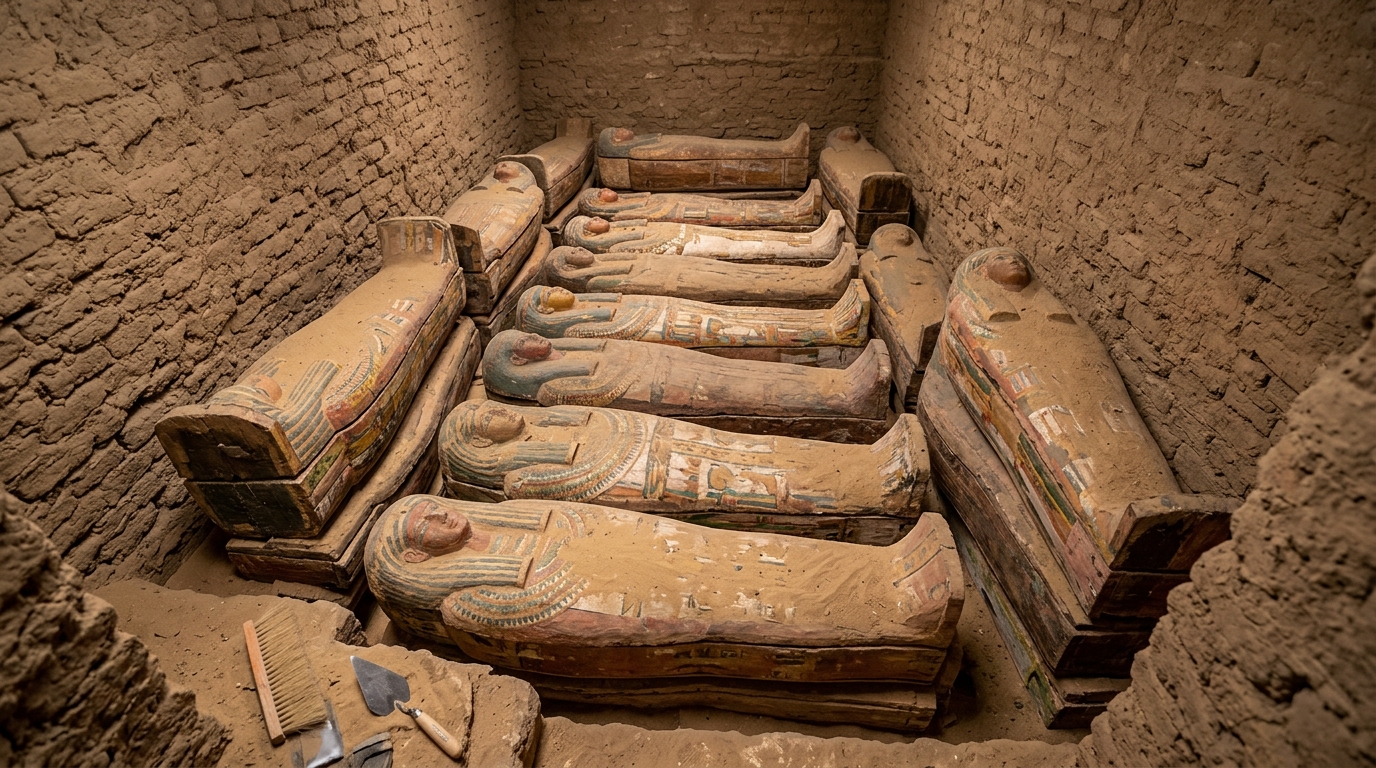
Archaeological discoveries in Egypt rarely fail to capture global attention, but few finds have been as extraordinary as the uncovering of 250 ancient coffins and 150 bronze statues at Saqqara. Hidden beneath the desert sands for centuries, these remarkable artifacts have offered researchers an unprecedented look into the religious beliefs, artistic achievements, and burial practices of ancient Egypt.
The discovery is not merely impressive because of the number of artifacts unearthed. It is significant because every coffin, statue, and ceremonial object contributes another piece to the puzzle of understanding one of history’s greatest civilizations.
Here are ten surprising facts about the incredible discoveries made at Saqqara.
1. The Artifacts Were Buried for More Than 2,000 Years
The coffins and statues date to the Late Period of ancient Egypt, approximately 2,500 years ago.
For centuries, these treasures remained hidden beneath layers of sand and debris. Their long burial protected many of the objects from human interference and environmental damage, allowing archaeologists to recover artifacts in remarkably good condition.
The fact that so many items survived intact for over two millennia makes the discovery exceptionally important.
2. Saqqara Is One of the World’s Greatest Archaeological Sites
The discovery took place at Saqqara, one of Egypt’s most significant ancient burial grounds.
For thousands of years, Saqqara served as the necropolis of Memphis, Egypt’s ancient capital. The vast site contains pyramids, tombs, temples, and burial chambers spanning multiple dynasties.
Archaeologists have been studying Saqqara for generations, yet it continues to produce astonishing discoveries, proving that many of its secrets remain buried beneath the desert.
3. The Discovery Included an Extraordinary Number of Coffins
Finding a single ancient coffin can be a major archaeological event. Discovering 250 at one site is truly remarkable.
The sheer quantity of coffins provides researchers with an unusually large collection of burial artifacts from a specific historical period. This allows scholars to compare designs, construction methods, and inscriptions on a much broader scale than is usually possible.
Such a large group of coffins offers valuable insights into ancient funerary practices and social customs.
4. Many of the Coffins Were Beautifully Decorated
The coffins were not simple containers.
Many were painted with vibrant colors and decorated with intricate designs featuring religious symbols, protective deities, and hieroglyphic inscriptions. Despite their age, some retained impressive levels of artistic detail.
The decorations reveal the importance ancient Egyptians placed on preparing for the afterlife and preserving spiritual identity after death.
5. The Bronze Statues Depict Ancient Egyptian Deities
Among the most fascinating discoveries were approximately 150 bronze statues representing various gods and goddesses.
Ancient Egyptians believed that divine beings played essential roles in both life and death. Statues of deities often served religious functions, acted as offerings, or symbolized spiritual protection.
The presence of so many sacred figures demonstrates the central role religion occupied in ancient Egyptian society.
6. Some Statues Were Dedicated to the Goddess Isis
Several of the bronze figures are believed to depict Isis, one of Egypt’s most revered goddesses.
Isis was associated with motherhood, magic, healing, and protection. She became one of the most widely worshipped deities in Egyptian history, and her influence eventually spread throughout the Mediterranean world.
Finding statues connected to Isis provides valuable evidence of her enduring importance during the Late Period.
7. The Discovery Reveals Complex Burial Practices
The large number of coffins and religious artifacts highlights how elaborate Egyptian funerary traditions could be.
Ancient Egyptians believed death represented a transition rather than an ending. Considerable effort was invested in preparing tombs, preserving bodies, and providing spiritual protection for the deceased.
The artifacts discovered at Saqqara reveal the sophistication and depth of beliefs surrounding death and the afterlife.
8. The Bronze Statues Showcase Exceptional Metalworking Skills
Creating bronze sculptures required advanced technical knowledge.
Ancient artisans needed to understand metal composition, casting techniques, and artistic design to produce detailed and durable figures. The quality of the statues demonstrates the remarkable abilities of Egyptian craftsmen.
These artifacts remind us that ancient civilizations often possessed technological and artistic skills that continue to impress modern experts.
9. The Discovery Is Expanding Historical Knowledge
Every artifact recovered from Saqqara provides new opportunities for research.
Archaeologists can study inscriptions, examine artistic styles, and analyze burial arrangements to better understand the people who lived during this period of Egyptian history. Even seemingly minor details can reveal important information about religion, economy, and social organization.
The discovery therefore represents not only a collection of treasures but also an invaluable source of historical evidence.
10. Saqqara Still Holds Countless Secrets
Perhaps the most surprising fact is that discoveries of this scale continue to occur.
Despite decades of excavation and research, Saqqara remains one of the world’s richest archaeological landscapes. Vast sections of the necropolis have yet to be fully explored, and experts believe many additional tombs and artifacts remain hidden beneath the sands.
The discovery of 250 coffins and 150 bronze statues serves as a powerful reminder that history still has many untold stories waiting to be uncovered.
Why This Discovery Continues to Fascinate the World
The remarkable finds at Saqqara offer far more than beautiful ancient objects. They provide a rare and detailed glimpse into a civilization that flourished thousands of years ago and developed complex beliefs about religion, death, and eternity.
The decorated coffins reveal how carefully ancient Egyptians prepared for the afterlife, while the bronze statues demonstrate exceptional artistic talent and profound spiritual devotion. Together, these artifacts create a vivid picture of a society that invested enormous effort in preserving memory and honoring the divine.
Most importantly, the discoveries remind us that archaeology is an ongoing journey of exploration. Beneath the deserts of Egypt, countless pieces of humanity’s shared past remain hidden, waiting for the moment when they once again emerge into the light.
The 250 coffins and 150 bronze statues found at Saqqara stand as extraordinary witnesses to one of history’s greatest civilizations, proving that even after thousands of years, ancient Egypt still possesses the power to surprise and inspire the modern world.







