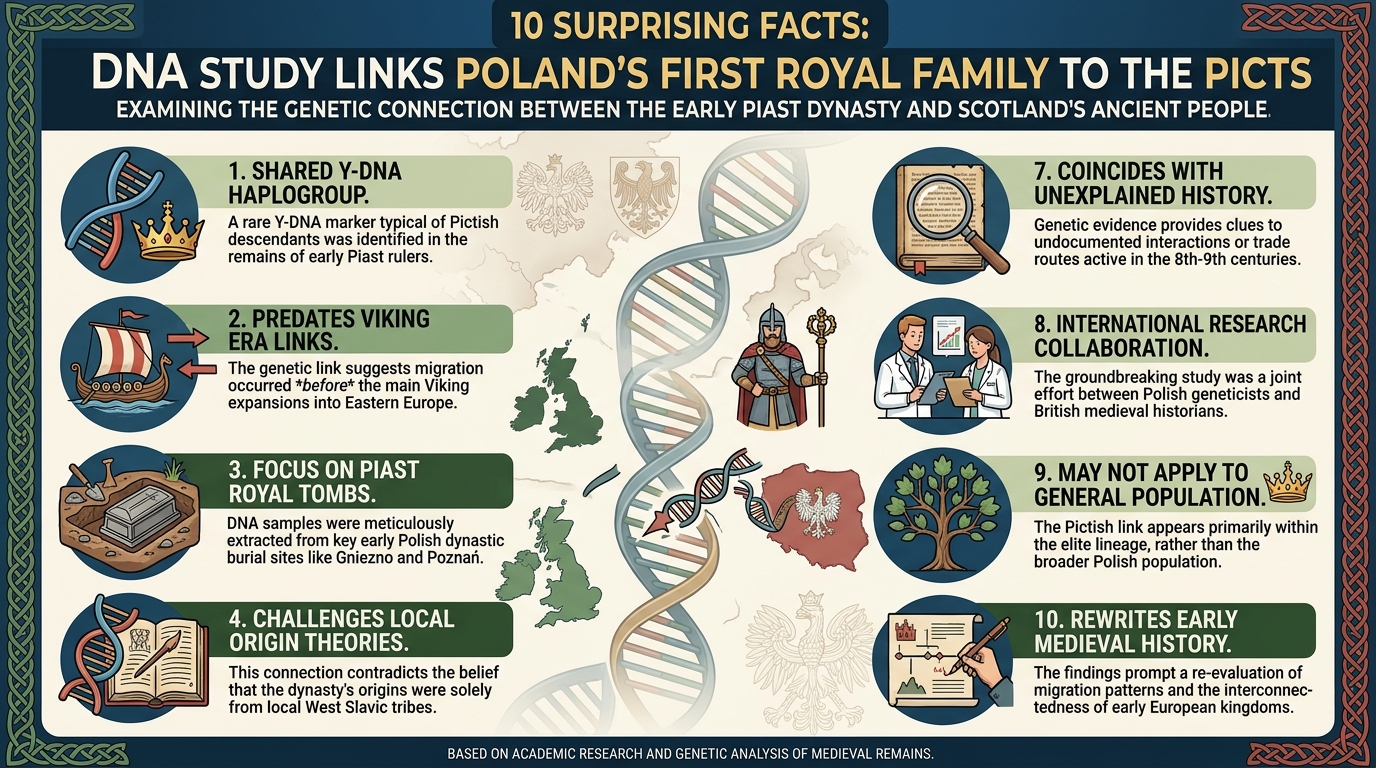
History is constantly evolving, and sometimes the biggest surprises come not from ancient texts or archaeological discoveries but from modern science. In recent years, a groundbreaking DNA study has sparked widespread fascination by suggesting a possible genetic connection between Poland’s first royal dynasty and the mysterious Picts of ancient Scotland.
The findings have challenged long-held assumptions about the origins of the Piast dynasty—the royal family that founded the medieval Polish state—and opened new discussions about migration, identity, and the interconnected nature of early Europe. While researchers are continuing to investigate the evidence, the study has already become one of the most intriguing historical discoveries in recent years.
Here are ten surprising facts about this remarkable DNA study and why it has captured the attention of historians around the world.
1. It Challenges a Thousand Years of Assumptions
For centuries, historians generally believed that the Piast dynasty, which ruled Poland from the 10th to the 14th century, emerged from local Slavic communities.
The new genetic findings have complicated that picture. Researchers identified a rare paternal genetic marker that may point to origins outside the region traditionally associated with the dynasty. This possibility has reignited debates about who the Piasts were and how medieval states were formed.
2. The Study Suggests a Link to the Mysterious Picts
Perhaps the most surprising aspect of the research is its proposed connection to the Picts, an ancient people who lived in what is now Scotland.
The Picts remain one of Europe’s most enigmatic societies. They resisted Roman expansion and left behind distinctive symbols and stone carvings, but much about their origins and culture remains uncertain. The possibility that Poland’s first royal family may share a paternal lineage associated with ancient Pictish populations has fascinated researchers and the public alike.
3. Scientists Examined Remains From Royal Tombs
The study was made possible by years of archaeological and genetic investigation.
Researchers analyzed skeletal remains recovered from several Piast-era crypts and burial sites, including tombs associated with medieval Polish rulers. Extracting usable DNA from centuries-old remains is an extraordinarily difficult process that requires advanced scientific techniques and meticulous laboratory work.
4. Ancient DNA Is Transforming Historical Research
Not long ago, questions about royal ancestry could only be explored through chronicles, legends, and archaeological evidence.
Today, ancient DNA analysis has become one of the most powerful tools in historical research. Scientists can identify genetic relationships, track migration patterns, and sometimes uncover connections that written records never preserved.
The Piast study demonstrates how modern genetics is revolutionizing our understanding of the past.
5. The Findings Do Not Mean the Piasts Were Necessarily “Scottish”
One of the biggest misconceptions surrounding the study is the idea that the Piast rulers were simply Scottish kings living in Poland.
The research points to a possible paternal genetic connection to lineages associated with ancient northwestern Europe and a Pictish individual from Scotland. However, medieval identities were far more complex than modern national labels. Genetics can reveal ancestry and migration patterns, but it does not directly determine culture, language, or political identity.
6. The Picts Are Still One of Europe’s Great Mysteries
The DNA findings are especially captivating because the Picts themselves remain poorly understood.
Historical sources about them are limited, and many aspects of their society continue to puzzle scholars. They inhabited northern Britain during Late Antiquity and the early Middle Ages, resisted Roman influence, and eventually became part of the emerging Kingdom of Scotland.
Any new research connected to the Picts naturally attracts enormous attention because so much about them remains unknown.
7. Medieval Europe Was More Connected Than We Often Imagine
The study highlights an important historical lesson: medieval Europe was not made up of isolated populations.
Trade routes, warfare, diplomacy, and marriage alliances frequently brought people into contact across vast distances. Elites often moved between regions, carrying cultural influences and family connections with them.
The possible link between Poland’s earliest rulers and populations from northwestern Europe illustrates just how interconnected medieval societies may have been.
8. The Research Has Sparked Healthy Academic Debate
Not all historians interpret the findings in exactly the same way.
Some researchers view the genetic evidence as highly significant, while others urge caution and argue that additional studies are needed before drawing broad conclusions about the dynasty’s origins.
This debate is a normal and essential part of scientific progress. Major discoveries often raise as many questions as they answer, encouraging further investigation and discussion.
9. The Piast Dynasty Changed European History
Regardless of its ultimate origins, the Piast dynasty played a foundational role in European history.
The Piasts established and ruled the first Polish state, shaped political institutions, and helped integrate medieval Poland into the wider European world. Their reign influenced religion, diplomacy, and the development of Central Europe for centuries.
Understanding where this influential royal family came from has implications that extend far beyond Poland itself.
10. The Discovery Shows That History Is Never Truly Finished
Perhaps the most surprising lesson from the DNA study is that even well-known historical narratives can change.
For generations, historians relied on chronicles and archaeological evidence to reconstruct the past. Today, technologies such as genetic analysis are revealing entirely new layers of information that previous generations could never have imagined.
The possible link between Poland’s first royal family and the ancient Picts reminds us that history is constantly being rewritten as new evidence emerges. Even dynasties that have been studied for centuries can still hold remarkable secrets.
Why This DNA Study Continues to Fascinate Historians
The proposed connection between the Piast dynasty and the Picts has captured worldwide attention because it combines two of history’s most intriguing subjects: the origins of a royal family and the mystery of an ancient people whose story remains only partly understood.
The research does not provide all the answers, and scientists continue to investigate its implications. Yet it demonstrates the extraordinary potential of modern genetics to illuminate the distant past in ways that were once impossible.
Most importantly, the study serves as a powerful reminder that history is not a fixed collection of facts. It is an ongoing investigation, constantly enriched by new discoveries. Sometimes, a tiny fragment of ancient DNA can challenge centuries of assumptions and reveal connections between peoples and places that nobody expected.