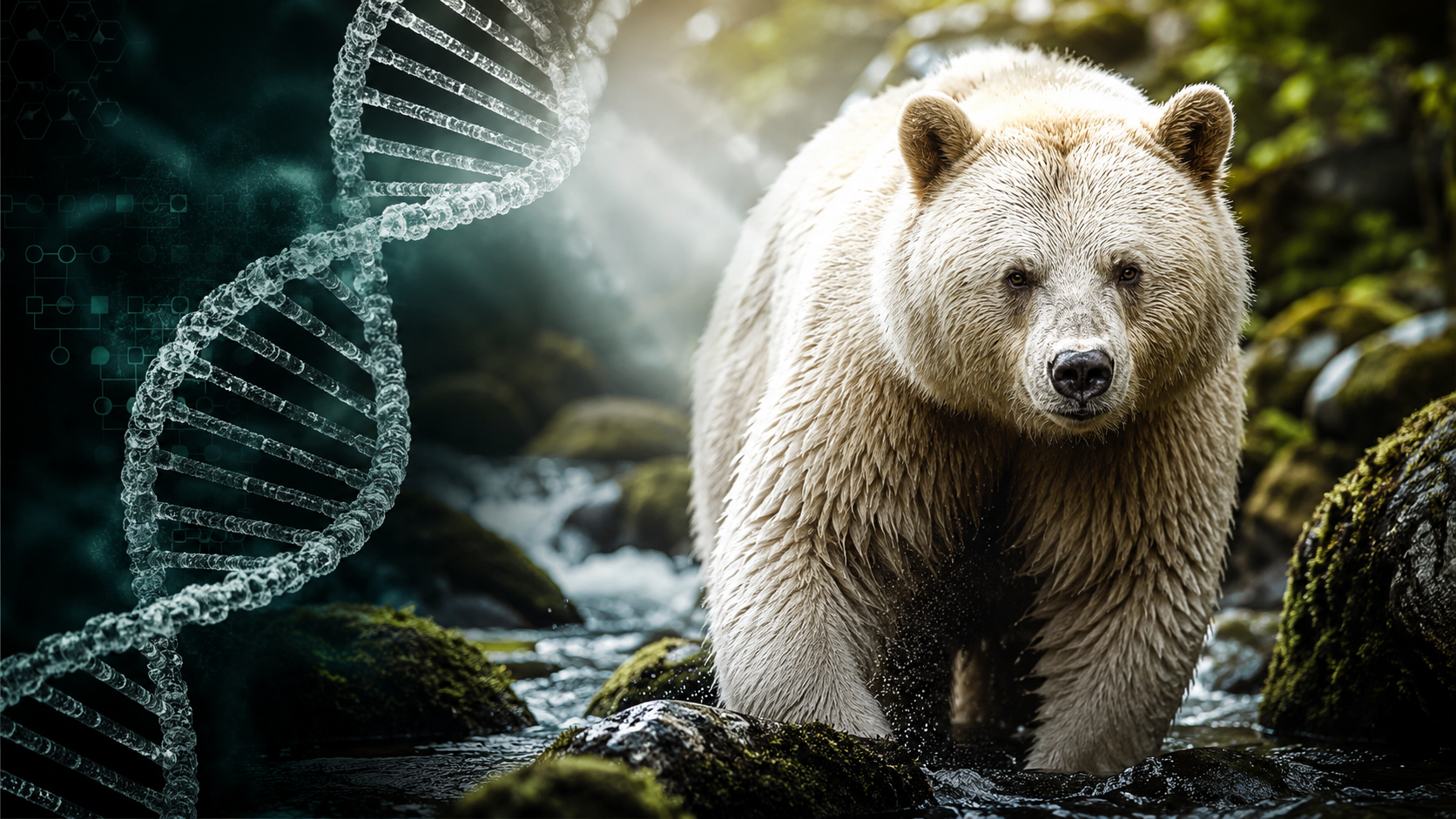
At first glance, the phrase “snow-white black bear” sounds like a contradiction. How can a black bear be white? Yet in the coastal rainforests of western Canada, a rare and remarkable bear challenges everything most people think they know about genetics and wildlife.
Known as the spirit bear, or Kermode bear, this unusual animal is not an albino or a separate species. Instead, it is a rare color variation of the American black bear. With creamy white fur and dark eyes, these bears have fascinated scientists, conservationists, and Indigenous communities for generations.
The existence of these striking animals offers a fascinating glimpse into how genes shape the natural world. Here are fifteen surprising truths about the genetics behind snow-white black bears.
1. They Are Actually Black Bears
Despite their white appearance, spirit bears belong to the same species as ordinary black bears.
They are a rare color form of the American black bear. Genetically and biologically, they are black bears in every meaningful way. Their white coats are simply the result of a specific inherited genetic trait.
This surprising fact demonstrates how a single genetic change can dramatically alter an animal’s appearance without creating an entirely new species.
2. Their White Fur Comes From a Single Gene Mutation
Scientists have discovered that the spirit bear’s distinctive coat color is linked to a mutation in one gene.
This genetic variation affects the production of pigments that normally darken the fur. As a result, the bears develop pale, creamy-white coats instead of the typical black coloration.
The discovery has provided researchers with an excellent example of how minor genetic changes can produce striking physical differences.
3. They Are Not Albinos
Many people assume that white animals are albinos, but spirit bears are entirely different.
Albino animals lack melanin and often have pink eyes and pink skin. Spirit bears, however, possess dark eyes, dark noses, and normally pigmented skin.
Their white coloration is caused by a separate genetic mechanism, making them one of the most intriguing examples of natural color variation in mammals.
4. Both Parents Can Look Black and Produce White Cubs
Perhaps the most surprising genetic fact is that two black bears can give birth to white cubs.
This happens because the gene responsible for white fur is recessive. A bear must inherit the specific genetic variant from both parents in order to display the white coloration.
As a result, bears carrying the gene may appear completely black while still passing the trait to future generations.
5. White Fur Is Surprisingly Rare
Although the genetic mutation exists within certain bear populations, white-coated individuals remain uncommon.
Only a small percentage of black bears in the spirit bear’s habitat possess the two copies of the gene necessary to develop white fur. This rarity makes every sighting of a spirit bear especially memorable.
Their scarcity also contributes to their legendary status among both scientists and wildlife enthusiasts.
6. The Gene Has Survived for Thousands of Years
The mutation responsible for white fur did not emerge recently.
Researchers believe the genetic trait has persisted within isolated coastal bear populations for thousands of years. Its continued presence suggests that it may have offered some survival advantage or at least was not harmful enough to disappear through natural selection.
The longevity of this gene highlights the complex ways evolution shapes animal populations.
7. Their Habitat Helped Preserve the Trait
Geography has played an important role in the survival of spirit bear genetics.
The remote coastal rainforests and islands where these bears live have limited movement between populations. This relative isolation allowed the rare gene to remain concentrated in specific areas.
Without these natural geographic barriers, the genetic trait might have become much rarer or even disappeared entirely.
8. White Fur May Offer Hunting Advantages
Scientists have explored the possibility that white fur may actually provide benefits under certain conditions.
Research suggests that salmon may be less likely to detect white bears against the bright, reflective waters of streams and rivers. This could allow spirit bears to catch fish more successfully than their darker relatives in some environments.
If true, it would represent a fascinating example of how appearance can influence survival and feeding behavior.
9. Their Genetics Help Scientists Understand Evolution
The spirit bear has become an important subject for evolutionary studies.
Because the white coat trait is relatively simple and easy to identify, researchers can examine how genes spread, persist, or decline within isolated populations.
These studies provide valuable insights into genetic inheritance, adaptation, and the factors that influence biological diversity.
10. They Demonstrate the Power of Recessive Genes
Many people are surprised to learn how recessive genes can remain hidden for generations.
A genetic trait does not need to be visible in every individual to survive within a population. The white-fur gene can be quietly carried by black bears and unexpectedly appear in future offspring.
Spirit bears provide one of nature’s most visually stunning examples of recessive inheritance.
11. Their Appearance Does Not Affect Their Species Identity
A white coat may make spirit bears look entirely different, but genetically they remain members of the same species.
This illustrates an important biological principle: physical appearance alone does not determine species boundaries. Animals can display considerable variation while remaining part of the same population.
Nature is often more flexible and diverse than simple labels suggest.
12. Genetic Diversity Helps Populations Stay Healthy
The existence of spirit bears highlights the importance of genetic diversity.
Populations with varied genetic traits often possess greater adaptability and resilience. Unique genes may become beneficial under changing environmental conditions or provide unforeseen advantages.
Protecting genetically diverse populations helps preserve nature’s ability to adapt and evolve.
13. Their Genetics Are Tied to Conservation Efforts
Because the white-fur gene exists within a limited geographic area, protecting spirit bear habitat has become a conservation priority.
Habitat loss and environmental disturbances could reduce the number of bears carrying this rare genetic trait. Conservationists therefore focus not only on protecting individual white bears but also on preserving the ecosystems that sustain the entire population.
The future of these remarkable animals depends heavily on maintaining healthy, connected habitats.
14. They Reveal How Extraordinary Evolution Can Be
Evolution often works through small, gradual genetic changes that produce unexpected results.
A single mutation affecting fur pigmentation created one of the world’s most visually extraordinary bears. The spirit bear reminds us that even minor genetic variations can lead to remarkable outcomes that capture human imagination.
Its existence is a testament to nature’s endless creativity.
15. They Are Living Symbols of Nature’s Hidden Wonders
Perhaps the most fascinating truth of all is that spirit bears remind us how much remains to be discovered about the natural world.
A recessive gene hidden within an ordinary black bear population gave rise to an animal so unusual that many people initially find it hard to believe it exists.
The snow-white black bear demonstrates that nature still holds extraordinary surprises, often concealed within familiar species.
Why the Genetics of Spirit Bears Matter
The story of the snow-white black bear goes far beyond its striking appearance. It provides scientists with a valuable opportunity to study inheritance, evolution, and the importance of preserving genetic diversity.
These bears also challenge assumptions about how species look and how traits are passed from one generation to the next. They remind us that biology is full of exceptions, surprises, and hidden complexities.
Most importantly, the spirit bear represents the incredible diversity that exists within the natural world. A single genetic mutation transformed an ordinary black bear into one of Earth’s most iconic and mysterious animals.
Every glimpse of a spirit bear standing beside a forest stream serves as a powerful reminder that some of nature’s greatest wonders are written not only in landscapes and ecosystems but also in the tiny genetic instructions carried within every living creature.