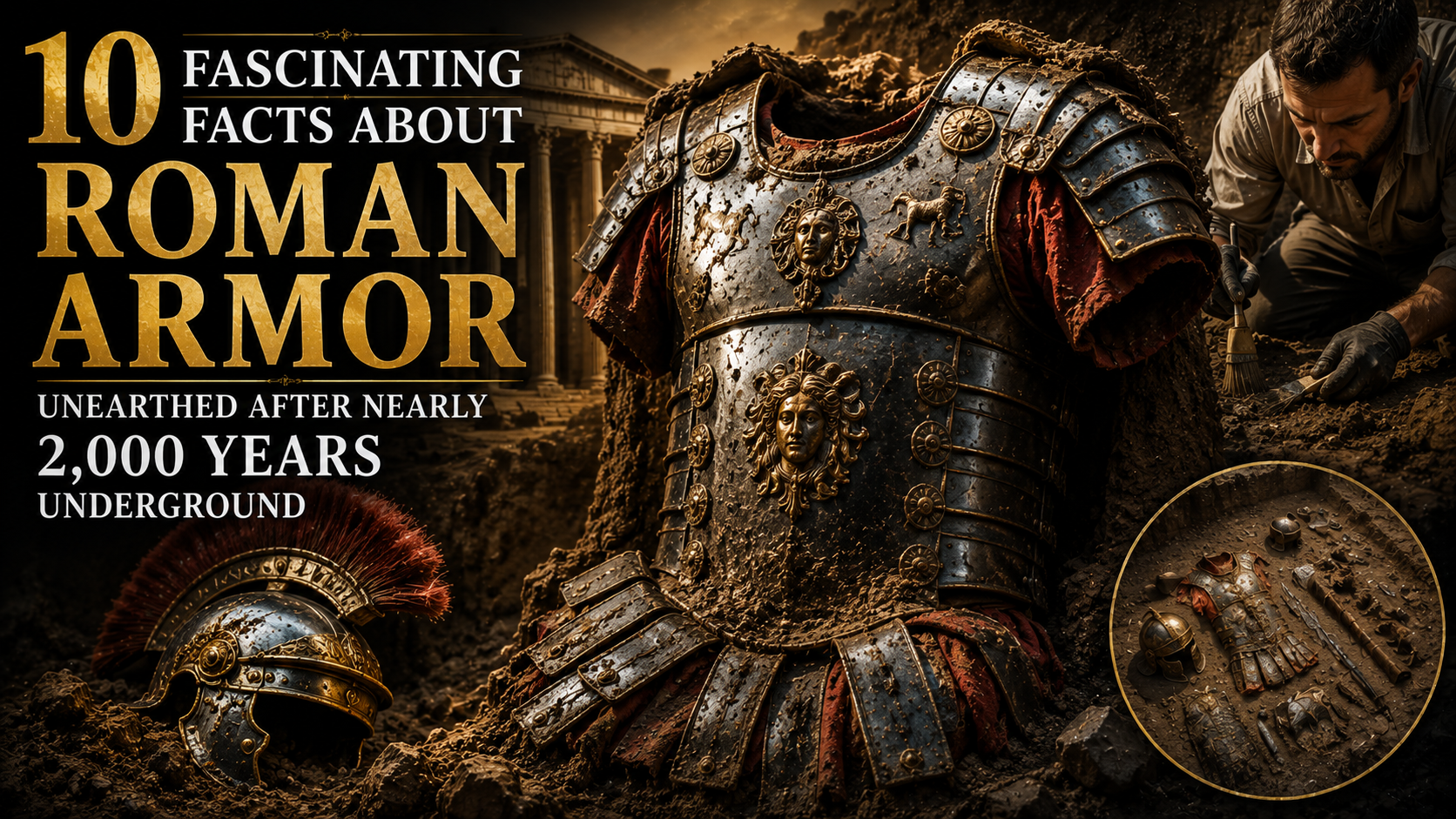
Archaeology often brings the ancient world to life in unexpected ways, but few discoveries are as visually striking as Roman armor that has survived nearly 2,000 years underground. These remnants of military equipment offer a rare glimpse into the discipline, engineering, and daily reality of one of history’s most powerful empires.
Unlike stone monuments or pottery, armor was designed for use in battle—making its survival over millennia extremely rare. When fragments of helmets, breastplates, and chainmail are uncovered, they provide valuable insight into Roman military organization, craftsmanship, and warfare strategy.
Here are 10 fascinating facts about Roman armor unearthed after nearly 2,000 years underground.
1. Most Surviving Armor Was Found in Fragments, Not Complete Sets
One of the first surprises for archaeologists is that Roman armor is rarely found intact.
Instead, it usually appears as broken pieces buried in soil, riverbeds, or ancient battlefield sites.
This fragmentation is the result of corrosion, battlefield damage, and long-term environmental exposure.
Reconstructing full armor sets requires careful study of many scattered pieces.
2. Iron Corrosion Nearly Destroyed Most Evidence
Iron, the primary material used in Roman armor, is highly vulnerable to rust over time.
In humid or oxygen-rich environments, armor often deteriorated completely.
The pieces that survived were usually preserved in low-oxygen soil conditions or buried quickly after battle.
Without these rare conditions, much of Roman military equipment would have been lost forever.
3. Chainmail Was a Roman Innovation That Lasted Centuries
The Romans perfected an early form of chainmail known as lorica hamata.
This armor was made of interlocking metal rings that provided flexibility and protection.
Remarkably, fragments of this design have been found across multiple excavation sites.
Its durability explains why it remained in use for centuries.
4. Helmets Show Evidence of Advanced Engineering
Roman helmets were not simple protective shells—they were highly engineered defense systems.
Many included cheek guards, neck protection, and reinforced ridges to deflect blows.
Some recovered helmets show signs of repair, suggesting they were valuable and reused.
These designs highlight the Romans’ understanding of battlefield mechanics.
5. Decorative Elements Indicated Rank and Identity
Not all armor was purely functional.
Some pieces included decorative engravings, embossing, or inscriptions.
These details often indicated rank, legion identity, or unit affiliation.
Armor was both protective gear and a symbol of military pride.
6. Armor Varied Across Different Regions of the Empire
The Roman Empire spanned vast territories, and armor designs reflected regional differences.
Soldiers stationed in colder climates often had heavier equipment, while those in warmer regions used lighter gear.
Archaeological finds show variations in style and construction across Europe, North Africa, and the Middle East.
This adaptability was key to Rome’s military success.
7. Some Armor Was Intentionally Buried After Battles
Not all armor ended up underground by accident.
In some cases, battlefield equipment appears to have been deliberately buried.
This may have been done to clear battlefields or as part of ritual practices.
Such discoveries provide insight into how Romans dealt with the aftermath of war.
8. Bronze Components Survive Better Than Iron
While iron corrodes easily, bronze components often survive in better condition.
Decorative fittings, rivets, and fittings made from bronze have been found in surprisingly detailed states.
These elements help archaeologists reconstruct how full armor sets originally looked.
Without bronze fragments, many designs would remain incomplete mysteries.
9. Armor Was Often Repaired and Reused
Evidence suggests Roman soldiers did not frequently discard damaged armor.
Instead, they repaired and modified equipment for continued use.
This reflects both the value of materials and the efficiency of Roman military logistics.
Some recovered pieces show multiple layers of repair over time.
10. Excavations Continue to Reveal New Insights Into Roman Warfare
Every new archaeological discovery adds to the understanding of Roman military life.
Armor finds help historians reconstruct battle strategies, troop movements, and technological development.
They also reveal how soldiers adapted to different environments and combat conditions.
Even after 2,000 years, these artifacts continue to reshape historical knowledge.
Why Roman Armor Still Captivates Historians
Roman armor is more than ancient military equipment—it is a physical connection to the people who once served in one of history’s most organized armies.
Each fragment tells a story of discipline, survival, and technological innovation.
The combination of craftsmanship and functionality makes these discoveries especially valuable to researchers.
They help bridge the gap between written history and material evidence.
Final Thoughts
The discovery of Roman armor buried for nearly two millennia continues to offer new insights into ancient warfare and engineering.
From chainmail innovation to regional adaptations and battlefield recovery practices, each finding adds depth to our understanding of the Roman military system.
Even in fragmented form, these artifacts preserve the legacy of an empire that shaped much of the modern world.
In the end, Roman armor is not just metal from the past—it is a record of human ingenuity, endurance, and historical transformation.







