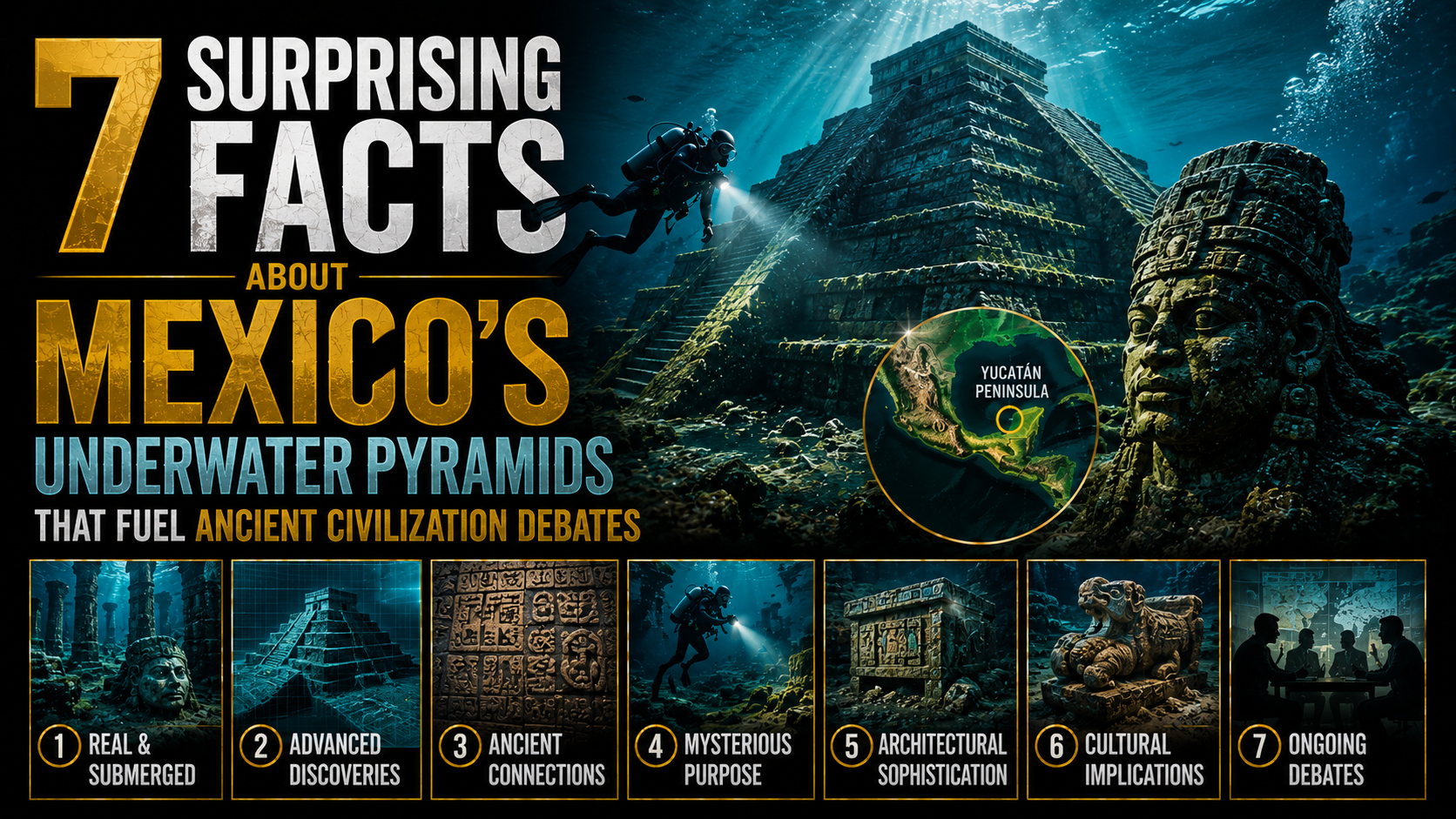
Off the coast of Mexico, beneath layers of ocean water and shifting sand, some of the most intriguing archaeological claims in recent years have captured global attention: so-called “underwater pyramids.” These submerged formations have sparked intense discussion among researchers, divers, and history enthusiasts.
While mainstream archaeology remains cautious about labeling them as true pyramids, the structures discovered underwater have unusual geometric shapes and alignments that raise important questions about ancient civilizations, sea-level changes, and human activity along coastal regions thousands of years ago.
Whether natural or man-made, these formations continue to fuel debate and curiosity.
Here are seven surprising facts about Mexico’s underwater pyramids that keep the mystery alive.
1. The Structures Were Discovered Using Advanced Sonar Technology
The initial identification of these formations came from sonar mapping of the ocean floor.
Modern marine technology allows researchers to detect shapes and elevations beneath sediment layers.
Some of the scanned formations showed stepped or angular structures that resemble pyramid-like designs.
This unexpected pattern triggered further exploration and scientific debate.
2. Not All Scientists Agree They Are Man-Made
One of the biggest points of controversy is interpretation.
Some researchers argue that these formations are natural geological structures shaped by underwater erosion and sediment movement.
Others suggest that their symmetry and alignment may indicate human involvement.
This disagreement continues to divide opinion in the archaeological community.
3. Sea Levels Were Much Lower in Ancient Times
During the last Ice Age, global sea levels were significantly lower than they are today.
Large portions of coastal land that are now underwater were once exposed and habitable.
If human settlements existed in those areas, they could now be submerged beneath the ocean.
This makes underwater archaeological discoveries scientifically plausible in theory.
4. The Formations Show Unusual Geometric Patterns
One reason the structures attract attention is their shape.
Some appear to have stepped layers, flat surfaces, and symmetrical angles.
These features resemble architectural planning seen in ancient civilizations.
However, similar patterns can also occur naturally under certain geological conditions.
5. Nearby Regions Have Known Ancient Civilizations
Mexico is home to some of the world’s most advanced ancient cultures, including the Maya and other pre-Columbian societies.
These civilizations built pyramids, temples, and complex urban centers on land.
The presence of such advanced architecture nearby adds intrigue to underwater discoveries.
It raises questions about whether coastal sites may have existed and later submerged.
6. Ocean Currents and Erosion Complicate Interpretation
Marine environments are highly dynamic.
Ocean currents, sediment movement, and tectonic activity can dramatically reshape underwater landscapes.
Over thousands of years, these forces can create formations that mimic man-made structures.
This makes it difficult to distinguish natural formations from archaeological remains.
7. The Debate Continues to Inspire Further Exploration
Despite the lack of consensus, interest in Mexico’s underwater formations continues to grow.
Researchers are using improved scanning technologies, underwater drones, and 3D mapping tools to study the sites in greater detail.
Each new exploration brings additional data, but also more questions.
The mystery remains unsolved, keeping both scientists and the public engaged.
Why These Underwater Structures Matter
Whether natural or artificial, these formations are important because they challenge assumptions about ancient geography and human history.
They encourage scientists to rethink how coastlines have changed over time and where ancient settlements might have existed.
Even if the structures are not pyramids in the traditional sense, they still provide valuable geological and environmental insights.
The discussion itself pushes the boundaries of underwater archaeology.
The Role of Changing Coastlines in Ancient History
Earth’s coastlines have never been static.
Over millennia, rising and falling sea levels have reshaped continents and submerged vast areas of land.
Many ancient human settlements that once existed near water sources are now underwater.
This possibility keeps researchers open to exploring submerged regions more carefully.
Final Thoughts
Mexico’s underwater pyramids remain one of the most debated and fascinating topics in modern archaeology.
While their true origin is still uncertain, the formations continue to inspire exploration, scientific inquiry, and public imagination.
Whether shaped by nature or ancient human hands, they remind us that much of Earth’s history still lies hidden beneath the waves.
As technology advances, future discoveries may eventually reveal clearer answers—but for now, the mystery remains part of their enduring appeal.







