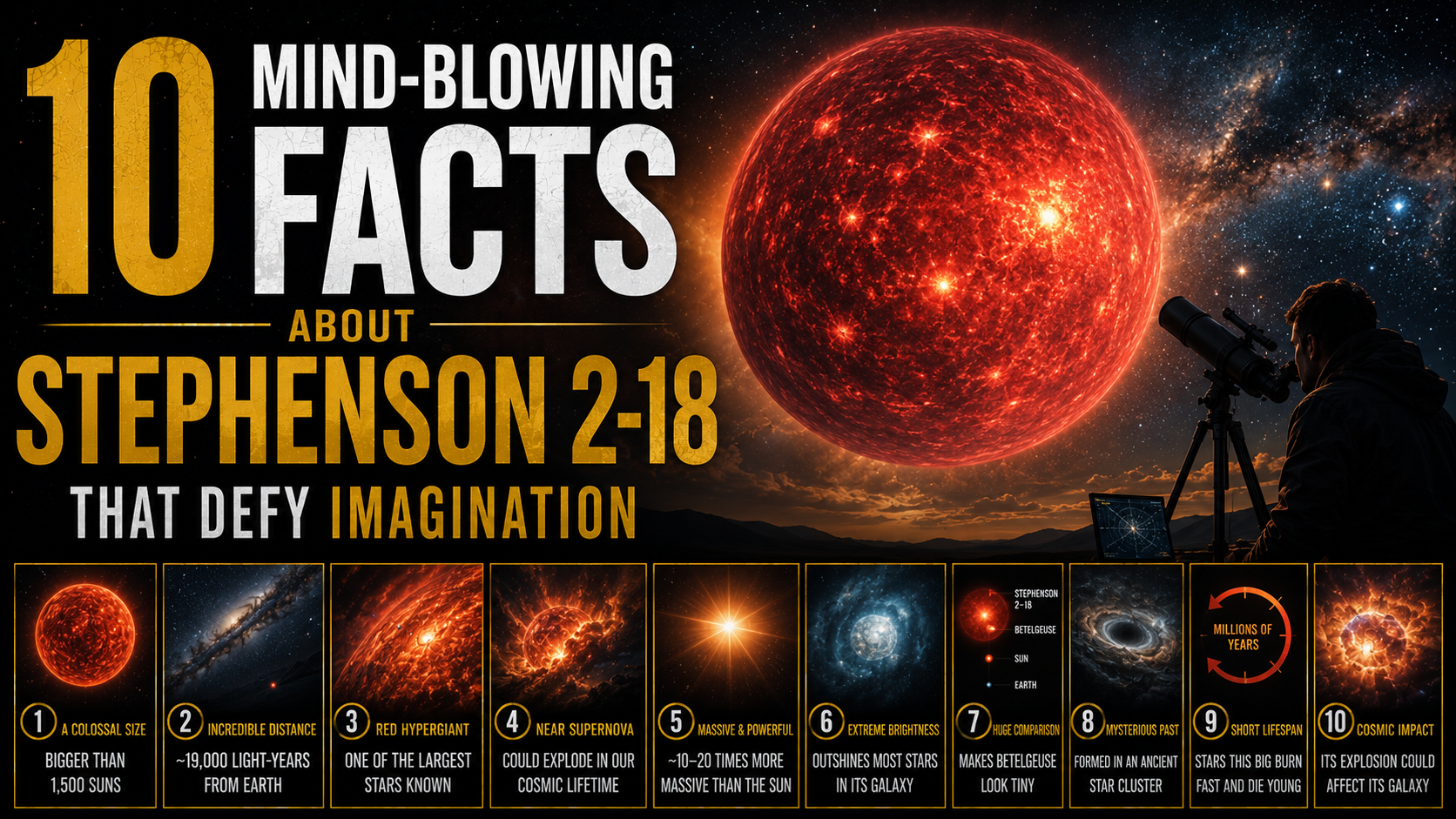
Deep in the vast cosmic neighborhood of our universe lies a star so enormous that it challenges almost everything we think we know about size, scale, and the limits of stellar evolution. Stephenson 2-18, often discussed in astronomy circles as one of the largest known stars, has fascinated scientists and space enthusiasts alike for years.
Located thousands of light-years away, this red supergiant is so massive that if placed at the center of our solar system, its outer edges could extend beyond the orbit of Saturn—or even farther depending on estimates.
While its exact measurements are still debated, one thing is certain: Stephenson 2-18 is not just big—it is almost beyond human comprehension.
Here are 10 mind-blowing facts about Stephenson 2-18 that reveal just how extraordinary this cosmic giant really is.
1. It Is One of the Largest Stars Ever Discovered
Stephenson 2-18 is widely considered among the largest known stars in the universe.
Estimates suggest its radius could be more than 2,000 times that of our Sun.
To put that into perspective, millions of Suns could fit inside it.
Even among supergiants, it stands out as an extreme example of stellar size.
2. It Is a Red Supergiant in Its Final Life Stage
This star belongs to a class known as red supergiants.
These are massive stars nearing the end of their life cycles.
As they age, they expand dramatically and cool at their surface.
Stephenson 2-18 is believed to be in this late evolutionary phase.
3. It Would Swallow Our Solar System
If placed in our solar system, Stephenson 2-18 would engulf everything well beyond Earth.
Depending on current estimates, its outer surface could extend past Jupiter or even Saturn’s orbit.
This highlights just how small our planetary system appears in comparison.
Such a scenario is purely hypothetical but helps illustrate its immense scale.
4. It Emits an Enormous Amount of Light and Energy
Despite its cooler surface temperature compared to smaller stars, Stephenson 2-18 is extremely luminous.
Its sheer size allows it to radiate massive amounts of energy into space.
However, much of this light is absorbed and scattered by surrounding cosmic dust.
This makes precise measurements challenging for astronomers.
5. Its Distance Makes Observation Difficult
Stephenson 2-18 lies thousands of light-years away from Earth.
Because of this extreme distance, even powerful telescopes struggle to measure it accurately.
Interstellar dust also interferes with observations.
As a result, scientists continue to refine their estimates of its size and brightness.
6. It Is Part of a Star Cluster
The star is located within the Stephenson 2 star cluster.
This cluster contains many other massive stars.
Studying it helps astronomers understand how large stars form and evolve in groups.
The cluster environment also influences the star’s development.
7. It Is Rapidly Losing Mass
Like many red supergiants, Stephenson 2-18 is shedding material into space.
Strong stellar winds blow gas and dust away from its surface.
This mass loss is a sign that the star is unstable and approaching the end of its life.
Over time, this process will significantly alter its structure.
8. It Will Eventually End in a Supernova
Stars of this size do not end quietly.
Stephenson 2-18 is expected to eventually collapse and explode in a supernova.
This explosion will release enormous amounts of energy.
It may even leave behind a neutron star or black hole.
9. Its Size Estimates Vary Among Scientists
One reason Stephenson 2-18 is so debated is the uncertainty in its measurements.
Different methods produce different estimates of its radius.
Dust interference and distance complications make accuracy difficult.
As a result, its exact ranking among the largest stars remains under discussion.
10. It Helps Scientists Understand Stellar Extremes
Despite uncertainties, Stephenson 2-18 plays an important role in astrophysics.
It helps researchers study the upper limits of star size and behavior.
By analyzing such extreme stars, scientists refine models of stellar evolution.
It serves as a natural laboratory for understanding the life cycles of massive stars.
Why Stephenson 2-18 Captivates the Scientific World
The fascination with Stephenson 2-18 goes beyond its size.
It represents the extreme boundaries of what stars can become.
Its existence challenges assumptions about stability, scale, and stellar physics.
For astronomers, it is both a mystery and a key to understanding the universe.
The Importance of Studying Giant Stars
Massive stars like Stephenson 2-18 play a crucial role in the cosmos.
When they die, they spread heavy elements into space.
These elements eventually contribute to the formation of new stars, planets, and even life.
In this way, even a dying giant star helps shape future cosmic generations.
Final Thoughts
Stephenson 2-18 stands as one of the most awe-inspiring objects in the known universe.
Its immense size, powerful energy output, and uncertain measurements make it a constant subject of scientific curiosity.
While we may never fully grasp its true scale, it continues to expand our understanding of what is possible in the cosmos.
In the end, Stephenson 2-18 is more than just a star—it is a reminder of how vast and extraordinary the universe truly is.







