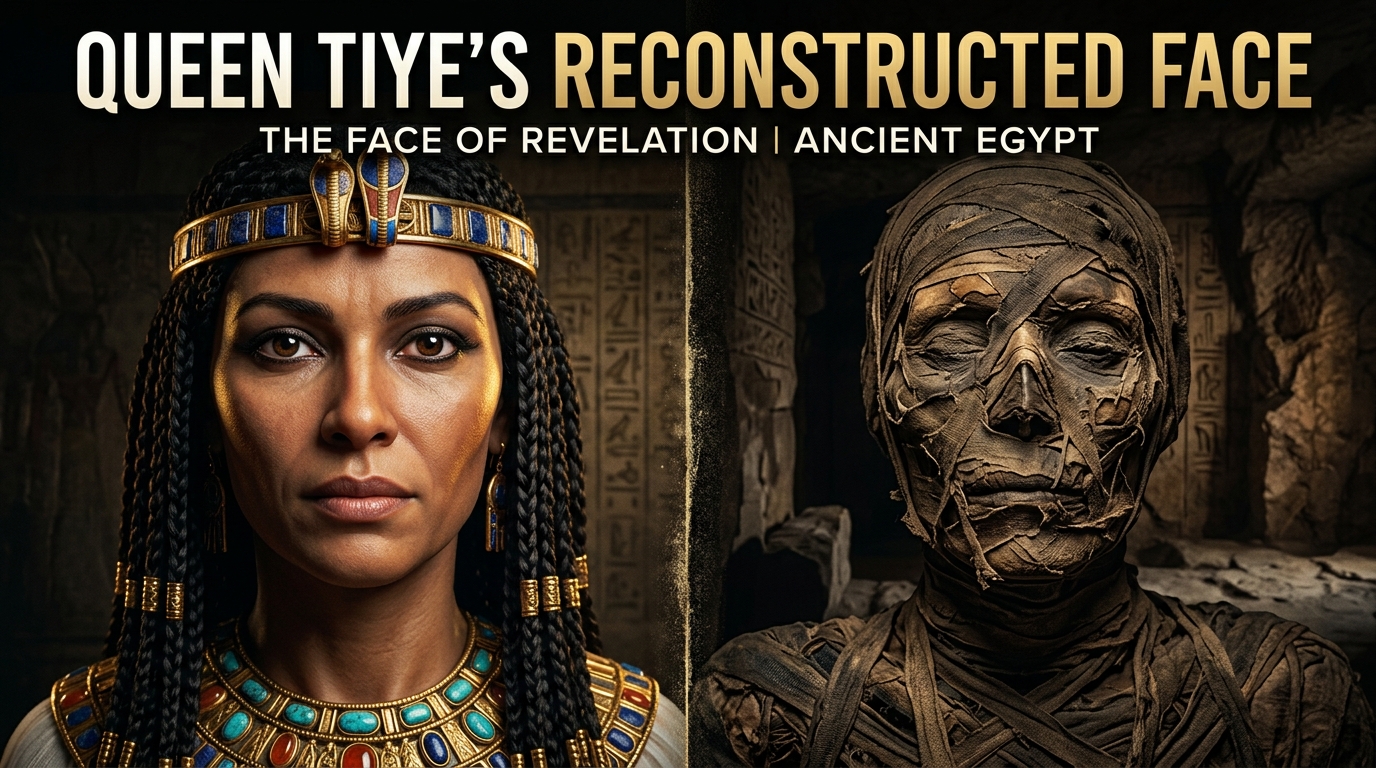
For thousands of years, the faces of ancient rulers existed only in statues, paintings, and the imagination of historians. But modern science is changing that. Thanks to advances in forensic reconstruction and the study of ancient remains, researchers can now create remarkably realistic images of people who lived millennia ago.
One of the most fascinating examples is Queen Tiye, one of ancient Egypt’s most influential royal women. By examining her mummy and combining archaeological evidence with modern technology, experts have produced reconstructions that offer a glimpse into what this powerful queen may have looked like in life.
Far from being a minor royal figure, Queen Tiye was a woman of extraordinary intelligence, political influence, and historical significance. Her reconstructed face has captivated historians and the public alike, revealing surprising details about both the queen herself and the world she helped shape.
Here are ten fascinating facts about Queen Tiye’s reconstructed face and the remarkable story behind it.
1. She Lived More Than 3,300 Years Ago
Queen Tiye lived during the 14th century BCE, making her one of history’s most famous women from over 3,300 years ago.
She became the Great Royal Wife of Pharaoh Amenhotep III, who ruled during one of ancient Egypt’s most prosperous and culturally vibrant periods. Egypt was wealthy, powerful, and internationally respected during their reign.
The fact that scientists can produce facial reconstructions of someone who lived more than three millennia ago is an extraordinary achievement. It creates a direct and personal connection to an individual who existed in one of humanity’s greatest civilizations.
2. She Was the Grandmother of Tutankhamun
One reason Queen Tiye remains famous today is her connection to one of Egypt’s best-known pharaohs: King Tutankhamun.
Historical and genetic evidence indicates that Queen Tiye was the grandmother of Tutankhamun, whose nearly intact tomb became one of archaeology’s greatest discoveries.
This family connection places Queen Tiye at the center of one of ancient Egypt’s most fascinating royal dynasties. Her reconstructed face offers a glimpse into the family line that produced some of Egypt’s most recognizable rulers.
3. Her Features Appear Surprisingly Modern
Many people are astonished by how familiar Queen Tiye’s reconstructed face looks.
Rather than appearing like a distant, almost mythical figure, the reconstruction reveals a woman with realistic facial proportions and expressions that seem remarkably contemporary. Her face reminds viewers that ancient Egyptians were real people whose features were not fundamentally different from those of modern humans.
This sense of familiarity helps bridge thousands of years of history and makes the ancient world feel far more personal and relatable.
4. Her Mummy Was Exceptionally Well Preserved
The reconstruction of Queen Tiye’s appearance was possible largely because her mummy survived in remarkably good condition.
Ancient Egyptian mummification techniques were highly sophisticated. Through careful preservation methods, embalmers protected many features of the body that would otherwise have disappeared over time.
Although no mummy can perfectly preserve every detail of a person’s appearance, Queen Tiye’s remains provided researchers with valuable information about her bone structure and physical characteristics, making a scientifically informed reconstruction possible.
5. She Was Probably in Her Fifties or Sixties When She Died
Researchers believe Queen Tiye died at an advanced age by ancient standards, likely in her fifties or sixties.
Life expectancy in the ancient world was generally lower than it is today, making her longevity particularly notable. Her reconstructed face often depicts mature features that reflect her age and status as an experienced and respected royal figure.
The reconstruction reminds us that she was not only a queen but also a mother, grandmother, and political adviser who lived long enough to witness significant changes within the Egyptian court.
6. Her Hair Became One of Her Most Recognizable Features
One of the most fascinating details about Queen Tiye’s mummy is the remarkable preservation of her hair.
Ancient accounts and surviving remains suggest that she had thick, wavy hair that remained identifiable even after thousands of years. This unusual level of preservation has greatly contributed to artistic reconstructions of her appearance.
Hair often plays a major role in how we recognize faces, and this distinctive feature makes Queen Tiye’s reconstructed image particularly striking and memorable.
7. She Was One of Egypt’s Most Powerful Queens
Queen Tiye was far more than a ceremonial wife of the pharaoh.
Historical records indicate that she participated actively in political affairs and maintained influence both within Egypt and abroad. Foreign rulers communicated directly with her, recognizing her authority and importance.
Her reconstructed face therefore represents not merely an ancient woman but one of the most powerful female figures of the ancient world. Looking at her image allows people to imagine the face of a queen who helped shape international diplomacy more than three thousand years ago.
8. Her Son Changed Egyptian Religion
Queen Tiye’s son was Pharaoh Akhenaten, one of history’s most controversial rulers.
Akhenaten attempted to transform Egyptian religion by elevating the worship of the sun disk Aten above traditional gods. His religious reforms dramatically altered the political and cultural landscape of ancient Egypt.
As Akhenaten’s mother, Queen Tiye occupied a unique position during this period of upheaval. Her reconstructed face belongs to a woman who witnessed one of the most extraordinary religious experiments in ancient history.
9. Modern Technology Helped Bring Her Face to Life
Creating a reconstruction of Queen Tiye’s appearance required a combination of science and art.
Researchers used information gathered from her mummy, including skull measurements and anatomical evidence, to estimate the thickness of facial tissues and reconstruct likely facial features. Digital technology and forensic methods allowed experts to produce images that are grounded in scientific evidence.
While no reconstruction can guarantee perfect accuracy, these techniques provide the closest approximation yet to seeing the face of someone who lived thousands of years ago.
The process demonstrates how modern technology continues to transform our understanding of ancient civilizations.
10. Her Reconstructed Face Makes History Feel Human
Perhaps the most surprising aspect of Queen Tiye’s reconstructed face is its emotional impact.
History often feels distant because it is filled with dates, monuments, and names from long ago. But seeing a realistic face changes our perspective entirely. Suddenly, Queen Tiye becomes more than a historical figure. She appears as a real person who once lived, aged, made decisions, raised a family, and exercised influence in one of history’s greatest empires.
The reconstruction creates a powerful sense of connection across time, reminding us that the ancient world was inhabited by people whose experiences, ambitions, and relationships were deeply human.
Why Queen Tiye Continues to Fascinate the World
Queen Tiye’s reconstructed face is remarkable because it combines archaeology, forensic science, and history to reveal an individual who lived more than 3,300 years ago. Through modern technology, researchers have transformed an ancient mummy into a recognizable human face, allowing people around the world to look into the features of one of Egypt’s most influential queens.
Her image represents far more than a scientific achievement. It symbolizes the enduring power of historical discovery and our desire to understand the people who shaped the civilizations that came before us.
More than three millennia after her death, Queen Tiye continues to captivate historians and the public alike—not only because she belonged to a famous royal family, but because her reconstructed face reminds us that behind every ancient monument and historical record was a real human being whose story still resonates today.







