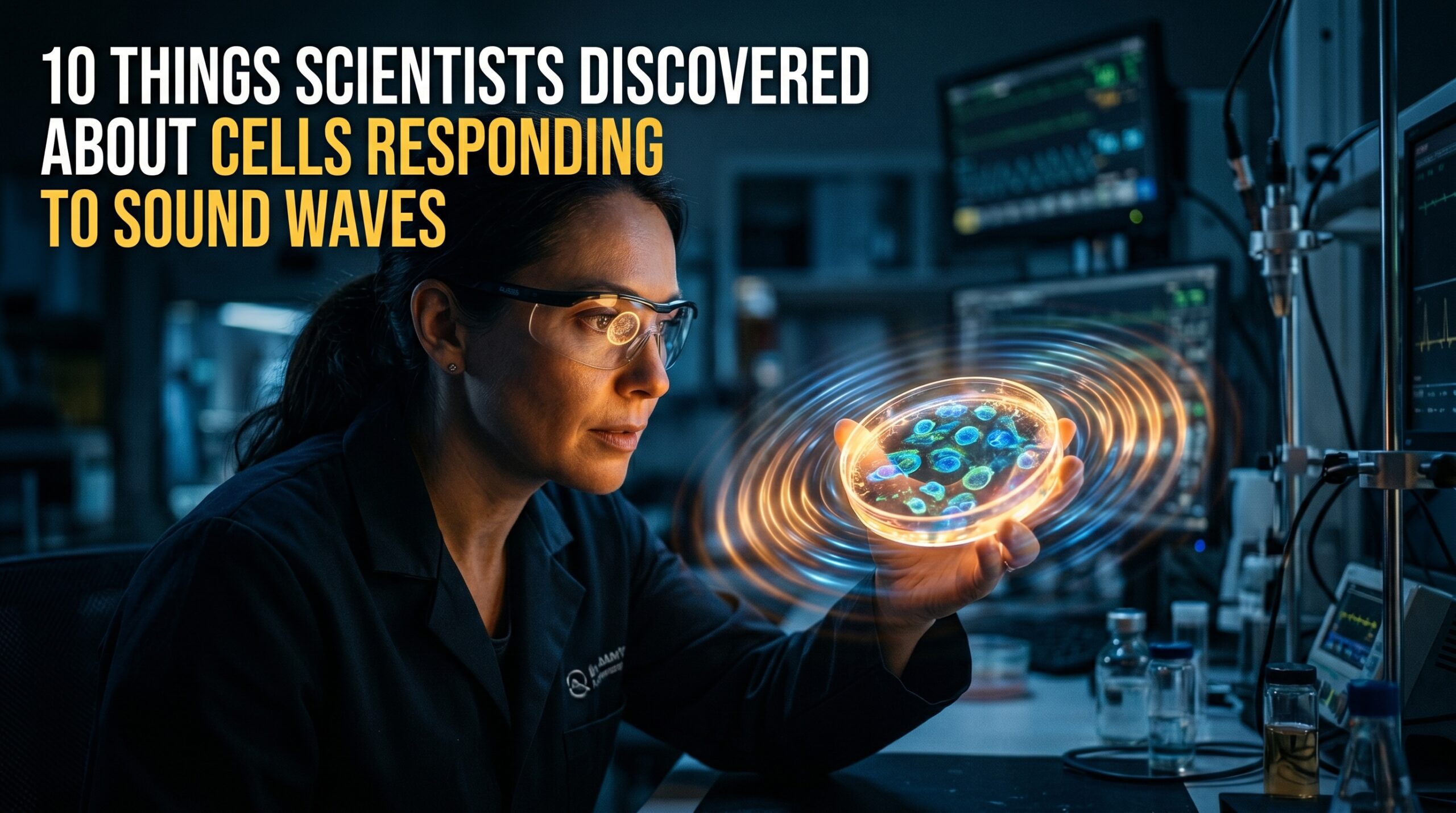
Sound is something we experience every day. From conversations and music to the hum of machinery, sound waves constantly move through our environment. For years, scientists viewed sound primarily as a way for humans and animals to communicate and interact with the world. However, emerging research suggests that sound may have effects that extend far beyond hearing.
Recent studies have revealed that living cells can detect and respond to mechanical vibrations, including certain sound frequencies. While research in this field is still developing, scientists are uncovering intriguing evidence that sound waves may influence cellular behavior, gene activity, tissue repair, and even biological communication.
It’s important to note that many claims about sound healing remain unproven, and researchers continue to investigate exactly how sound affects living systems. Nevertheless, the discoveries made so far are opening exciting new possibilities in biology and medicine.
Here are ten fascinating findings scientists have made about the relationship between sound waves and cellular activity.
1. Cells Can Sense Mechanical Vibrations
One of the most important discoveries in modern cell biology is that cells are not passive structures. They constantly monitor their physical environment and respond to mechanical forces around them.
Scientists have found that cells possess specialized structures known as mechanoreceptors. These receptors can detect pressure, stretching, vibration, and movement within surrounding tissues.
Because sound waves are essentially vibrations traveling through a medium, researchers discovered that cells can respond to certain sound-induced mechanical forces. This finding helped establish the foundation for an entirely new area of research known as mechanobiology.
Rather than simply existing within the body, cells actively interpret physical signals and adjust their behavior accordingly.
2. Sound Waves May Influence Gene Expression
Gene expression refers to the process by which cells activate or deactivate specific genes.
Several laboratory studies have suggested that mechanical stimulation, including vibration-based stimulation, may influence which genes are turned on or off within certain cell types.
Researchers believe that when sound-generated vibrations alter a cell’s physical environment, signaling pathways inside the cell may respond by adjusting gene activity.
This doesn’t mean sound can magically rewrite DNA. Instead, it suggests that physical vibrations may influence how cells utilize existing genetic instructions under specific conditions.
Understanding these mechanisms could eventually lead to new therapeutic approaches in regenerative medicine and tissue engineering.
3. Certain Frequencies Appear to Affect Cell Growth
Scientists have observed that different frequencies can produce different effects on cultured cells in laboratory environments.
In some experiments, specific vibration patterns have been associated with changes in cell growth rates, while others appear to have little effect.
Researchers believe cells may respond differently depending on factors such as:
- Frequency
- Intensity
- Duration of exposure
- Cell type
- Surrounding environment
Because each cell type has unique characteristics, what affects one type of cell may not affect another in the same way.
This area remains highly complex, but findings suggest that biological systems may be more sensitive to physical vibrations than previously believed.
4. Ultrasound Is Already Used to Support Healing
One of the most practical applications of sound-based technology is therapeutic ultrasound.
Unlike audible sound, ultrasound uses frequencies above the range of human hearing. Medical professionals have used ultrasound for decades in imaging, but researchers also discovered its potential role in tissue repair.
Low-intensity ultrasound has been studied for its ability to:
- Stimulate bone healing
- Promote tissue regeneration
- Improve circulation
- Encourage cellular activity
Scientists believe these effects occur because ultrasound delivers controlled mechanical energy directly into tissues, triggering cellular responses that support healing processes.
This represents one of the strongest examples of sound-related technology influencing biological function in a measurable way.
5. Sound Vibrations Can Affect Stem Cells
Stem cells are among the most valuable cells in the human body because they have the ability to develop into various specialized cell types.
Researchers have found that mechanical stimulation can influence stem cell behavior and development.
In laboratory settings, certain vibration patterns appear capable of affecting how stem cells grow, divide, and mature.
Scientists are particularly interested in understanding whether controlled mechanical stimulation could help guide stem cells toward specific developmental pathways.
If future studies confirm these effects, sound-based technologies could potentially become useful tools in regenerative medicine.
6. Cells Communicate Through Mechanical Signals
For many years, scientists focused primarily on chemical communication between cells.
Today, researchers know that cells also exchange information through mechanical forces.
When one cell moves, stretches, contracts, or changes shape, neighboring cells can detect those physical changes and respond.
This discovery has transformed our understanding of cellular communication.
Because sound waves create mechanical disturbances within tissues, scientists are investigating whether sound can indirectly influence cellular signaling networks.
The idea that physical vibrations may affect how cells communicate with one another continues to be an exciting area of ongoing research.
7. Sound May Influence Cellular Organization
Cells do not exist randomly within tissues. They organize themselves into highly structured patterns that allow organs and biological systems to function properly.
Researchers have observed that mechanical vibrations can influence how cells arrange themselves in laboratory environments.
In some experiments, sound-generated vibrations appeared to affect:
- Cell alignment
- Tissue formation
- Structural organization
- Cellular movement
This phenomenon suggests that physical forces may play a larger role in biological development than previously recognized.
Scientists hope these findings may eventually help improve tissue engineering techniques used to create artificial organs and repair damaged tissues.
8. Bone Cells Respond Strongly to Mechanical Stimulation
Bone is a living tissue that constantly remodels itself throughout life.
Researchers have discovered that bone cells are particularly sensitive to mechanical forces.
Activities such as walking, running, and resistance training create physical stress that encourages bone maintenance and growth.
Studies suggest that vibration-based stimulation may activate some of the same cellular pathways involved in bone remodeling.
This is one reason scientists continue exploring sound-related therapies for bone repair and osteoporosis treatment.
The responsiveness of bone cells demonstrates how deeply physical forces influence cellular behavior throughout the body.
9. Cellular Membranes React to Vibrational Energy
The cell membrane serves as the protective outer boundary of every cell.
Scientists have learned that membranes are dynamic structures rather than static barriers. They continuously respond to changes in their environment.
Mechanical vibrations can alter membrane tension and influence how certain proteins embedded within the membrane behave.
These changes may trigger internal signaling pathways that affect cellular function.
Researchers believe membrane responses may represent one of the primary ways cells detect and interpret sound-related mechanical stimulation.
Understanding this process could provide valuable insights into how cells convert physical energy into biological responses.
10. Sound-Based Medicine May Have a Promising Future
Perhaps the most exciting discovery is not a single finding but an emerging field of research.
Scientists are increasingly exploring how controlled sound and vibration technologies might be used in medicine.
Potential future applications include:
- Accelerating tissue repair
- Supporting wound healing
- Enhancing drug delivery
- Improving rehabilitation therapies
- Promoting bone regeneration
- Assisting regenerative medicine treatments
While many of these possibilities remain under investigation, early results suggest that sound-based approaches could eventually become valuable tools alongside conventional medical treatments.
Researchers emphasize that much more evidence is needed before broad conclusions can be drawn. However, the growing body of research highlights the remarkable sensitivity of living cells to physical forces.
What These Discoveries Really Mean
The idea that cells can respond to sound may sound surprising, but it becomes easier to understand when we remember that sound is fundamentally a form of vibration.
Cells evolved in dynamic physical environments where pressure, movement, tension, and mechanical forces constantly influence biological processes. Rather than ignoring these forces, cells have developed sophisticated systems for detecting and responding to them.
Current research does not support many of the exaggerated claims often found online regarding sound frequencies and miraculous healing effects. However, legitimate scientific studies do show that mechanical stimulation—including sound-related vibrations—can influence cellular behavior under certain conditions.
The challenge for researchers now is determining exactly which frequencies, intensities, and exposure patterns produce beneficial effects and how those effects can be safely applied in medical settings.
Final Thoughts
Scientific understanding of sound’s influence on cells is still evolving, but the discoveries made so far are reshaping how researchers think about biology. Evidence increasingly suggests that cells are highly responsive to mechanical vibrations and can alter their behavior in response to physical signals.
From influencing gene activity and stem cell development to supporting tissue repair and bone healing, sound-based stimulation may hold significant promise for future healthcare innovations.
Although much remains to be learned, one thing is becoming clear: cells are far more aware of their physical surroundings than scientists once imagined. As research advances, sound waves may prove to be an important tool for understanding—and potentially improving—human health at the cellular level.







