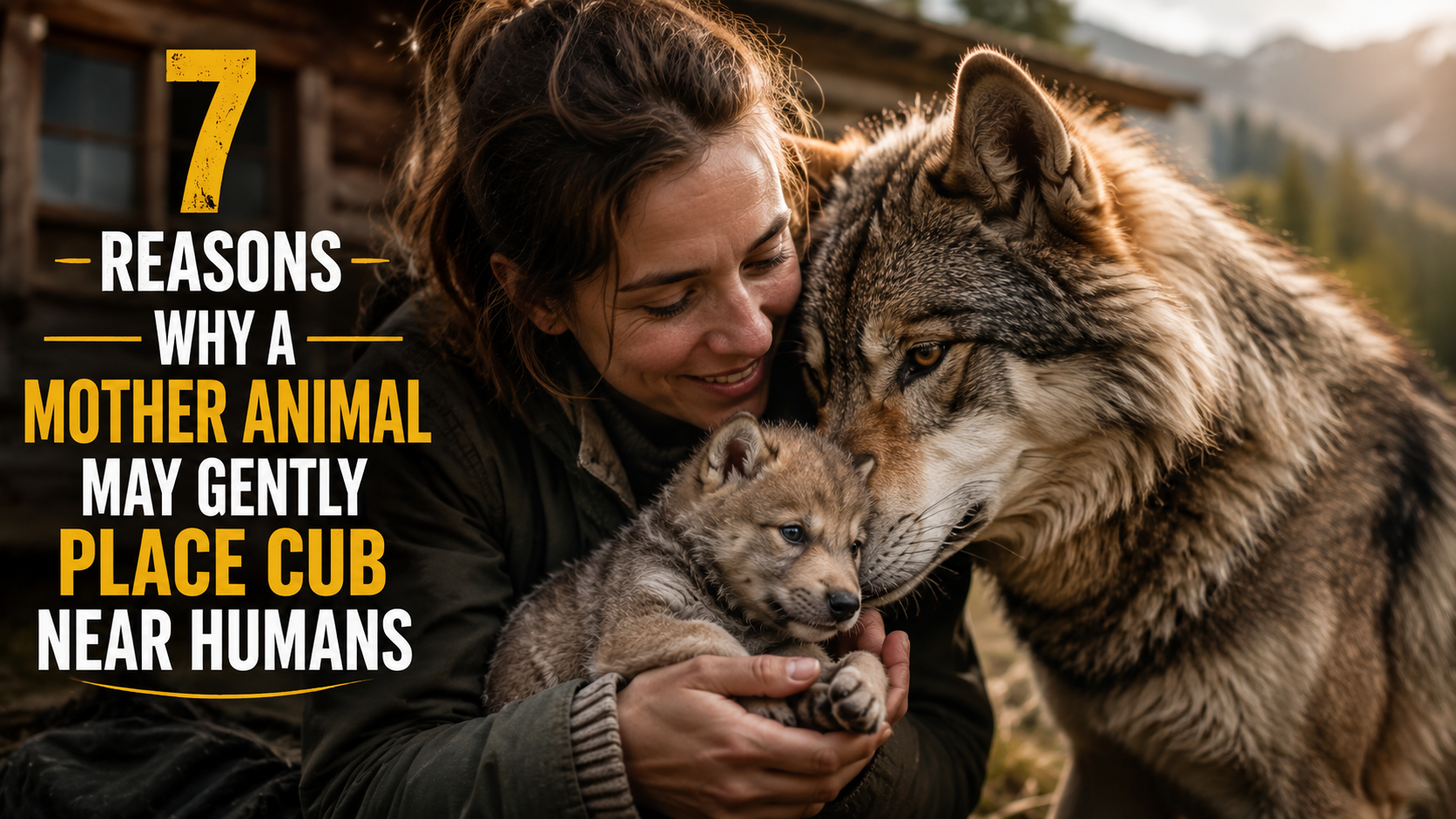
Encounters between wild animals and humans often feel unpredictable, even tense. Most of us are used to seeing animals keep their distance, especially when it comes to mothers protecting their young. In the wild, maternal instincts are typically associated with strong defense, caution, and a clear boundary between “safe” and “unsafe.”
That’s why moments where a mother animal appears to gently place her cub near humans can feel both surprising and deeply emotional. These rare situations often spread quickly online, sparking curiosity and debate about what the behavior really means.
While it’s important not to misinterpret wild behavior through a purely human lens, wildlife experts have observed that such interactions can arise from a variety of natural causes. In most cases, these actions are not about “trusting humans” in a human sense, but rather about instinct, environment, and survival strategy.
Here are seven possible explanations that help make sense of why a mother animal might gently place her cub close to people.
1. She May Be Seeking Safety in a Moment of Stress
One of the most common reasons behind unusual maternal behavior is stress.
Wild animals constantly assess their environment for threats. If a mother feels cornered by predators, harsh conditions, or unexpected disturbances, she may react in ways that seem unusual to human observers.
In rare situations, a human presence might feel less immediately threatening than a predator nearby. This does not mean the animal trusts people, but rather that she is making a rapid survival calculation.
Placing her cub near humans may sometimes be an attempt to temporarily avoid a more dangerous threat or create a distraction while she reassesses the situation.
2. She Could Be Experiencing Confusion or Disorientation
Wildlife behavior is strongly influenced by environmental conditions.
Illness, injury, exhaustion, or exposure to harsh weather can affect a mother’s ability to act normally. In such cases, instinctive decision-making may become less precise.
A disoriented mother may accidentally place her cub in an unusual location or fail to properly guide it back to safety.
While this sounds concerning, it is a natural consequence of survival under stress. In the wild, even small disruptions can significantly alter behavior.
3. Humans May Be Near a Familiar Feeding or Shelter Area
Animals often build mental maps of their surroundings.
If humans are present near an area the mother considers safe—such as a feeding zone, den site, or resting place—the cub may end up close to people simply because both are sharing space.
In these cases, the mother is not intentionally placing the cub near humans. Instead, she is continuing her normal routine while tolerating nearby human presence.
Wild animals sometimes adjust to human activity when it becomes a consistent part of their environment, especially in regions where human expansion overlaps with wildlife territory.
4. She Might Be Testing the Environment
Mother animals are highly protective and cautious, especially when it comes to offspring survival.
In some cases, a mother may appear to “introduce” her cub to a new environment by allowing it to explore while she monitors from a short distance. If humans are nearby, they may unintentionally become part of that environment.
This behavior is not about trust—it is about observation and evaluation.
The mother remains alert, watching closely for any signs of danger. If she senses risk, she will typically intervene immediately.
This controlled exposure helps young animals gradually learn how to navigate the world around them.
5. She May Be Responding to a Perceived Lack of Threat
Not all human encounters are interpreted as dangerous by wildlife.
In some regions, animals that are frequently exposed to humans—especially in conservation areas or reserves—may become habituated to human presence. Habituation does not mean domestication; it simply means reduced fear due to repeated exposure without harm.
A mother animal in such an environment may not see humans as immediate threats.
As a result, she may continue her maternal behavior without changing her natural movement patterns, even if humans are nearby.
This can create the impression that she is placing her cub close to people, when in reality she is simply continuing her routine.
6. She Could Be Attempting to Distract a Threat
In the animal kingdom, distraction is a survival strategy.
Some mother animals may behave in ways that draw attention away from their offspring. By creating confusion or moving unpredictably, they reduce the likelihood of predators focusing on the cub.
If humans are present, they may unintentionally become part of this distraction effect.
The mother’s priority is not interaction—it is survival. Every decision is shaped by instinct aimed at protecting her young.
What appears as “placing the cub near humans” may actually be part of a broader defensive strategy designed to reduce risk.
7. Human Interpretation May Misread Natural Behavior
Perhaps the most important factor to consider is perspective.
Humans naturally interpret animal behavior through emotional and social frameworks familiar to us. We may assign meaning such as trust, intention, or communication where none was intended in a human sense.
Wildlife behavior, however, is primarily driven by instinct, survival, and environmental cues.
A mother animal placing her cub near humans is rarely a deliberate act of communication. More often, it is the result of overlapping space, stress responses, or environmental pressures.
Understanding this distinction is essential for interpreting wildlife encounters responsibly.
The Complexity of Maternal Instinct in the Wild
Maternal care in wild animals is one of nature’s most powerful forces.
From lions and bears to elephants and primates, mothers invest enormous energy in protecting and raising their young. This includes feeding, teaching, guarding, and guiding offspring through dangerous environments.
However, motherhood in the wild is not always calm or predictable. It exists within a constant balance of risk and survival pressure.
Every decision a mother makes is influenced by immediate environmental conditions, available resources, and perceived threats.
This is why behavior that seems unusual to humans can still be entirely logical within an animal’s instinctual framework.
Why Human-Wildlife Encounters Are Becoming More Common
As human populations expand, natural habitats are increasingly overlapping with human settlements.
Deforestation, urban growth, and agricultural development have reduced the space available for wildlife. As a result, animals often travel closer to human environments in search of food, shelter, or territory.
This overlap increases the likelihood of unexpected encounters, including situations where mothers and cubs are seen near people.
In many cases, these encounters are brief and accidental rather than intentional interactions.
Understanding this context helps reduce fear and promotes safer coexistence.
The Role of Conservation Areas and Protected Reserves
In protected wildlife areas, human presence is often controlled but still visible.
Tourists, researchers, and park staff regularly operate within these environments. Wildlife in such areas may become accustomed to observing humans from a distance.
This does not remove their natural instincts, but it does influence their level of caution.
Mother animals in these regions may appear more tolerant of human proximity simply because they have learned that not all human activity poses immediate danger.
However, they remain wild animals, and protective instincts toward cubs remain strong and unpredictable.
Why Cubs Are Especially Vulnerable
Young animals depend entirely on their mothers for survival in early life stages.
Cubs lack the strength, experience, and awareness needed to navigate threats on their own. This makes maternal protection absolutely critical.
Because of this vulnerability, mothers are highly sensitive to environmental changes and potential risks.
Even minor disturbances can influence how they move, hide, or protect their young.
This sensitivity can sometimes result in unexpected behavior, especially in unfamiliar or stressful situations.
How to Respond if You Encounter Wildlife
If anyone encounters a mother animal with her cub in the wild, the safest response is always distance and non-interference.
Wild animals are highly protective, and even unintentional human presence can cause stress.
Experts recommend:
- Keeping a safe distance
- Avoiding sudden movements
- Not attempting to touch or feed animals
- Slowly and calmly leaving the area if possible
- Reporting sightings to local wildlife authorities when appropriate
Respecting space is essential for both human safety and animal well-being.
Final Thoughts
Moments where a mother animal appears to gently place her cub near humans may seem extraordinary, but they are usually rooted in natural instincts rather than intentional behavior toward people.
Whether driven by stress, environmental overlap, habituation, or survival strategy, these actions reflect the complexity of wildlife behavior in a changing world.
Understanding these situations requires careful observation and respect for the realities of life in the wild. Animals do not operate through human logic—they respond to instinct, pressure, and immediate survival needs.
And when we interpret these moments with patience and awareness, we gain a deeper appreciation for the delicate balance between humans and the natural world we continue to share.







