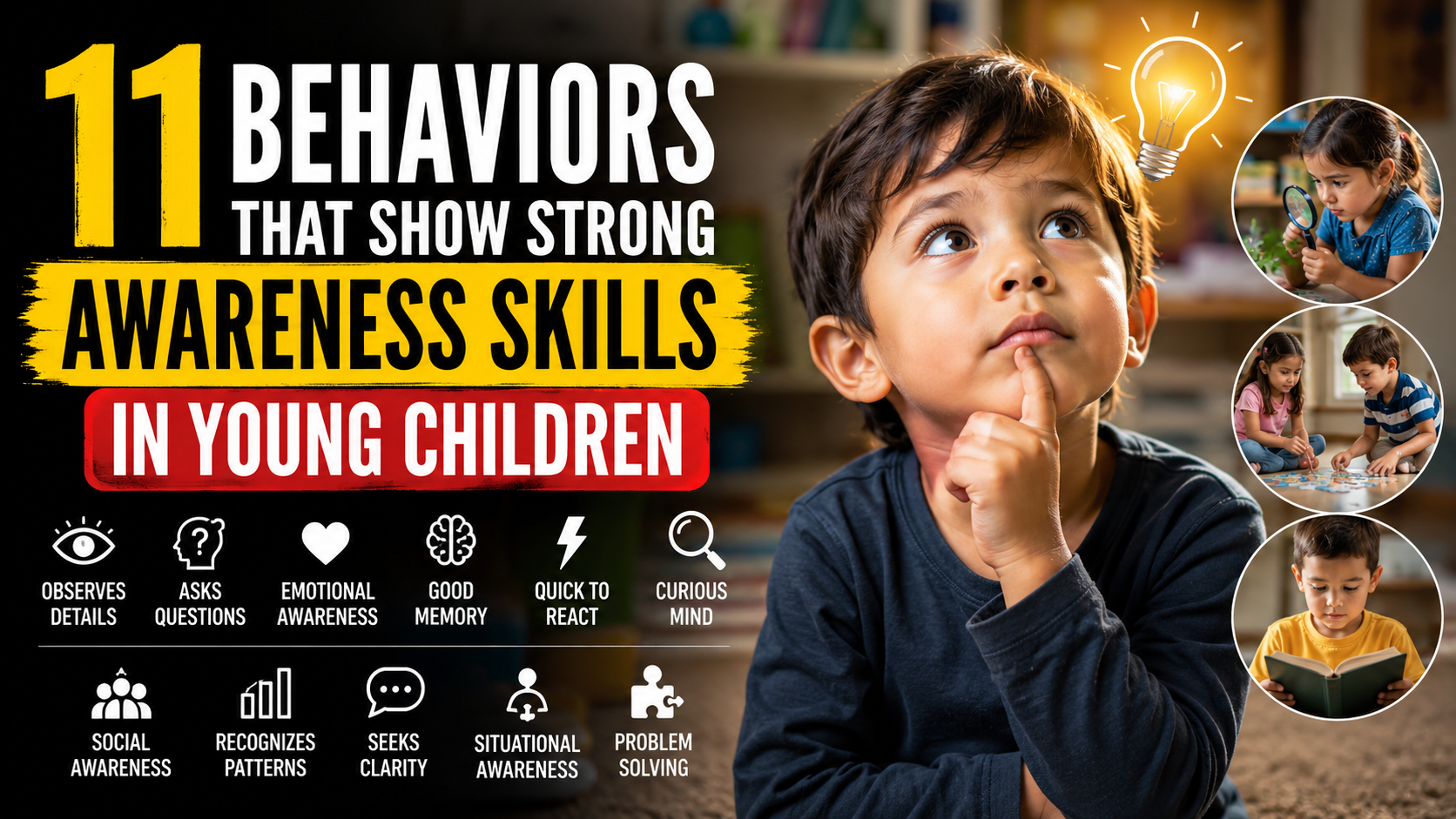
Young children are often more observant than adults expect. While they may not always express their thoughts clearly, many children demonstrate a surprisingly high level of awareness about their surroundings, emotions, and the behavior of others. This awareness is an important part of cognitive and emotional development, shaping how they learn, respond to situations, and interact with the world.
In psychology, “awareness skills” in children refer to their ability to notice details, understand context, recognize patterns, and respond appropriately to changes in their environment. These skills develop gradually through experience, interaction, and learning.
Below are 11 common behaviors that indicate strong awareness skills in young children, along with explanations of what they reveal about a child’s developing mind.
1. Noticing Small Changes in Their Environment
Children with strong awareness skills often pick up on small changes that others might overlook. This could include noticing when furniture is moved, when someone changes their hairstyle, or when a routine is slightly different.
This behavior shows that the child is actively observing their environment and forming mental “maps” of what is normal. When something changes, they immediately recognize the difference.
2. Asking Thoughtful and Unexpected Questions
Curious questioning is a strong sign of awareness. Children who ask questions like “Why did that happen?” or “What happens if…?” are actively trying to understand cause and effect.
These questions often go beyond basic curiosity and show that the child is processing information deeply and trying to connect ideas.
3. Recognizing Emotional Changes in Others
Some children are highly sensitive to emotional shifts in people around them. They may notice when a parent is upset, when a teacher is stressed, or when a friend feels sad—even if no one says anything directly.
This reflects early emotional intelligence and the ability to read non-verbal cues such as tone of voice, facial expressions, and body language.
4. Remembering Details from Past Experiences
Children with strong awareness often have impressive memory recall for events that happened days, weeks, or even months earlier. They may remember conversations, locations, or small details that others forget.
This ability helps them build connections between past experiences and current situations, strengthening learning and understanding.
5. Reacting Quickly to Environmental Changes
Fast reaction to changes is another key indicator of awareness. For example, a child might quickly move away from a loud noise, step aside when something falls, or alert an adult when something seems unusual.
This shows that the child is constantly scanning their environment and responding to potential changes in real time.
6. Showing Interest in How Things Work
Children who are highly aware often show curiosity about systems and processes. They might ask how machines operate, how animals behave, or how everyday objects function.
This interest reflects analytical thinking and a desire to understand the structure behind what they observe.
7. Observing Social Interactions Closely
Many aware children pay close attention to how people interact with each other. They may notice arguments, friendships, or emotional exchanges and try to understand the relationships involved.
This behavior indicates early social awareness and the ability to interpret complex human dynamics.
8. Noticing Patterns and Repetitions
Pattern recognition is a key part of cognitive awareness. Children who notice repeated routines, sounds, or behaviors are developing the ability to predict what might happen next.
For example, they may recognize daily schedules or anticipate events based on repetition, showing strong mental organization skills.
9. Asking for Clarification When Something Feels “Off”
Some children have a strong instinct when something doesn’t feel right. They may ask follow-up questions or seek reassurance when they notice inconsistencies.
This behavior shows that the child is not only observing but also evaluating situations critically, even at a young age.
10. Demonstrating Situational Awareness in Groups
In group settings, aware children often adjust their behavior based on what others are doing. They may wait their turn, step back when needed, or help others without being asked.
This shows that they are processing social cues and adapting their actions accordingly.
11. Showing Early Problem-Solving Skills
One of the strongest signs of awareness is problem-solving. Children may try different approaches when faced with a challenge, such as figuring out how to reach an object, fix a toy, or complete a task.
This reflects not only awareness but also cognitive flexibility—the ability to think through solutions and adjust strategies.
Why Awareness Skills Matter in Early Childhood
Awareness skills are an essential foundation for learning and development. They help children understand their surroundings, build relationships, and make informed decisions as they grow.
These skills are closely linked to:
- Cognitive development
- Emotional intelligence
- Memory formation
- Social understanding
- Problem-solving ability
Children who develop strong awareness early on often find it easier to adapt to new environments and challenges later in life.
How Awareness Skills Develop Over Time
Awareness in children is not fixed—it grows through experience. Interaction with caregivers, exposure to new environments, and opportunities for exploration all contribute to development.
Simple activities like reading, playing, and talking with adults can significantly enhance a child’s observational and analytical abilities.
Supporting Awareness Development in Children
Parents and educators can help strengthen awareness skills by:
- Encouraging curiosity and questions
- Allowing children to explore safely
- Talking about emotions and social situations
- Introducing problem-solving activities
- Observing nature and everyday surroundings together
These practices help children become more attentive, thoughtful, and confident in their understanding of the world.
Final Thoughts
Strong awareness skills in young children are often visible long before they can articulate them. Through behavior such as noticing details, asking questions, and responding to changes, children reveal a growing ability to interpret and understand their environment.
Recognizing these signs helps adults better support a child’s development and nurture their natural curiosity. Rather than overlooking these behaviors as simple childhood curiosity, it is important to see them as early indicators of intelligence, emotional depth, and cognitive growth.
In many ways, awareness is one of the most important building blocks of a child’s future learning and success.







