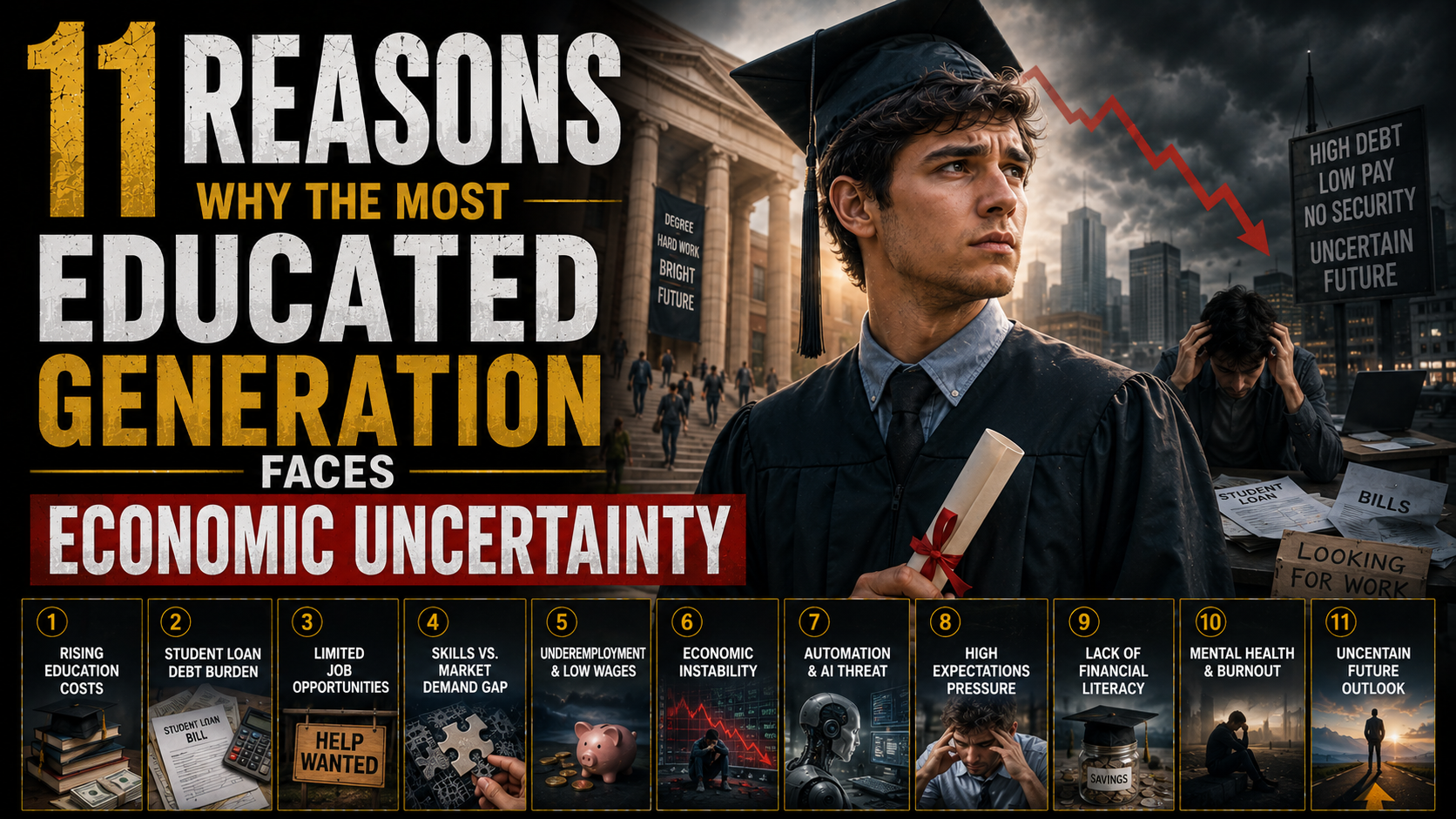
For decades, higher education has been seen as a reliable pathway to financial stability and upward mobility. A college degree was often described as a ticket to better jobs, higher salaries, and long-term security. Yet today’s reality feels more complicated.
Despite being the most educated generation in history, many young adults are facing a growing sense of economic uncertainty. Rising costs, shifting job markets, and structural changes in the global economy have reshaped expectations about what education can deliver.
Here are 11 key reasons why this generation, despite its academic achievements, is navigating an unpredictable financial landscape.
1. Rising Cost of Education Outpaces Wage Growth
One of the most significant challenges is the cost of education itself.
Tuition fees, housing, and student-related expenses have increased dramatically over the past few decades.
Meanwhile, wage growth has not kept pace, making it harder for graduates to recover their investment.
2. Student Loan Debt Creates Long-Term Pressure
Many graduates enter adulthood with substantial debt burdens.
Monthly loan repayments limit financial flexibility and delay major life decisions such as buying a home or starting a business.
This long-term financial pressure contributes to ongoing uncertainty.
3. Job Market Saturation in Popular Fields
As more people earn degrees, competition in certain fields has intensified.
Industries like business, media, and humanities often have more graduates than available positions.
This oversupply makes it harder for individuals to secure stable employment quickly.
4. Rapid Technological Change Disrupts Careers
Technology is transforming industries faster than ever before.
Automation and artificial intelligence are replacing some traditional roles while creating new ones.
However, the transition period creates instability for workers trying to adapt.
5. Skills Mismatch Between Education and Industry Needs
Many employers report a gap between academic training and real-world job requirements.
Graduates may possess theoretical knowledge but lack practical or technical skills needed in modern workplaces.
This mismatch can delay career entry or limit job options.
6. Rise of the Gig Economy
Traditional full-time employment is no longer the only path available.
The gig economy has expanded rapidly, offering flexible but often unstable work opportunities.
While it provides income, it often lacks benefits and long-term security.
7. Inflation Reduces Purchasing Power
Even when graduates secure employment, rising inflation affects their financial stability.
Higher costs for housing, food, transportation, and healthcare reduce disposable income.
This creates the feeling that earnings do not stretch as far as expected.
8. Housing Market Challenges
In many regions, housing prices have increased faster than income levels.
Renting has become expensive, and homeownership feels out of reach for many young adults.
This limits financial independence and long-term planning.
9. Global Economic Instability
Economic uncertainty is no longer limited to local markets.
Global events such as recessions, pandemics, and geopolitical tensions affect job security and investment stability.
This interconnectedness increases unpredictability in career planning.
10. Changing Nature of Career Paths
The idea of a single lifelong career is becoming less common.
Many workers now change jobs or industries multiple times throughout their lives.
While this allows flexibility, it also creates uncertainty about long-term stability.
11. High Expectations Meet Uncertain Outcomes
Modern education systems often promote the idea that success is guaranteed with hard work and academic achievement.
However, real-world outcomes do not always match these expectations.
This gap between expectation and reality contributes to frustration and anxiety among graduates.
The Paradox of Education and Opportunity
The situation today reflects a paradox: more education than ever before, yet less certainty about financial stability.
Education still holds value, but it no longer guarantees a straightforward path to success.
Instead, it serves as one part of a broader and more complex system shaped by economic, technological, and social forces.
Adapting to a New Economic Reality
In response to these challenges, many individuals are rethinking how they approach careers and education.
There is a growing emphasis on lifelong learning, skill diversification, and adaptability.
Rather than relying solely on degrees, people are combining formal education with practical experience and continuous upskilling.
The Role of Resilience and Flexibility
One of the most important traits in today’s economy is adaptability.
Those who can adjust to new industries, technologies, and opportunities are better positioned to navigate uncertainty.
Resilience is becoming just as valuable as academic achievement.
Final Thoughts
The most educated generation in history is not facing a lack of knowledge, but rather a rapidly changing world that challenges traditional assumptions about success.
Economic uncertainty is shaped by multiple interconnected factors—from rising costs and debt to technological disruption and global instability.
While education remains important, it is no longer a guaranteed pathway to security on its own.
Instead, success today increasingly depends on adaptability, continuous learning, and the ability to navigate change with confidence and flexibility.







