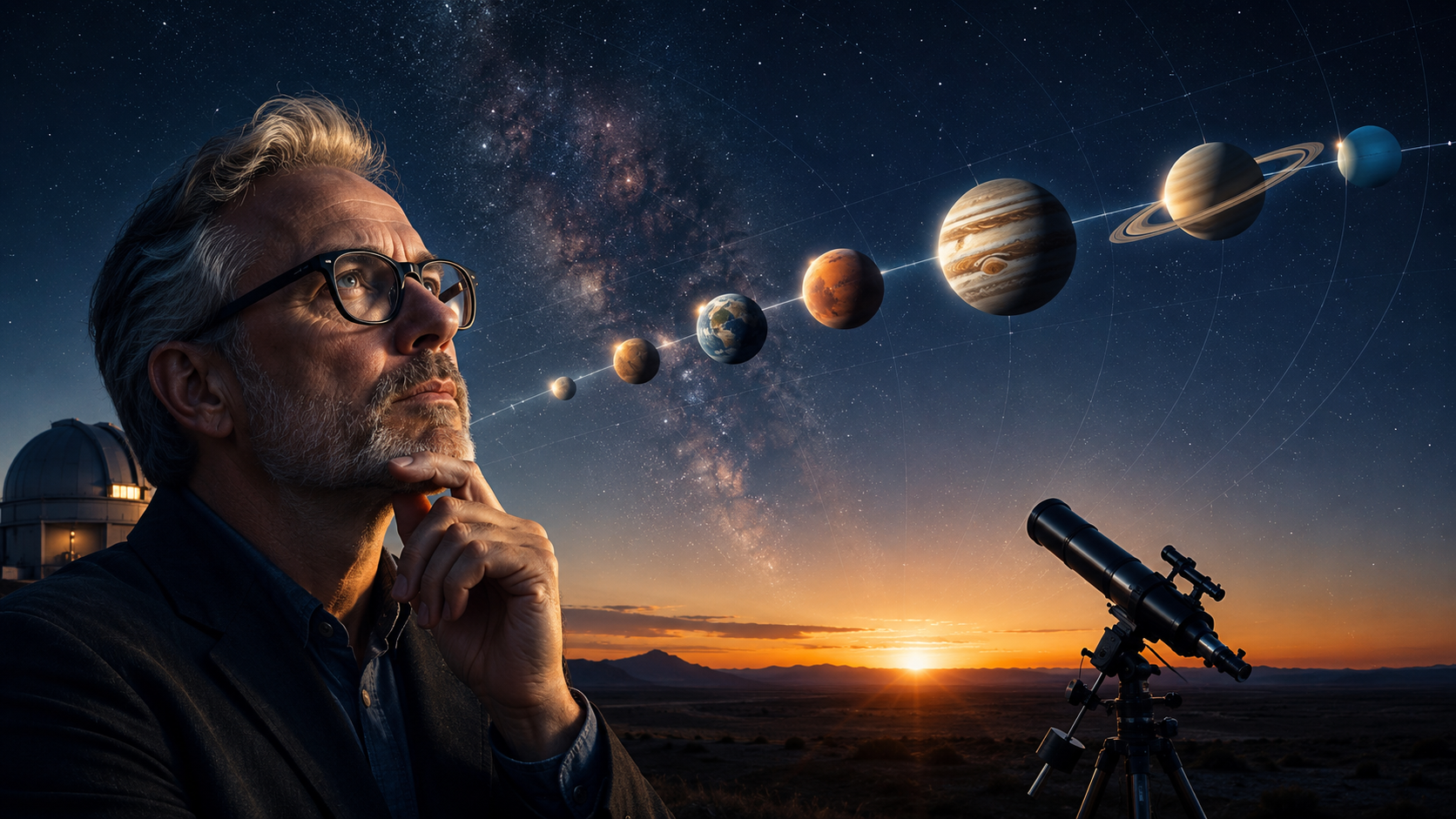
Few astronomical events capture public attention quite like a planetary alignment. Whenever multiple planets appear together in the night sky, headlines often describe the event as rare, spectacular, and not to be missed. One of the most talked-about celestial gatherings in recent years has been the six-planet alignment, an event that brings several worlds of our solar system into roughly the same region of the sky from Earth’s perspective.
While planetary alignments may look extraordinary, astronomers emphasize that there is much more to these events than dramatic photographs and social media excitement. They provide opportunities to learn about the solar system, observe planets that are not always easy to find, and gain a deeper appreciation for the mechanics of planetary motion.
Here are 11 fascinating things experts say about the six-planet alignment and why it continues to generate so much interest among skywatchers.
1. The Planets Are Not Actually Lined Up in Space
One of the most common misconceptions about a planetary alignment is that the planets form a perfectly straight line across the solar system.
In reality, the alignment is largely a matter of perspective. The planets continue to orbit the Sun at vastly different distances and positions. From Earth, however, they appear clustered along a similar path in the sky.
Astronomers explain that this visual effect occurs because all major planets orbit the Sun on roughly the same plane, known as the ecliptic plane.
The result is an impressive sight, even though the planets remain separated by hundreds of millions—or even billions—of miles.
2. These Events Showcase the Solar System’s Architecture
Experts often view planetary alignments as natural demonstrations of how the solar system is organized.
Because the planets orbit within a relatively flat disk-shaped region, they tend to appear along a common path across the sky. Alignments help observers visualize this structure in a way that textbooks and diagrams cannot fully capture.
For many people, seeing multiple planets together creates a stronger understanding of our place within the larger solar system.
3. They Are Rare—but Not Once-in-a-Lifetime Rare
Planetary alignments are often described as extremely rare, but astronomers point out that the details matter.
A six-planet alignment is certainly noteworthy, yet different types of planetary gatherings occur with varying frequency. Some involve only a few planets, while others include many more.
The exact arrangement, visibility conditions, and timing determine how unusual a particular event may be.
While some alignments may not repeat for years, the solar system regularly produces new celestial configurations for future generations to enjoy.
4. Visibility Depends on Location and Timing
Experts stress that not everyone sees the same alignment under identical conditions.
Factors such as latitude, local weather, light pollution, and the time of observation can dramatically affect visibility. In some locations, all six planets may be visible. In others, certain planets may sit too low on the horizon or become obscured by atmospheric conditions.
Careful planning often improves the viewing experience.
Checking local astronomical forecasts and finding a dark observing site can make a significant difference.
5. Some Planets Are Easier to Spot Than Others
Not all planets shine equally brightly in the night sky.
Planets such as Venus and Jupiter often stand out immediately because of their brightness. Others, including Saturn or Mars, may require a bit more attention to identify.
The more distant planets can be particularly challenging. In some cases, binoculars or telescopes may help observers distinguish them from surrounding stars.
Experts recommend learning the basic appearance of each planet before heading outside to observe an alignment.
6. Alignments Inspire Public Interest in Astronomy
Astronomers frequently note that planetary alignments serve as excellent gateways into science.
People who rarely pay attention to astronomy often become curious when they hear about a special celestial event. That curiosity can lead to broader interest in planetary science, space exploration, and the workings of the universe.
Many astronomy clubs report increased participation during major alignments as newcomers seek opportunities to learn more about the night sky.
In this way, alignments help connect scientific knowledge with public fascination.
7. The Event Highlights Planetary Motion
One reason experts find alignments so valuable educationally is that they reveal the constant movement of the planets.
Unlike stars, which maintain relatively fixed positions over short timescales, planets slowly shift against the background sky as they orbit the Sun.
Observing a six-planet alignment over several days or weeks allows people to witness these changes firsthand. The planets gradually drift into new positions, reminding observers that the solar system is dynamic rather than static.
8. Ancient Civilizations Watched Similar Events
Long before modern telescopes existed, ancient skywatchers paid close attention to planetary groupings.
Many civilizations tracked the movements of visible planets and incorporated them into calendars, navigation systems, religious traditions, and cultural stories.
Experts often point out that modern observers share a connection with generations of people who looked skyward and marveled at the same celestial motions.
The six-planet alignment continues a tradition of observation that stretches back thousands of years.
9. No Scientific Evidence Supports Extraordinary Claims
Whenever planetary alignments occur, unusual claims sometimes circulate online.
Astronomers emphasize that there is no credible evidence suggesting planetary alignments trigger natural disasters, major geological events, or dramatic changes in human behavior.
The gravitational influence of distant planets on Earth is extremely small compared to the effects of the Moon and the Sun.
Experts encourage people to appreciate alignments for what they truly are: fascinating astronomical events rather than sources of supernatural influence.
10. Photography Has Made Alignments More Accessible
Modern cameras and smartphones have transformed the way people experience astronomical events.
Experienced astrophotographers can capture stunning images showing multiple planets against colorful twilight skies. These photographs often reveal details that may be difficult to notice with the naked eye.
Experts note that photography allows people to preserve and share their observations, inspiring others to explore the night sky as well.
The popularity of alignment photos has helped introduce astronomy to entirely new audiences.
11. They Remind Us of the Scale of the Universe
Perhaps the most important observation experts make about planetary alignments is the sense of perspective they provide.
Looking at several planets at once can be a powerful reminder of how vast the solar system truly is. Each bright point represents an entire world with its own history, environment, and unique characteristics.
Some are rocky planets. Others are giant worlds surrounded by dozens of moons. Yet from Earth, they appear together in a single sweep of sky.
That contrast between apparent closeness and actual distance helps convey the immense scale of the cosmos.
Why Planetary Alignments Happen
Planetary alignments occur because all major planets orbit the Sun within roughly the same plane.
As the planets travel at different speeds and distances, their positions constantly change. Occasionally, their apparent locations from Earth’s perspective place them within a relatively narrow section of the sky.
This creates the visual impression of an alignment.
Although perfect alignments are extraordinarily unlikely, partial alignments involving multiple planets occur naturally as part of the solar system’s ongoing motion.
The Best Ways to Observe an Alignment
Experts often recommend a few simple strategies for getting the most out of a planetary alignment:
Find a Dark Location
Artificial lighting can wash out fainter planets. Rural locations generally offer the best viewing conditions.
Check the Weather
Clear skies are essential for successful observation. Even thin cloud cover can obscure planets near the horizon.
Use Astronomy Apps
Modern sky-mapping applications can help identify each planet and track its position.
Bring Binoculars
While many planets are visible without equipment, binoculars can enhance the experience and make identification easier.
Arrive Early
Some planets may only be visible during specific windows around sunrise or sunset.
What Makes Six-Planet Alignments Special?
While smaller planetary groupings occur relatively often, six-planet alignments attract attention because they bring together a large portion of the solar system’s major planets in a single viewing opportunity.
For observers, the event combines scientific significance with visual beauty. It offers a chance to locate multiple planets, learn about their movements, and appreciate the orderly mechanics governing our solar neighborhood.
The sight of several worlds sharing the same sky can be both educational and inspiring.
Final Thoughts
The six-planet alignment is much more than a visually impressive sky event. It serves as a reminder of the elegant motions that govern the solar system and provides a unique opportunity to observe several neighboring worlds at once.
From demonstrating the structure of planetary orbits to inspiring curiosity about astronomy, these celestial gatherings continue to capture the imagination of people around the globe. Experts emphasize that while alignments may not carry mystical significance, they offer something equally valuable: a chance to connect with the universe through observation, discovery, and wonder.
The next time a planetary alignment appears overhead, take a moment to look up. You won’t just be seeing bright points of light—you’ll be witnessing the ongoing dance of worlds that has unfolded for billions of years.







