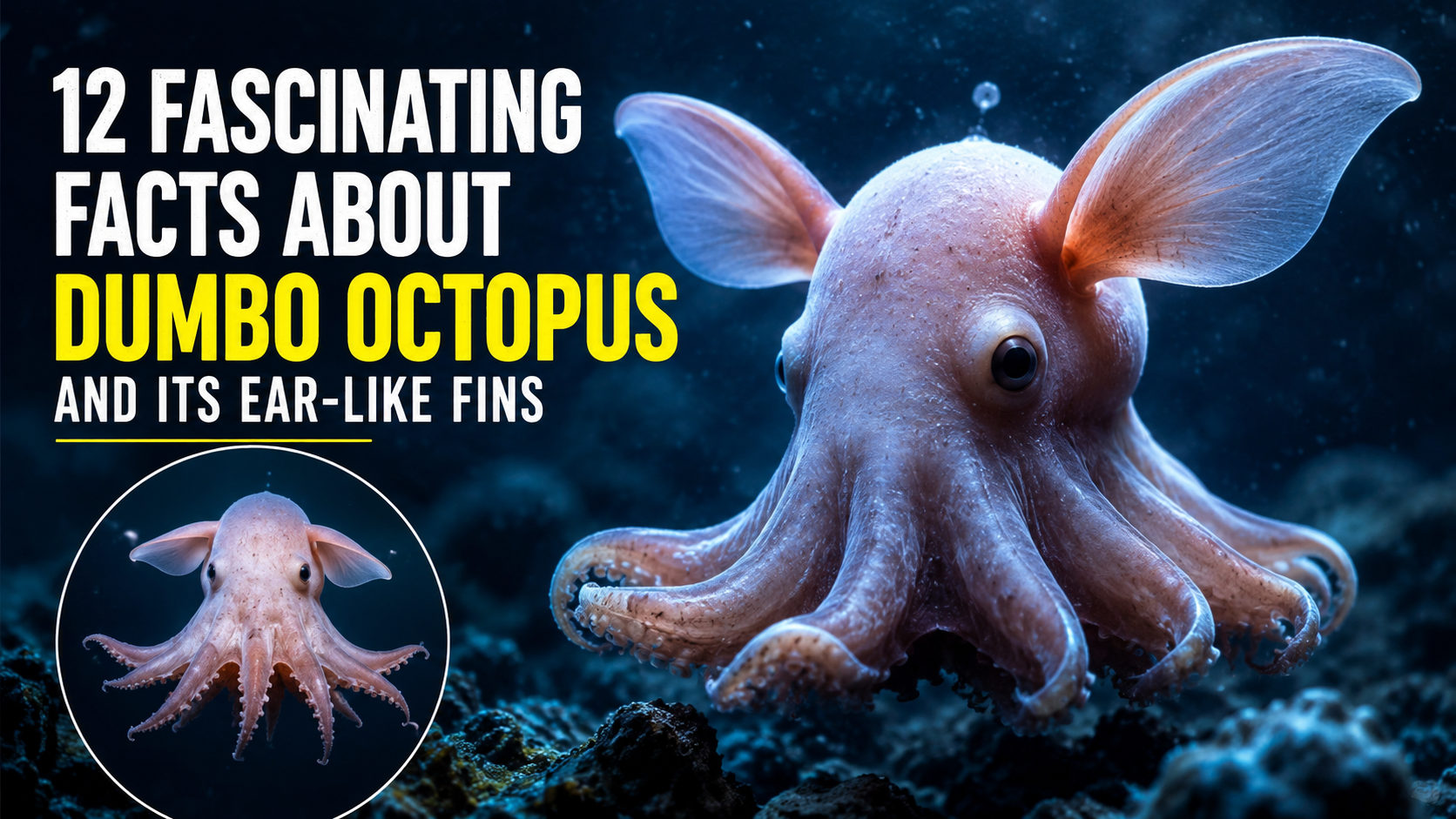
The deep ocean is home to some of the most unusual creatures on Earth, but few are as charming and mysterious as the Dumbo octopus. With its rounded body and distinctive ear-like fins, this remarkable animal looks like something from a fantasy film rather than a real marine species.
Its nickname comes from its resemblance to the famous elephant character, whose oversized ears made him instantly recognizable. Yet beyond its adorable appearance lies an extraordinary deep-sea survivor perfectly adapted to one of the harshest environments on the planet.
Living in near-total darkness under immense water pressure, the Dumbo octopus remains one of the ocean’s most fascinating and least-understood inhabitants. Here are twelve incredible facts about the deep-sea Dumbo octopus and its famous ear-like fins.
1. It Gets Its Name From a Fictional Elephant
The Dumbo octopus earned its nickname because of its large fins that resemble the ears of the beloved cartoon elephant, Dumbo.
These fins extend from the sides of its mantle and give the animal an appearance unlike that of any other octopus. The name may sound playful, but the creature itself is a highly specialized marine predator.
2. It Lives in Some of the Deepest Parts of the Ocean
Dumbo octopuses inhabit extremely deep waters, often living thousands of meters below the ocean’s surface.
At these depths, sunlight never reaches the seafloor. The environment is cold, dark, and subjected to crushing pressure that would be impossible for humans to survive without specialized equipment.
This makes the Dumbo octopus one of the deepest-living groups of octopuses known to science.
3. Its Ear-Like Fins Are Used for Swimming
Despite looking like ears, the fins are actually powerful tools for movement.
The Dumbo octopus gently flaps these fins to propel itself through the water. This graceful method of swimming allows it to move efficiently while conserving energy in an environment where food can be scarce.
Watching a Dumbo octopus glide through the water often resembles watching a tiny underwater creature fly.
4. It Also Uses Its Arms to Steer
The fins are not the octopus’s only means of movement.
Its eight arms and webbed membranes can change shape and assist with steering, hovering, and making subtle adjustments while swimming. By combining fin movements with arm motions, the animal can navigate the deep ocean with remarkable precision.
This flexibility makes it an elegant and highly efficient swimmer.
5. There Are Multiple Species of Dumbo Octopus
The term “Dumbo octopus” does not refer to just one species.
Instead, it describes a group of deep-sea octopuses belonging to the genus Grimpoteuthis. Scientists have identified several species, each with slight differences in size, coloration, and habitat preferences.
Because these animals inhabit remote regions of the ocean, researchers continue learning new information about them.
6. It Lives Under Enormous Pressure
The environment inhabited by the Dumbo octopus is one of the most extreme on Earth.
At such depths, water pressure can be hundreds of times greater than atmospheric pressure at sea level. Most surface-dwelling animals could not survive these conditions.
The Dumbo octopus possesses specialized biological adaptations that allow its body to function normally under immense pressure.
7. It Has No Ink Sac
Unlike many familiar octopuses, the Dumbo octopus does not produce defensive ink.
Scientists believe that because it lives in the deep ocean, where predators and encounters are less frequent and escape strategies differ, the ability to release ink became unnecessary over evolutionary time.
This absence illustrates how species evolve traits that match their specific environments.
8. It Eats a Variety of Small Deep-Sea Creatures
The Dumbo octopus is an active predator.
Its diet includes small crustaceans, worms, and tiny marine organisms that inhabit the deep ocean floor. Rather than tearing apart its prey, the Dumbo octopus often swallows smaller animals whole.
Its feeding habits are perfectly suited to the limited food resources available in deep-sea ecosystems.
9. It Has One of the Most Unusual Reproductive Strategies Among Octopuses
Many octopus species reproduce during a specific breeding season. The Dumbo octopus appears to follow a different approach.
Researchers believe females may carry eggs at various stages of development simultaneously. This could allow them to reproduce whenever environmental conditions become favorable rather than being restricted to one season.
Such flexibility may improve reproductive success in the unpredictable deep-sea environment.
10. Their Appearance Has Captivated Scientists and the Public
Despite living in remote regions rarely seen by humans, the Dumbo octopus has become one of the ocean’s most beloved creatures.
Photographs and video footage of these animals often inspire fascination because they seem both alien and endearing at the same time. Their graceful movements and unusual appearance have made them icons of deep-sea biodiversity.
They remind us that some of Earth’s most extraordinary creatures live far beyond everyday experience.
11. They Are Difficult to Study
The Dumbo octopus remains one of marine biology’s great mysteries.
Because these animals live at extreme depths, scientists rely on remotely operated vehicles and specialized submersibles to observe them. Such expeditions are complex, expensive, and relatively rare.
As a result, many aspects of their behavior, population sizes, and life cycles remain poorly understood.
12. They Demonstrate How Extraordinary Evolution Can Be
Perhaps the most fascinating thing about the Dumbo octopus is how perfectly it is adapted to its environment.
Its ear-like fins, pressure-resistant body, efficient swimming style, and unusual reproductive strategies all illustrate the remarkable power of evolution. Over millions of years, natural selection shaped this creature into a specialist capable of thriving in one of Earth’s most extreme habitats.
The Dumbo octopus stands as a living example of nature’s creativity and adaptability.
Why the Dumbo Octopus Matters
The deep ocean covers most of our planet, yet it remains one of the least explored environments on Earth. Every species discovered there provides valuable clues about life’s ability to adapt to extraordinary conditions.
The Dumbo octopus is especially important because it demonstrates that even the harshest environments can support highly specialized and beautiful creatures. Its existence challenges assumptions about where life can flourish and reminds us that biodiversity extends far beyond familiar ecosystems.
Studying deep-sea animals like the Dumbo octopus also improves our understanding of evolution, marine ecology, and the delicate balance that sustains life in the ocean.
A Tiny Ambassador of the Deep Sea
The deep-sea Dumbo octopus may look like a character from an animated film, but it is a real and remarkable animal that has mastered survival in the dark depths of the ocean.
Its distinctive ear-like fins, graceful swimming style, and extraordinary adaptations have made it one of the most captivating creatures ever discovered beneath the waves.
Perhaps its greatest lesson is that the natural world still contains countless wonders waiting to be explored. Hidden thousands of meters below the surface, the Dumbo octopus reminds us that some of Earth’s most fascinating mysteries exist in places we are only beginning to understand.







