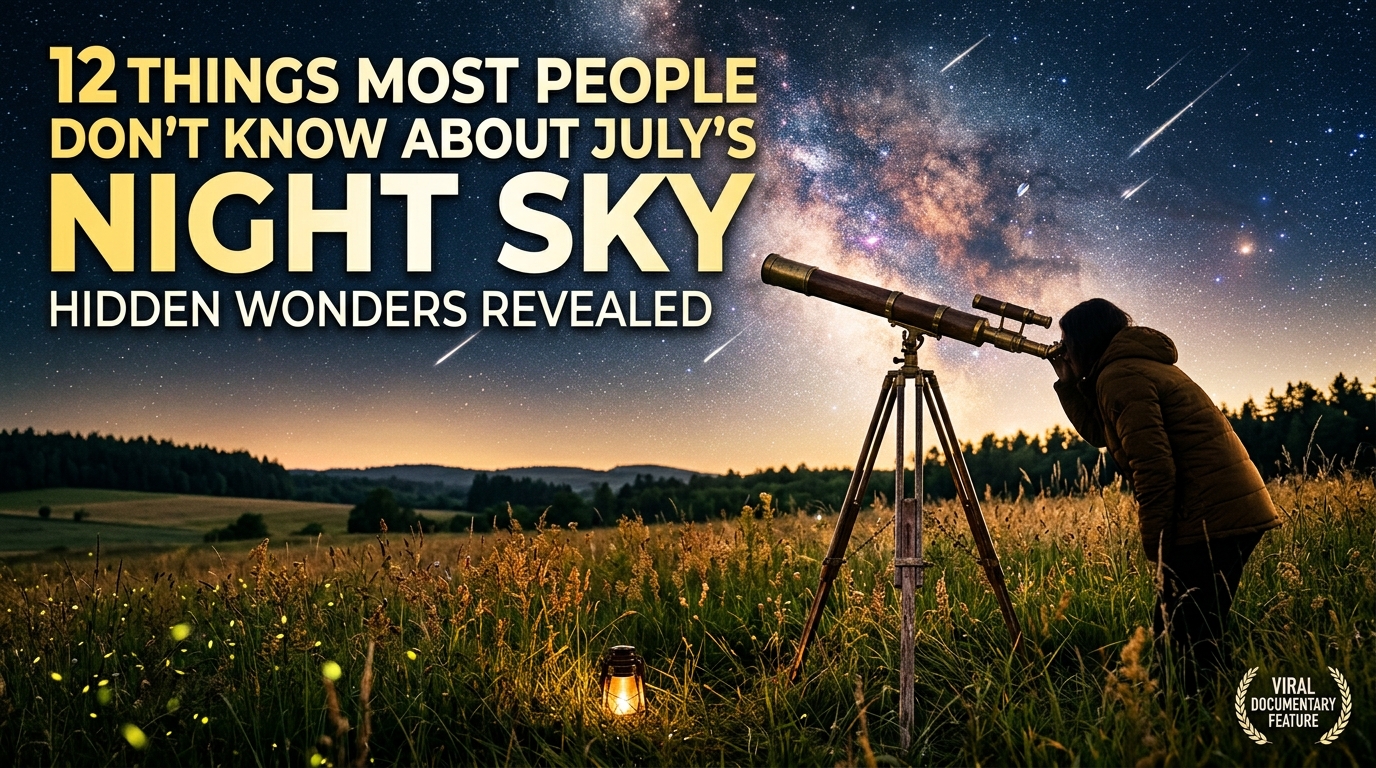
July is one of the most rewarding months for anyone who enjoys looking up at the stars. Warm evenings, comfortable temperatures, and a variety of celestial events make it an ideal time for skywatching. While many people notice a bright planet or an occasional shooting star, there is far more happening overhead than most realize.
From dazzling meteor showers and glowing planets to the heart of the Milky Way shining across the darkness, July’s night sky offers a remarkable display of astronomical wonders. Whether you’re an experienced observer or simply curious about what appears above after sunset, understanding the hidden details of the July sky can make every evening more fascinating.
Here are 12 things most people don’t know about July’s night sky.
1. July Offers Some of the Best Milky Way Views of the Year
For observers in the Northern Hemisphere, July is one of the prime months for viewing the Milky Way.
During dark, moonless nights, the bright central region of our galaxy becomes especially prominent. This dense area contains countless stars, star clusters, and nebulae packed into the galactic core.
Away from city lights, the Milky Way can appear as a luminous river stretching across the sky.
2. The Brightest Part of the Galaxy Is Visible in Summer
Many people don’t realize that the most spectacular portion of the Milky Way is located toward the constellation Sagittarius.
In July, this region rises high enough for excellent viewing during the evening hours. When seen from a dark location, the galactic center appears richer, brighter, and more detailed than most other sections of the Milky Way.
It is one of the most impressive sights available to naked-eye observers.
3. July Marks the Start of Peak Meteor Season
Although August often receives more attention because of the Perseids, July serves as the unofficial beginning of the year’s busiest meteor season.
Several meteor showers become active during the month, including the Southern Delta Aquariids. At the same time, the first meteors from the upcoming Perseid shower begin appearing.
Dedicated skywatchers often spend July preparing for weeks of increased meteor activity.
4. Shooting Stars Are Usually Tiny Particles
When people see a bright meteor streaking overhead, they often imagine a large rock burning through the atmosphere.
In reality, many meteors are produced by particles no larger than grains of sand. These tiny fragments enter Earth’s atmosphere at tremendous speeds, creating brilliant flashes of light as they vaporize.
Despite their small size, they can create surprisingly dramatic displays.
5. Jupiter Often Dominates the Night Sky
Depending on its position during a given year, Jupiter can become one of the brightest objects visible in July.
Its steady glow makes it easy to distinguish from stars, which typically twinkle more noticeably. Through binoculars or a small telescope, observers can often see several of Jupiter’s largest moons.
These moons change position from night to night, offering a dynamic celestial show.
6. Saturn’s Rings Can Be Seen With Modest Telescopes
One of astronomy’s most memorable experiences is seeing Saturn’s rings for the first time.
During favorable viewing periods in July, even a relatively small telescope can reveal the planet’s iconic ring system. The sight often exceeds expectations and remains a favorite among amateur astronomers.
Few celestial objects inspire as much awe as Saturn.
7. The Moon Changes the Sky More Than People Realize
The Moon’s phase has a major influence on what can be seen at night.
A bright full moon can wash out faint stars, nebulae, and portions of the Milky Way. Conversely, nights near the new moon provide much darker skies and dramatically better visibility for deep-sky objects.
Experienced observers often plan viewing sessions around the lunar cycle.
8. Summer Constellations Fill the Evening Sky
July brings several famous constellations into excellent viewing positions.
Among the most recognizable are Cygnus, Lyra, Scorpius, and Sagittarius. Together, these constellations form part of the rich star fields that dominate summer evenings.
Learning to identify these patterns can make skywatching much more enjoyable.
9. The Summer Triangle Is Easy to Spot
One of July’s most famous asterisms is the Summer Triangle.
Formed by the bright stars Vega, Deneb, and Altair, the Summer Triangle serves as a useful guide for navigating the night sky.
Once located, it can help observers identify several nearby constellations and celestial objects.
10. You Can See Thousands of Stars Under Dark Skies
Most people living in cities see only a fraction of the stars visible from truly dark locations.
Under ideal conditions, the human eye can detect several thousand stars across the night sky. Light pollution dramatically reduces that number, often hiding much of the universe from view.
A trip to a rural area can reveal a completely different sky than many people are accustomed to seeing.
11. The Night Sky Changes Every Night
Many people assume the stars remain fixed in place, but the sky is constantly changing.
The Moon shifts position daily, planets slowly move against the background stars, and constellations rise and set throughout the night. Even observing at the same time each evening reveals subtle changes from one night to the next.
This motion reflects the dynamic nature of Earth’s orbit and the solar system itself.
12. You’re Looking Into Deep Time
One of the most profound facts about July’s night sky is that you’re seeing the past.
Light takes time to travel through space. The stars visible overhead are seen as they existed years, decades, or even hundreds of years ago. Some objects visible through telescopes are observed as they appeared millions of years in the past.
Every glance upward is also a glimpse backward through time.
Why July Is a Special Month for Stargazing
July combines comfortable weather with some of the year’s richest celestial scenery. The Milky Way is prominently displayed, bright planets often decorate the sky, and meteor activity begins to increase. These factors make it one of the best months for both casual observers and serious astronomy enthusiasts.
Unlike many hobbies, skywatching requires little equipment. Some of the most impressive sights—including meteor showers, planetary conjunctions, and the Milky Way itself—can be enjoyed with nothing more than your eyes and a clear night.
Conclusion
July’s night sky is filled with wonders that many people overlook. From the glowing band of the Milky Way and the beauty of Saturn’s rings to the first meteors of the season and the timeless patterns of summer constellations, the month offers countless opportunities for discovery.
The next time a clear July evening arrives, take a few minutes to step outside and look up. You may find that the sky is far more active, beautiful, and fascinating than you ever imagined. Above you lies a constantly changing cosmic landscape waiting to be explored.







