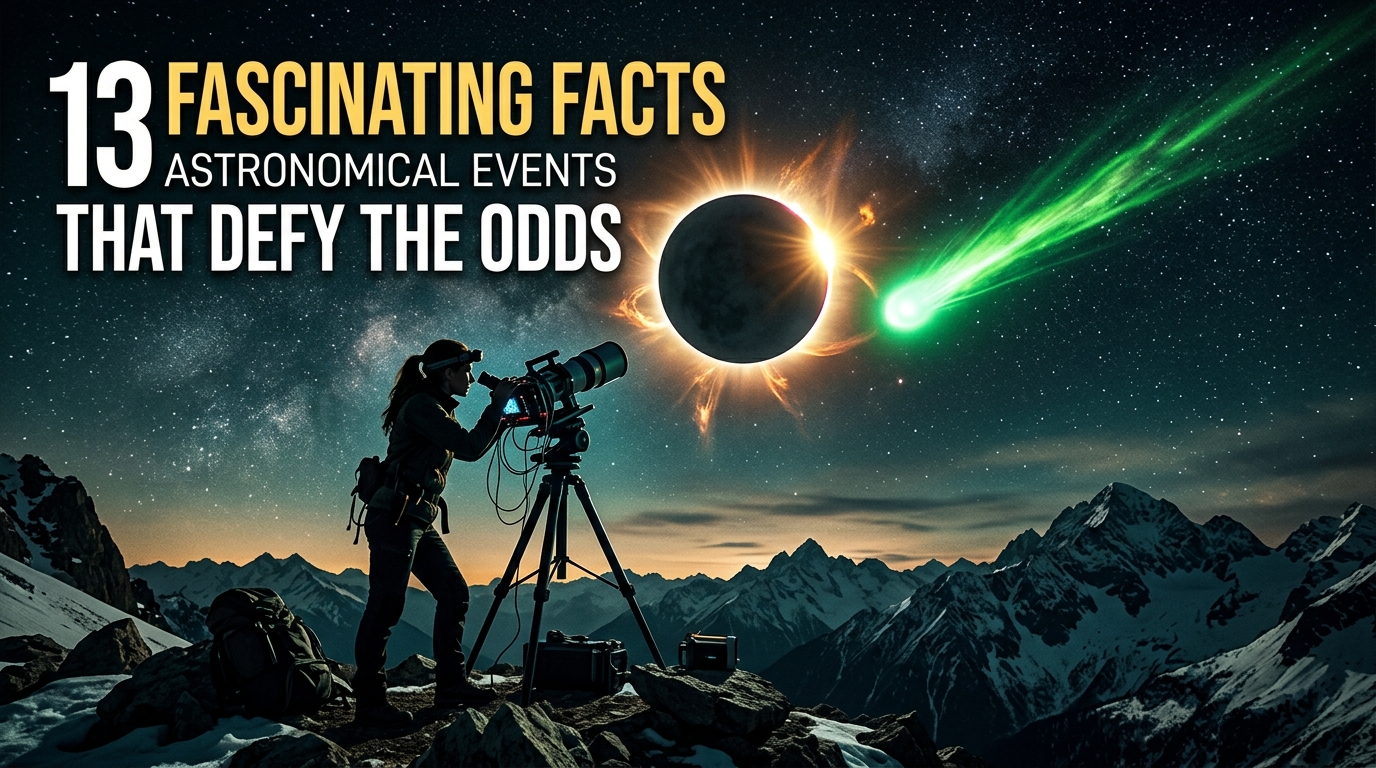
The universe is governed by the laws of physics, yet it continually produces events so rare, extreme, and astonishing that they seem almost impossible. From stars colliding in deep space to planets aligning in ways that captivate skywatchers, some astronomical phenomena occur under such extraordinary circumstances that they appear to defy the odds.
While these events can often be explained through science, their rarity and scale make them some of the most fascinating occurrences in the cosmos. Studying them helps astronomers better understand how the universe works and reveals just how dynamic and unpredictable space can be.
Here are 13 fascinating facts about astronomical events that seem to defy the odds.
1. Total Solar Eclipses Are an Extraordinary Cosmic Coincidence
One of the most remarkable astronomical events visible from Earth is a total solar eclipse.
The Moon is about 400 times smaller than the Sun, but it is also roughly 400 times closer to Earth. This incredible coincidence allows the Moon to appear almost exactly the same size as the Sun in our sky.
As a result, the Moon can perfectly cover the Sun’s bright disk during a total solar eclipse, creating one of nature’s most breathtaking spectacles.
2. Neutron Star Collisions Are Among the Rarest Explosions in Space
Neutron stars are the incredibly dense remnants of massive stars that exploded as supernovae.
When two neutron stars orbit each other for millions or billions of years and eventually collide, the result is a powerful event known as a kilonova. These rare collisions release enormous amounts of energy and are believed to create many of the universe’s heaviest elements, including gold and platinum.
Astronomers consider such mergers among the most extraordinary events ever observed.
3. Some Stars Survive What Should Destroy Them
Supernova explosions are typically thought of as the violent deaths of stars.
However, astronomers have discovered unusual cases where stars experience massive eruptions that resemble supernovae but survive the event. These so-called “supernova impostors” challenge traditional assumptions about stellar evolution and demonstrate that stars can sometimes behave in unexpected ways.
The universe often proves more creative than scientists anticipate.
4. Rogue Planets Wander Through Space Alone
Most planets orbit stars, but not all.
Astronomers have found evidence that some planets travel through the galaxy without orbiting any star at all. These rogue planets may have been ejected from their original planetary systems through gravitational interactions.
The idea of an isolated world drifting through interstellar darkness sounds like science fiction, yet it appears to be a genuine cosmic phenomenon.
5. Black Holes Can Collide Across Billions of Light-Years
For decades, black hole mergers were purely theoretical.
Today, observatories can detect gravitational waves generated when two black holes collide. These ripples in space-time travel across vast cosmic distances before reaching Earth.
The fact that scientists can detect signals from events occurring billions of light-years away is one of the most impressive achievements in modern astronomy.
6. Some Meteorites Are Older Than Earth
Not all astronomical wonders happen far away.
Researchers have discovered ancient mineral grains within certain meteorites that predate the formation of our solar system. These particles originated in stars that existed before the Sun was born.
Holding such a meteorite means touching material that formed before Earth even existed.
7. Planetary Alignments Are More Complex Than They Appear
When multiple planets appear lined up in the sky, many people imagine them forming a perfect straight line in space.
In reality, planetary alignments are largely a matter of perspective. The planets remain separated by enormous distances but appear grouped together from Earth’s viewpoint.
Even so, seeing several planets gathered in one region of the sky remains a striking and relatively uncommon sight.
8. Some Stars Orbit Black Holes at Incredible Speeds
Near the centers of galaxies, stars can orbit supermassive black holes at astonishing velocities.
In our own galaxy, astronomers have tracked stars completing orbits around the central black hole in just a few years. Their motion provides valuable evidence for the existence and mass of these invisible cosmic giants.
Such extreme environments push the limits of known physics.
9. Fast Radio Bursts Remain One of Astronomy’s Greatest Mysteries
Fast radio bursts, or FRBs, are incredibly brief but powerful pulses of radio energy arriving from distant galaxies.
Most last only milliseconds, yet they can release tremendous amounts of energy. Although scientists have identified several possible sources, the exact origins of many FRBs remain uncertain.
Their sudden appearance and immense power continue to intrigue researchers worldwide.
10. Some Galaxies Grow Through Cosmic Collisions
Galaxies may appear stable and permanent, but many are shaped by collisions and mergers.
When galaxies interact, stars, gas, and dark matter can become dramatically rearranged. Over billions of years, these encounters help create larger and more complex galactic structures.
Even our own Milky Way is expected to merge with the nearby Andromeda Galaxy several billion years from now.
11. The Northern and Southern Lights Depend on Solar Activity
The beautiful auroras seen near Earth’s polar regions result from interactions between charged particles from the Sun and Earth’s magnetic field.
Although auroras occur regularly, especially during periods of heightened solar activity, strong geomagnetic storms can produce displays visible much farther from the poles than usual.
When this happens, millions of people may witness an event that seems almost magical.
12. Gravitational Lensing Can Create Cosmic Illusions
Massive objects such as galaxies and galaxy clusters can bend light through gravity.
This effect, known as gravitational lensing, can magnify distant objects, create multiple images of the same galaxy, or distort their appearance into arcs and rings.
What appears to be several objects in the sky may actually be different views of a single distant source.
13. The Universe Continues to Surprise Astronomers
Perhaps the most fascinating fact of all is that unexpected discoveries happen regularly.
New telescopes, observatories, and space missions continue to reveal objects and events that challenge existing theories. From mysterious signals and unusual planets to previously unknown types of cosmic explosions, the universe repeatedly demonstrates that there is still much left to learn.
Each new discovery reminds us that the cosmos is far more complex and astonishing than we once believed.
Why Rare Astronomical Events Matter
Unusual astronomical events do more than capture our imagination. They provide scientists with opportunities to test theories, study extreme environments, and gain insights into the fundamental workings of the universe.
Many breakthroughs in astronomy have come from investigating rare or unexpected phenomena. These events often reveal new information about gravity, matter, energy, and the evolution of stars and galaxies.
By studying the exceptions, researchers can better understand the rules that govern the cosmos.
Conclusion
The universe is filled with events that seem almost too extraordinary to be real. From total solar eclipses and neutron star collisions to rogue planets and mysterious radio bursts, these phenomena showcase the incredible diversity and complexity of the cosmos.
Although science can explain many of these occurrences, their rarity and scale continue to inspire wonder. They remind us that the universe is not a static place but a dynamic and ever-changing arena where remarkable events unfold every day.
As astronomical technology continues to improve, future discoveries will likely reveal even more phenomena that appear to defy the odds—expanding our understanding of the universe and our place within it.







