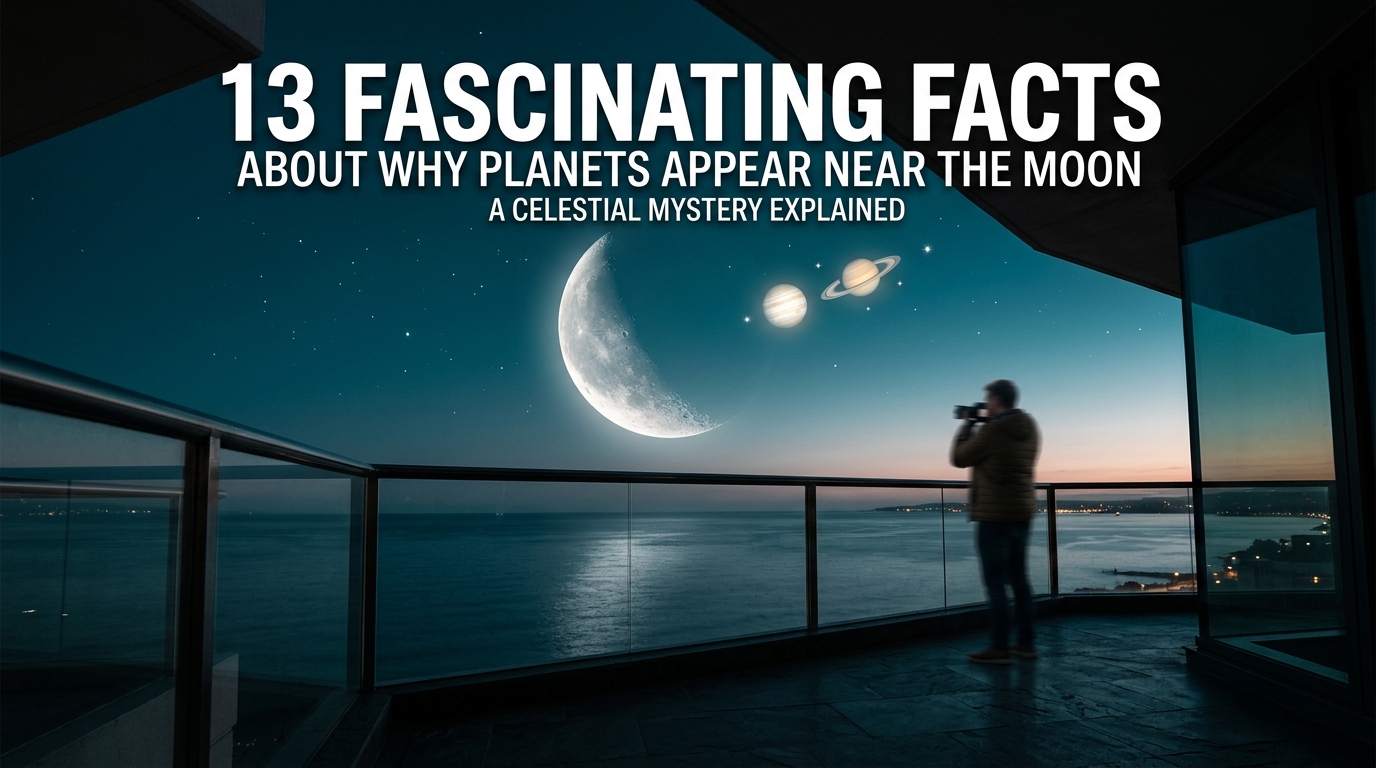
If you’ve ever looked up at the night sky and noticed a bright planet shining close to the Moon, you’re not alone. These striking celestial pairings often attract attention from casual observers and experienced stargazers alike. Whether it’s Venus glowing beside a thin crescent Moon or Jupiter appearing near a brilliant full Moon, these events can create some of the most beautiful sights in the sky.
What many people don’t realize is that these close encounters are usually a matter of perspective rather than actual proximity. The Moon and planets may appear side by side from our viewpoint on Earth, even though they are separated by vast distances in space.
Here are 13 fascinating facts about why planets appear near the Moon.
1. It’s Mostly a Matter of Perspective
One of the biggest misconceptions about planetary and lunar pairings is that the objects are actually close to each other in space.
In reality, the Moon is relatively nearby, averaging about 238,855 miles (384,400 kilometers) from Earth. Planets, on the other hand, are millions or even hundreds of millions of miles away.
When they appear close together in the sky, it is usually because they happen to line up from our vantage point on Earth.
2. The Moon and Planets Follow Similar Paths Across the Sky
The reason these encounters happen so often is that both the Moon and the planets travel along a similar celestial route known as the ecliptic.
The ecliptic is the apparent path the Sun follows through the sky over the course of a year. Because the planets orbit the Sun in roughly the same plane, they also appear near this path.
The Moon’s orbit is slightly tilted but remains close enough to the ecliptic that frequent alignments occur.
3. Conjunctions Create Beautiful Sky Events
When two celestial objects appear especially close together in the sky, astronomers call the event a conjunction.
A conjunction can occur between the Moon and a planet, two planets, or other celestial objects. These events are popular among skywatchers because they are easy to observe without specialized equipment.
Many conjunctions are visible even from urban areas with moderate light pollution.
4. Venus Often Creates the Most Dramatic Pairings
Among all the planets visible to the naked eye, Venus frequently produces some of the most spectacular encounters with the Moon.
Because Venus is usually one of the brightest objects in the night sky, its appearance beside a crescent Moon can create a stunning visual display. These pairings are often visible shortly after sunset or before sunrise.
Photographers particularly enjoy capturing these events.
5. Jupiter Is Another Frequent Companion
Jupiter, the largest planet in our solar system, is also one of the brightest.
When Jupiter appears near the Moon, the pairing can be especially eye-catching because both objects stand out prominently against the night sky. Even casual observers often notice these conjunctions without needing to know exactly what they’re seeing.
Jupiter’s brilliance makes it a favorite target for amateur astronomers.
6. The Objects Are Usually Far Apart in Reality
Although the Moon and a planet may seem almost close enough to touch in the sky, the physical distance between them is enormous.
For example, Jupiter can be hundreds of millions of miles farther away from Earth than the Moon. Yet from our viewpoint, both appear projected onto the same celestial backdrop.
This effect is similar to seeing two distant mountains appear side by side despite being many miles apart.
7. The Moon Moves Surprisingly Fast
The Moon is constantly moving across the sky as it orbits Earth.
In fact, it shifts noticeably from one night to the next, traveling about its own apparent width every hour. Because of this motion, the Moon frequently passes near planets and stars during its monthly journey around Earth.
These encounters are a natural consequence of its orbital motion.
8. Sometimes the Moon Can Cover a Planet
On rare occasions, the Moon doesn’t just pass near a planet—it passes directly in front of it.
This event is known as an occultation. During an occultation, the planet temporarily disappears behind the Moon before reemerging later.
Such events are particularly exciting for astronomers because they provide opportunities for detailed observations.
9. Planetary Pairings Have Inspired Cultures for Centuries
Throughout history, close approaches between the Moon and planets have attracted attention from civilizations around the world.
Ancient astronomers carefully recorded these events, often associating them with seasonal changes, religious observances, or celestial symbolism. Long before modern science explained planetary motions, these encounters were viewed as significant and sometimes mysterious occurrences.
Today, they remain a source of fascination and wonder.
10. Not Every Bright Object Near the Moon Is a Planet
People often assume that any bright point near the Moon must be a planet, but that’s not always true.
Bright stars such as Aldebaran, Spica, or Antares can also appear near the Moon at certain times of the year.
Learning to distinguish planets from stars adds another layer of enjoyment to skywatching.
11. Binoculars Can Enhance the Experience
Although conjunctions are usually visible with the naked eye, binoculars can make them even more impressive.
A good pair of binoculars may reveal details of the Moon’s craters while also showing the nearby planet in the same field of view. This combination often creates a beautiful and memorable observing experience.
Many beginners find binoculars to be an excellent introduction to astronomy.
12. These Events Help People Learn the Night Sky
Moon-planet pairings often serve as a gateway into astronomy.
Because the Moon is easy to identify, people can use it as a guide to locate planets they might otherwise overlook. Many amateur astronomers first learned to recognize planets by spotting them near the Moon.
These events make celestial navigation much easier for newcomers.
13. Every Encounter Is Unique
No two Moon-planet conjunctions are exactly alike.
The appearance of the Moon changes throughout its phases, planets vary in brightness, and viewing conditions differ depending on location and time of year. Some pairings occur in twilight, while others happen in the middle of the night.
This constant variety ensures that each event offers a unique skywatching experience.
Why These Celestial Pairings Matter
Moon-planet conjunctions are among the most accessible astronomical events for the general public. They require no expensive equipment, no advanced knowledge, and often no preparation beyond stepping outside and looking up.
These encounters provide a wonderful opportunity to appreciate the mechanics of the solar system in action. They also remind us that the night sky is constantly changing, with planets, moons, and stars moving through intricate patterns that have captivated observers for thousands of years.
For many people, a simple glimpse of a bright planet beside the Moon becomes the spark that ignites a lifelong interest in astronomy.
Conclusion
The next time you notice a bright planet appearing close to the Moon, you’ll know that you’re witnessing a fascinating alignment shaped by perspective, orbital motion, and the geometry of our solar system.
While the Moon and planets may seem like close neighbors in the sky, they are often separated by immense distances. Yet these visual pairings continue to create some of the most beautiful and memorable sights available to skywatchers.
From conjunctions and occultations to the shared path of the ecliptic, the science behind these celestial encounters is every bit as fascinating as the view itself. So the next time the Moon meets a planet in the evening sky, take a moment to enjoy one of astronomy’s simplest and most enchanting spectacles.







