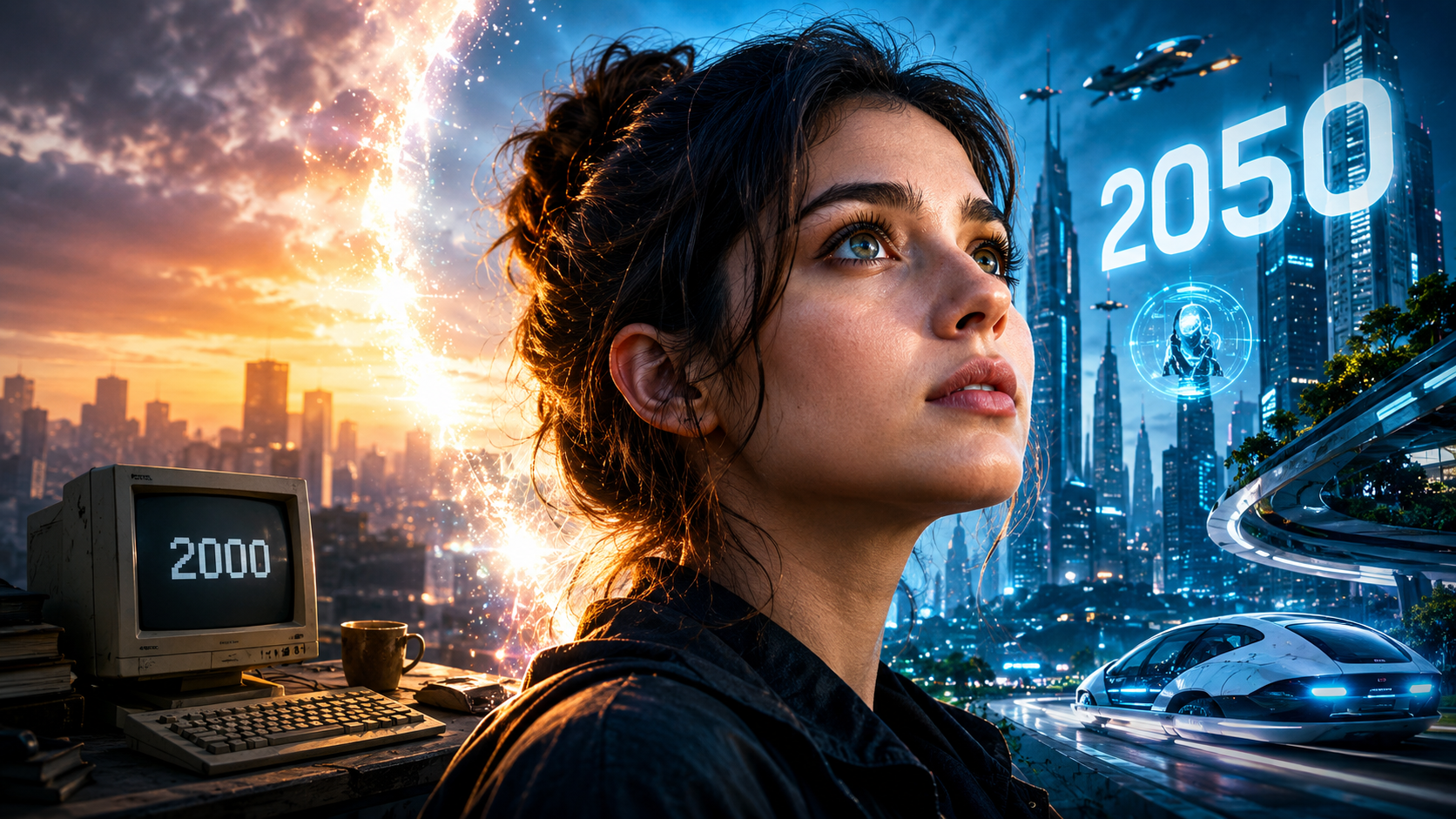
It sounds like a strange math puzzle, but it’s true: we have reached the point where the year 2050 is closer to us than the year 2000.
For many people, 2000 still feels like it happened just yesterday. It was the dawn of a new millennium, a time filled with excitement, uncertainty, and predictions about the future. Yet the calendar keeps moving forward, and the moment when 2050 became closer than 2000 serves as a powerful reminder of how quickly time passes.
Beyond the simple numbers, this milestone reveals fascinating truths about technology, culture, demographics, and the pace of change in modern society.
Here are 13 surprising facts about the day 2050 became closer than 2000.
1. The New Millennium Is No Longer “New”
For years, people referred to the early 2000s as the “new millennium.”
Today, that description no longer fits. The year 2000 now belongs firmly to history rather than the present. In fact, we’re closer to the middle of the 21st century than we are to the start of it.
What once felt futuristic has become part of the past.
2. Many Adults Have Never Known a World Before Smartphones
In 2000, smartphones barely existed in any recognizable form.
Now, an entire generation has grown up with internet-connected devices in their pockets. For younger adults, constant access to information, navigation, streaming, and social media has always been normal.
The technological transformation between 2000 and today has been astonishingly rapid.
3. Social Media Wasn’t Yet a Daily Habit
When the year 2000 arrived, social media as we know it did not exist.
There were no viral TikTok videos, Instagram stories, or global online influencers. Most people communicated through email, phone calls, or face-to-face conversations.
The rise of social platforms has dramatically reshaped how people connect, work, and consume information.
4. The Internet Was a Very Different Place
At the start of the millennium, many people still relied on dial-up internet connections.
Websites were simpler, video streaming was limited, and online shopping was still developing. Today, cloud computing, high-speed internet, and digital services power much of the global economy.
The internet has evolved from a useful tool into essential infrastructure.
5. Technology Advanced Faster Than Many Predictions
Some forecasts from 2000 imagined flying cars and robot servants by now.
While those visions haven’t fully arrived, many real-world innovations exceeded expectations. Artificial intelligence, video conferencing, wearable technology, and advanced medical tools have become part of everyday life.
The future arrived—it just didn’t always look the way people expected.
6. The Population of the World Has Grown Dramatically
Around the year 2000, the global population stood at roughly 6 billion people.
Since then, billions more have been added, creating new opportunities and challenges related to resources, infrastructure, healthcare, and sustainability.
The world of today is significantly more interconnected than it was at the beginning of the century.
7. Many Technologies From 2000 Are Now Obsolete
Remember floppy disks, bulky desktop monitors, CD players, and paper road maps?
Many technologies that were common in 2000 have disappeared or become niche items. Devices once considered cutting-edge are now museum pieces or nostalgic collectibles.
Innovation often moves faster than people realize.
8. Children Born in 2000 Are Adults
Perhaps one of the most startling reminders of time’s passage is that babies born in 2000 are now fully grown adults.
Many have completed their education, entered careers, started families, and become part of the workforce.
For those who remember celebrating the new millennium, this fact alone can make the passage of time feel very real.
9. The Future Is No Longer a Distant Concept
For decades, 2050 was used as a benchmark for future predictions.
Scientists, economists, and policymakers often discussed what the world might look like in 2050 because it seemed comfortably far away. Today, that year is close enough that many long-term plans and forecasts are beginning to take shape in the real world.
The future is becoming the present.
10. Climate and Energy Goals Are Increasingly Focused on 2050
Many governments and organizations have established major targets for 2050.
These include goals related to energy systems, emissions reductions, infrastructure development, and technological innovation. As the date draws closer, discussions about these objectives become more immediate and practical.
What once seemed like distant planning is now entering implementation.
11. Artificial Intelligence Has Moved From Fiction to Reality
In 2000, advanced AI was largely associated with science fiction.
Today, AI helps power search engines, language translation, medical research, customer support, content creation, and countless other applications. While experts continue debating its long-term impact, there’s no question that AI has become one of the defining technologies of the century.
Its growth illustrates how quickly innovation can reshape society.
12. Our Perception of Time Changes as We Age
Psychologists suggest that time often seems to move faster as people get older.
A decade feels enormous to a child but relatively brief to an adult. This may help explain why the year 2000 can feel surprisingly recent even though it is now decades behind us.
The calendar and our memories don’t always move at the same pace.
13. 2050 Will Arrive Sooner Than Most People Expect
The most surprising fact may be the simplest one.
The year 2050 is no longer a distant destination reserved for science-fiction stories and long-range forecasts. It is approaching rapidly. Many children alive today will still be relatively young adults in 2050, while many major projects being planned now are designed specifically for that era.
The future is not waiting somewhere far ahead—it is steadily becoming today’s reality.
Why This Milestone Matters
The moment when 2050 became closer than 2000 is more than a mathematical curiosity. It highlights the extraordinary speed of change that has defined the first half of the 21st century.
In just a few decades, society has transformed through technological breakthroughs, global connectivity, scientific advances, and cultural shifts that would have seemed remarkable at the turn of the millennium.
Looking back at 2000 reminds us how far we’ve come. Looking ahead to 2050 reminds us how much more change is still to come.
And perhaps that’s the most fascinating lesson of all: the future arrives gradually, one day at a time—until suddenly, it feels closer than the past.