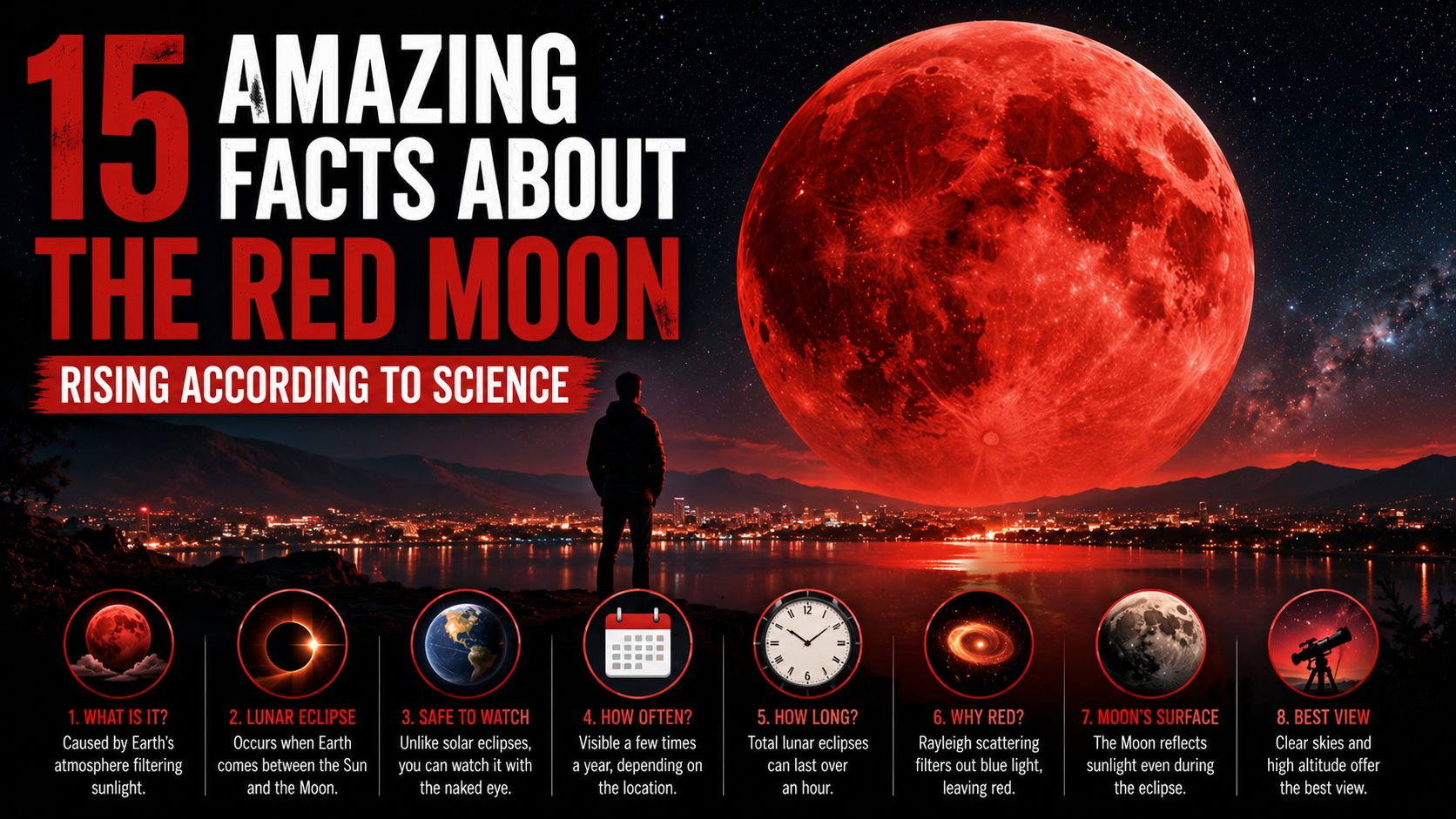
A “red moon rising” is one of the most striking sights in the night sky. When the Moon takes on a deep red or orange glow as it rises above the horizon, it often feels dramatic, almost otherworldly. Throughout history, this phenomenon has inspired myths, stories, and even superstition. But behind the stunning appearance lies a completely natural scientific explanation.
A red moon is not a separate type of Moon—it is simply a full or near-full Moon that appears reddish due to the way light travels through Earth’s atmosphere. Still, the effect can be breathtaking, and it continues to fascinate skywatchers around the world.
Here are 15 fascinating science-based facts that explain the mystery, beauty, and behavior of the red moon rising.
1. The Red Color Comes From Earth’s Atmosphere
The Moon turns red during certain conditions because of how sunlight interacts with Earth’s atmosphere.
As moonlight passes through the atmosphere, shorter blue wavelengths are scattered away, while longer red wavelengths pass through. This process is similar to what causes sunsets to appear red or orange.
The result is a warm, reddish glow that can make the Moon look almost fiery as it rises.
2. It Is Most Noticeable Near the Horizon
A red moon is typically most visible when the Moon is low in the sky.
At this point, its light must pass through a thicker layer of Earth’s atmosphere compared to when it is overhead.
This increased atmospheric distance enhances the scattering effect, making the Moon appear more intensely red or orange.
3. Dust and Pollution Can Intensify the Effect
Particles in the air, such as dust, smoke, or pollution, can amplify the red coloring of the Moon.
These particles increase the scattering of shorter wavelengths, allowing even more red light to dominate.
This is why red moons are sometimes more vivid in certain locations or during specific environmental conditions, such as after wildfires or dust storms.
4. Lunar Eclipses Create the Most Dramatic Red Moons
One of the most famous types of red moon is the “blood moon,” which occurs during a total lunar eclipse.
During this event, Earth moves directly between the Sun and the Moon, blocking direct sunlight.
However, some sunlight still passes through Earth’s atmosphere and is bent toward the Moon, giving it a deep red hue.
The exact shade can vary depending on atmospheric conditions at the time of the eclipse.
5. The Term “Blood Moon” Is Not Scientific
Although widely used in media and culture, the term “blood moon” has no official scientific definition.
Astronomers simply refer to it as a lunar eclipse with a reddish appearance.
The dramatic name comes from historical and cultural interpretations rather than astronomy itself.
6. Red Moons Can Appear During Normal Full Moons
A red or orange moon is not limited to eclipses.
Even during a regular full moon, atmospheric conditions near the horizon can cause the Moon to appear reddish.
This is especially common when the Moon is rising or setting, when its light passes through more atmospheric layers.
7. The Effect Is Similar to Sunsets and Sunrises
The red color of the Moon is caused by the same physics that creates colorful sunsets.
When the Sun is low in the sky, sunlight travels through more atmosphere, scattering blue light and allowing red tones to dominate.
Since the Moon reflects sunlight, it experiences the same effect under similar conditions.
8. The Moon Does Not Actually Change Color
Despite appearances, the Moon itself does not physically change color.
Its surface remains gray and rocky, regardless of how we see it from Earth.
The red appearance is purely an optical effect caused by light scattering in Earth’s atmosphere.
9. Volcanic Eruptions Can Make Red Moons More Common
Major volcanic eruptions can inject large amounts of ash and particles into the atmosphere.
These particles enhance the scattering of light, often leading to more frequent or more intense red-colored moons.
Historically, periods following large eruptions have been associated with unusually vivid lunar and solar colors.
10. The Earth’s Atmosphere Acts Like a Lens
Earth’s atmosphere doesn’t just scatter light—it also bends it slightly.
This bending effect, known as refraction, helps redirect some sunlight into Earth’s shadow during a lunar eclipse.
Without this atmospheric “filter,” the Moon would appear much darker during an eclipse instead of glowing red.
11. Different Atmospheric Conditions Create Different Shades
Not all red moons look the same. Some appear deep crimson, while others are more orange or copper-colored.
The exact shade depends on how many particles are in the atmosphere and the angle of light passing through it.
Clear skies tend to produce lighter shades, while dusty or polluted air can create deeper reds.
12. Ancient Cultures Often Interpreted Red Moons Symbolically
Before modern science explained the phenomenon, red moons were often seen as omens or spiritual signs.
Many cultures associated them with change, conflict, or important events.
Today, we understand that the effect is purely natural, but its dramatic appearance still captures human imagination.
13. Red Moons Are Completely Safe to Observe
Unlike solar eclipses, which require eye protection, lunar eclipses and red moons are completely safe to watch with the naked eye.
No special equipment is needed, although binoculars or telescopes can enhance the viewing experience.
This makes red moon events accessible to everyone, regardless of experience level.
14. They Can Be Predicted Years in Advance
Lunar eclipses and major red moon events are highly predictable.
Astronomers can calculate their timing with great precision using orbital mechanics.
This allows scientists and skywatchers to plan observations long before the event occurs.
15. The Red Moon Inspires Public Interest in Astronomy
One of the most powerful effects of a red moon rising is its ability to spark curiosity about space.
When people see the Moon turning red, many become interested in learning about astronomy, physics, and Earth’s atmosphere.
These events often lead to increased engagement in science education and skywatching communities around the world.
Why the Red Moon Rising Still Captivates Us
Even though science fully explains the red moon phenomenon, its visual impact remains powerful.
It transforms an everyday celestial object into something rare and memorable. The combination of color, scale, and timing creates a moment that feels special every time it occurs.
For many people, watching a red moon rise is a reminder of how dynamic and beautiful our planet’s relationship with space truly is.
Final Thoughts
The red moon rising is not a mystery in the scientific sense, but it remains one of the most visually stunning events in the night sky.
From atmospheric scattering to lunar eclipses, the science behind it is well understood. Yet its emotional impact continues to inspire wonder.
Whether seen through a telescope or with the naked eye, a red moon is a powerful reminder that even familiar celestial objects can reveal breathtaking beauty under the right conditions.
In the end, it is not just a phenomenon of physics—it is a shared human experience that connects science, nature, and imagination.







