Archaeologists often uncover monumental structures, precious jewelry, and elaborate works of art, but sometimes the most extraordinary discoveries are surprisingly simple. One such find is a piece of yarn that has survived for approximately 4,700 years. At first glance, it may seem like an ordinary strand of fiber, yet its survival offers an incredible window into the daily lives, technologies, and creativity of ancient people.
Textiles are among the most fragile materials produced by humans. They usually decay quickly, leaving little trace behind. That is why the discovery of this ancient yarn has fascinated researchers around the world. Despite the passage of nearly five millennia, the thread still has stories to tell.
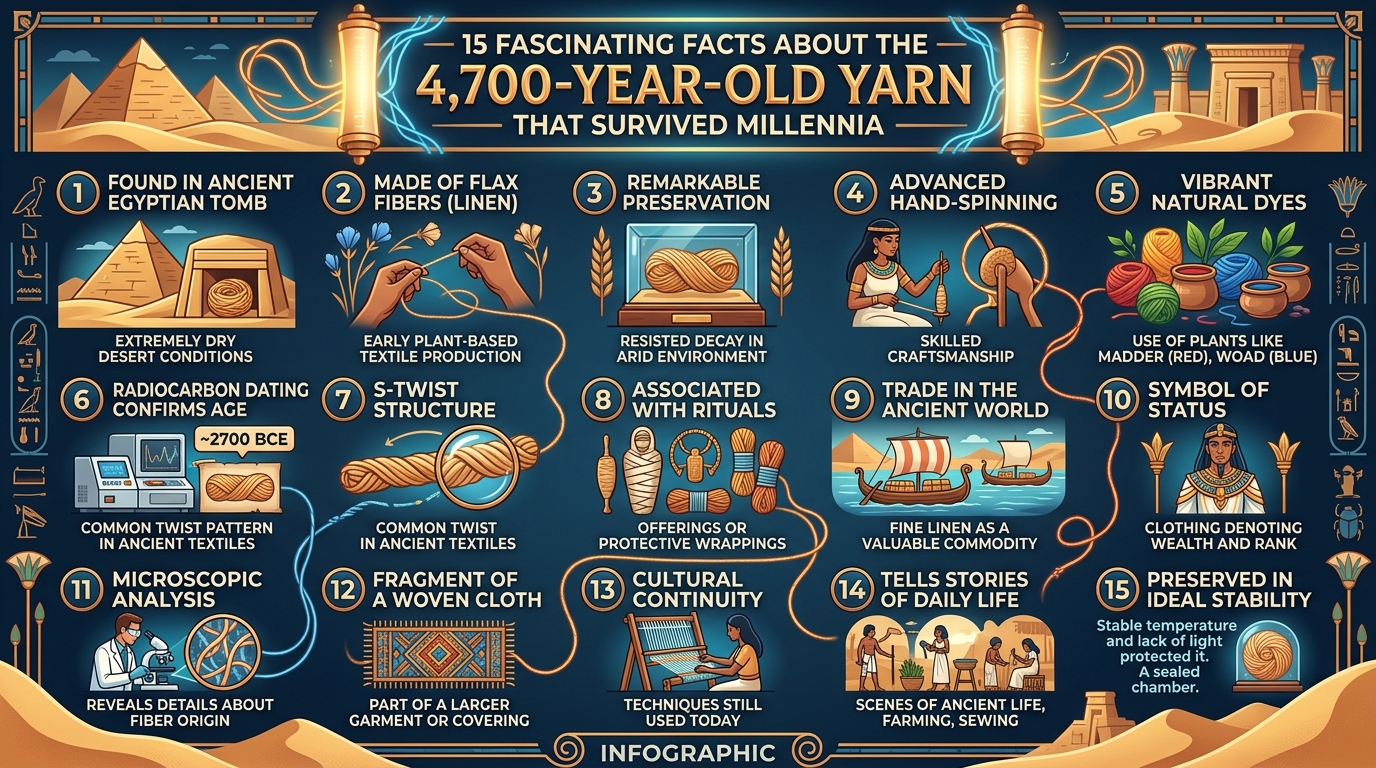
Here are fifteen fascinating facts about the 4,700-year-old yarn that managed to survive the ages.
1. It Is Nearly Five Thousand Years Old
The yarn dates back around 4,700 years, placing its creation during a period when many of the world’s earliest civilizations were emerging.
At the time this thread was spun, monumental building projects were underway in various regions, cities were expanding, and early societies were developing increasingly sophisticated technologies. The yarn is therefore not just an ancient object—it is a surviving witness to a transformative era in human history.
2. Textiles Rarely Survive for So Long
Ancient fabrics and fibers are notoriously difficult to preserve.
Materials such as wool, flax, and plant fibers naturally break down due to moisture, microorganisms, and changing environmental conditions. As a result, textiles are often among the first archaeological materials to disappear.
The survival of this yarn is therefore exceptionally rare and makes it an invaluable archaeological treasure.
3. It Preserves Evidence of Everyday Life
Unlike royal jewelry or monumental architecture, yarn was a practical item used in daily activities.
Ancient people relied on threads and textiles for clothing, bags, fishing nets, household items, and countless other necessities. This humble strand of fiber provides direct evidence of ordinary life and reminds us that history is shaped not only by rulers and monuments but also by everyday objects.
4. Creating Yarn Required Skill and Knowledge
Producing yarn was a sophisticated process.
Ancient craftspeople had to gather suitable fibers, prepare the raw materials, and carefully twist them into durable thread. The quality of the yarn depended on experience, patience, and technical understanding.
Its existence demonstrates that early societies possessed specialized knowledge and developed practical technologies long before the industrial age.
5. Textile Production Was Essential to Ancient Economies
Cloth and fibers were valuable resources in ancient communities.
Producing textiles demanded considerable time and labor, making fabrics important economic assets. In some societies, textiles even served as indicators of wealth and social status.
The ancient yarn therefore represents not merely a piece of thread but also an important element of early economic systems.
6. The Yarn Offers Clues About Ancient Materials
By studying the fibers, researchers can learn which materials ancient people used and how they obtained them.
The yarn may reveal whether people relied on plant fibers, animal wool, or other locally available resources. Such information helps archaeologists reconstruct agricultural practices, trade networks, and environmental conditions from thousands of years ago.
Even a small strand of thread can provide valuable scientific insights.
7. It Demonstrates Human Creativity
Spinning fibers into yarn may seem simple today, but it represented an important technological achievement.
Early communities learned how to transform natural materials into useful products that improved daily life. This ability required observation, experimentation, and innovation.
The yarn stands as evidence of humanity’s long tradition of solving problems through creativity and craftsmanship.
8. Textile Production Was Often a Community Activity
In many ancient societies, making yarn and fabric was not an isolated task.
Spinning and weaving frequently involved family members and community cooperation. Knowledge about textile production was passed from generation to generation, helping preserve important skills and traditions.
The ancient yarn therefore also reflects social relationships and cultural continuity.
9. The Discovery Challenges Our Assumptions About Ancient Life
People sometimes imagine early societies as technologically primitive.
However, discoveries like this yarn reveal a more complex reality. Producing durable thread required planning, specialized techniques, and practical knowledge.
The artifact reminds us that ancient communities developed sophisticated technologies suited to their needs and environments.
10. It Connects Us to the People Who Made It
One of the most compelling aspects of the yarn is its deeply human dimension.
Someone gathered the fibers, twisted them together, and created this thread thousands of years ago. Although we may never know that person’s name, the yarn preserves traces of their labor and skill.
Holding such an object can create a surprisingly personal connection with individuals who lived nearly five millennia ago.
11. It Helps Archaeologists Reconstruct Ancient Clothing
Because textiles rarely survive, every preserved fiber is valuable.
Researchers can use the yarn to estimate how ancient garments may have been made, what techniques were employed, and what materials were available. Such discoveries contribute significantly to our understanding of appearance, social customs, and daily activities in ancient societies.
A tiny strand of yarn can therefore illuminate entire aspects of lost cultures.
12. The Preservation Was Likely Due to Exceptional Conditions
The yarn’s remarkable survival probably depended on unusual environmental circumstances.
Extreme dryness, waterlogged conditions, freezing temperatures, or protective burial environments can sometimes preserve fragile organic materials for thousands of years.
Without these rare conditions, the yarn would almost certainly have vanished long ago.
13. It Demonstrates the Value of Small Discoveries
Archaeology often celebrates spectacular finds such as tombs, statues, and treasure hoards.
Yet humble artifacts can be equally important. Objects like this ancient yarn frequently reveal details about ordinary life that larger monuments cannot provide.
Its discovery reminds us that even the smallest items can significantly enhance our understanding of the past.
14. It Highlights the Importance of Preservation and Research
Fragile artifacts require careful scientific study and conservation.
Modern techniques allow researchers to examine fibers under magnification, analyze materials, and preserve delicate objects for future generations. Without such efforts, important information about ancient technologies and daily life could be permanently lost.
The yarn demonstrates why archaeological preservation remains essential.
15. It Serves as a Remarkable Symbol of Human Continuity
Perhaps the most fascinating aspect of the 4,700-year-old yarn is what it represents.
Thread has connected human societies for thousands of years. Ancient people used yarn to create clothing, tools, and household items that improved everyday life. Today, threads and textiles remain indispensable components of modern civilization.
This simple strand of fiber therefore symbolizes humanity’s enduring ingenuity and our ability to transform natural materials into useful creations.
Why This Ancient Yarn Continues to Fascinate Historians
The 4,700-year-old yarn is extraordinary precisely because it is so ordinary. It is not a crown, a weapon, or a monumental sculpture. Instead, it is a humble object created by someone whose name has long been forgotten.
Yet this small artifact reveals remarkable truths about ancient societies. It demonstrates technological knowledge, economic organization, social cooperation, and human creativity. Most importantly, it reminds us that history is not composed solely of kings and empires. It is also the story of everyday people whose labor and innovations shaped the foundations of civilization.
After surviving nearly five millennia, this ancient strand of yarn continues to connect us to the distant past, proving that even the simplest objects can preserve extraordinary stories across the ages.







