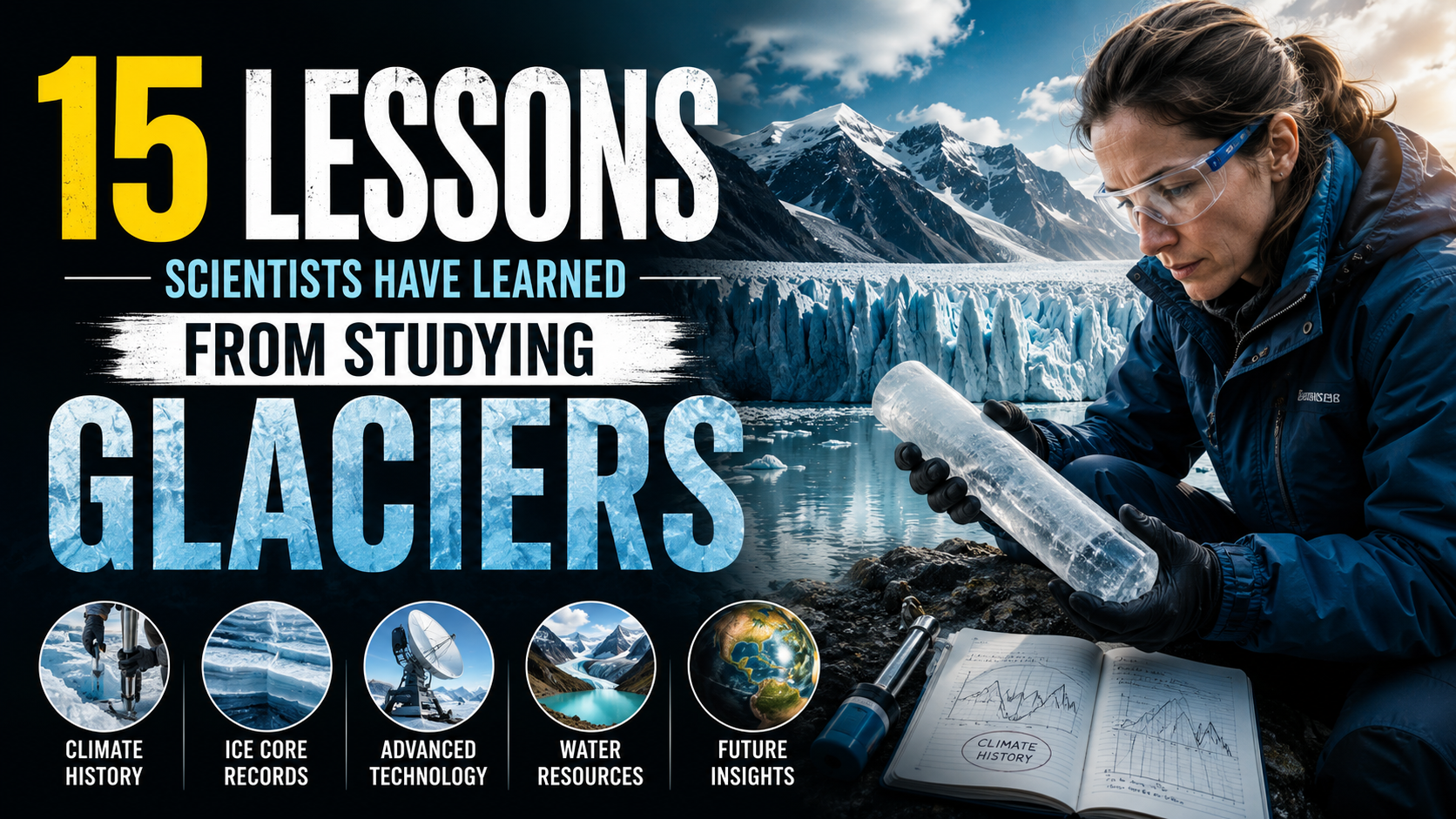
At first glance, glaciers may seem like little more than enormous rivers of ice frozen in some of the coldest places on Earth. Yet for scientists, glaciers are far more than breathtaking natural landmarks. They are living archives of our planet’s history, storing clues about ancient climates, environmental changes, volcanic eruptions, atmospheric conditions, and even the future of life on Earth.
For decades, researchers have traveled to remote mountain ranges, polar regions, and frozen landscapes to study these massive bodies of ice. What they’ve discovered has transformed our understanding of the planet and revealed just how interconnected Earth’s systems truly are.
Glaciers act like time capsules, preserving information that can stretch back hundreds, thousands, and sometimes even hundreds of thousands of years. By analyzing ice layers, trapped air bubbles, sediments, and movement patterns, scientists have uncovered remarkable insights about Earth’s past, present, and future.
Here are 15 important lessons researchers have learned from studying glaciers.
1. Earth’s Climate Has Always Changed
One of the most fundamental lessons from glacier research is that Earth’s climate has never remained completely stable.
Throughout history, the planet has experienced warmer and colder periods. Ice ages have come and gone, temperatures have shifted, and environmental conditions have evolved over time.
Glaciers preserve evidence of these changes within their layers, allowing scientists to reconstruct ancient climates and understand long-term environmental patterns.
This historical perspective helps researchers distinguish between natural climate variations and more recent trends.
2. Ice Stores a Remarkable Record of the Atmosphere
Every snowfall that contributes to a glacier captures tiny particles from the atmosphere.
As snow accumulates and compresses into ice, it traps microscopic air bubbles that preserve samples of ancient air.
Scientists can analyze these bubbles to determine past concentrations of gases such as carbon dioxide and methane.
In many ways, glaciers function as natural environmental archives, providing direct evidence of atmospheric conditions from thousands of years ago.
3. Small Temperature Changes Can Have Big Effects
One surprising discovery is how sensitive glaciers are to relatively small shifts in temperature.
Even modest increases in average temperatures can influence melting rates, glacier movement, and overall ice mass.
Because glaciers respond to temperature changes over time, they often serve as early indicators of broader environmental trends.
Their behavior helps researchers understand how ecosystems may respond to future climate shifts.
4. Water Resources Depend on Glaciers
Many people associate glaciers with remote mountain peaks, but their influence extends far beyond those regions.
Glaciers serve as natural freshwater reservoirs. During warmer months, melting ice supplies rivers, lakes, and streams that support agriculture, drinking water systems, and ecosystems.
Millions of people around the world depend directly or indirectly on glacier-fed water sources.
Studying glaciers has highlighted the critical role they play in global water security.
5. Glaciers Shape Entire Landscapes
Some of Earth’s most recognizable geographic features were created by glaciers.
Valleys, fjords, lakes, ridges, and countless other landforms owe their existence to ancient ice movements.
As glaciers advance and retreat, they carve through rock, transport sediments, and reshape terrain.
Research has helped scientists understand how glaciers have transformed landscapes across continents over thousands of years.
6. Ice Can Reveal Ancient Natural Disasters
Glaciers often preserve evidence of major environmental events.
Volcanic eruptions, wildfires, dust storms, and other natural phenomena leave traces within ice layers.
By studying these records, scientists can identify when significant events occurred and how they affected Earth’s atmosphere.
This information helps researchers build detailed timelines of environmental history.
7. Polar Regions Influence the Entire Planet
Research has shown that what happens in cold regions rarely stays there.
Changes in polar environments can affect ocean circulation, weather systems, sea levels, and ecosystems across the globe.
Studying glaciers has reinforced the idea that Earth functions as a connected system, where changes in one region often influence conditions elsewhere.
This understanding has become increasingly important in modern environmental science.
8. Ecosystems Adapt in Surprising Ways
As glaciers advance or retreat, they create entirely new environments.
Scientists have observed plants, insects, microorganisms, and animals gradually colonizing newly exposed land after glaciers recede.
These natural experiments provide valuable insights into ecological succession, adaptation, and biodiversity.
They help researchers understand how life responds to changing environmental conditions.
9. Glaciers Move More Than Most People Realize
Although glaciers appear stationary, they are constantly moving.
Driven by gravity, massive ice bodies slowly flow downhill over time.
Some glaciers move only a few inches per year, while others advance much faster under certain conditions.
Studying glacier movement has improved understanding of ice dynamics and how environmental factors influence glacier behavior.
10. Sea Levels Are Closely Linked to Ice Loss
One of the most significant lessons from glacier research involves the relationship between land-based ice and sea levels.
When glaciers lose mass, water eventually contributes to oceans.
Scientists use glacier measurements to better understand how changing ice conditions may influence future sea-level trends.
This research helps communities plan for potential long-term environmental changes.
11. Ancient Microorganisms Can Survive in Ice
Glaciers have revealed something remarkable about life itself.
Researchers have discovered microorganisms preserved within ice for extremely long periods.
Some microbial life forms can remain dormant under harsh conditions and become active again when environmental circumstances change.
These findings have expanded scientific understanding of biological resilience and survival.
12. Glaciers Help Test Climate Models
Predicting future environmental conditions requires accurate scientific models.
Because glaciers respond to changes in temperature, precipitation, and atmospheric conditions, they provide valuable data for testing climate predictions.
Scientists compare model projections with observed glacier behavior to improve forecasting accuracy.
This process strengthens our ability to understand potential future scenarios.
13. Human Activity Leaves Detectable Traces
One fascinating discovery is that glaciers preserve evidence of human activity.
Industrial pollution, airborne chemicals, heavy metals, and other particles can become trapped in ice layers.
By analyzing these records, scientists can track changes in environmental conditions over time and better understand humanity’s influence on the atmosphere.
Glaciers often serve as long-term environmental monitoring systems.
14. Earth’s Systems Are Deeply Connected
One of the most important lessons from glacier science is that environmental systems rarely operate in isolation.
Ice influences oceans. Oceans influence weather. Weather affects ecosystems. Ecosystems affect biodiversity and human societies.
Studying glaciers has revealed countless examples of these interconnected relationships.
Understanding these connections helps scientists evaluate environmental challenges from a broader perspective.
15. Glaciers Are Windows Into the Future
Perhaps the greatest lesson scientists have learned is that glaciers provide insight not only into Earth’s past but also its future.
Their behavior reflects ongoing environmental changes and offers valuable information about long-term trends.
By monitoring glaciers, researchers gain early warnings about shifts in water resources, ecosystems, sea levels, and climate patterns.
These observations help governments, communities, and scientists make informed decisions for future generations.
Why Glacier Research Matters More Than Ever
Although glaciers often exist far from major population centers, their influence extends across the globe.
They affect water supplies, agriculture, ecosystems, weather patterns, and ocean systems that millions of people rely upon every day.
The information contained within glaciers also represents one of humanity’s most valuable environmental records.
Every ice core extracted from a glacier provides scientists with a detailed snapshot of conditions that existed long before modern instruments were available.
This ability to look into the past gives researchers a unique advantage when studying long-term environmental trends.
The Technology Behind Modern Glacier Science
Modern glacier research combines traditional fieldwork with cutting-edge technology.
Scientists now use:
- Satellites
- Drones
- GPS monitoring systems
- Remote sensing technologies
- Ice-penetrating radar
- Climate modeling software
- High-resolution imaging
These tools allow researchers to monitor glaciers more accurately than ever before.
What once required years of observation can now be measured with remarkable precision from space and ground-based instruments.
Final Thoughts
Glaciers are far more than frozen masses of ice. They are natural archives, environmental indicators, freshwater reservoirs, and powerful scientific tools. Through decades of research, scientists have uncovered invaluable lessons about Earth’s climate, ecosystems, geological history, and interconnected environmental systems.
From preserving ancient atmospheric records to revealing how landscapes evolve, glaciers continue to expand our understanding of the world. They remind us that the planet’s history is written not only in rocks and fossils but also in layers of ice that have silently recorded environmental changes for thousands of years.
As technology advances and scientific knowledge grows, glaciers will remain among the most important sources of information about both Earth’s past and the challenges and opportunities that lie ahead.







