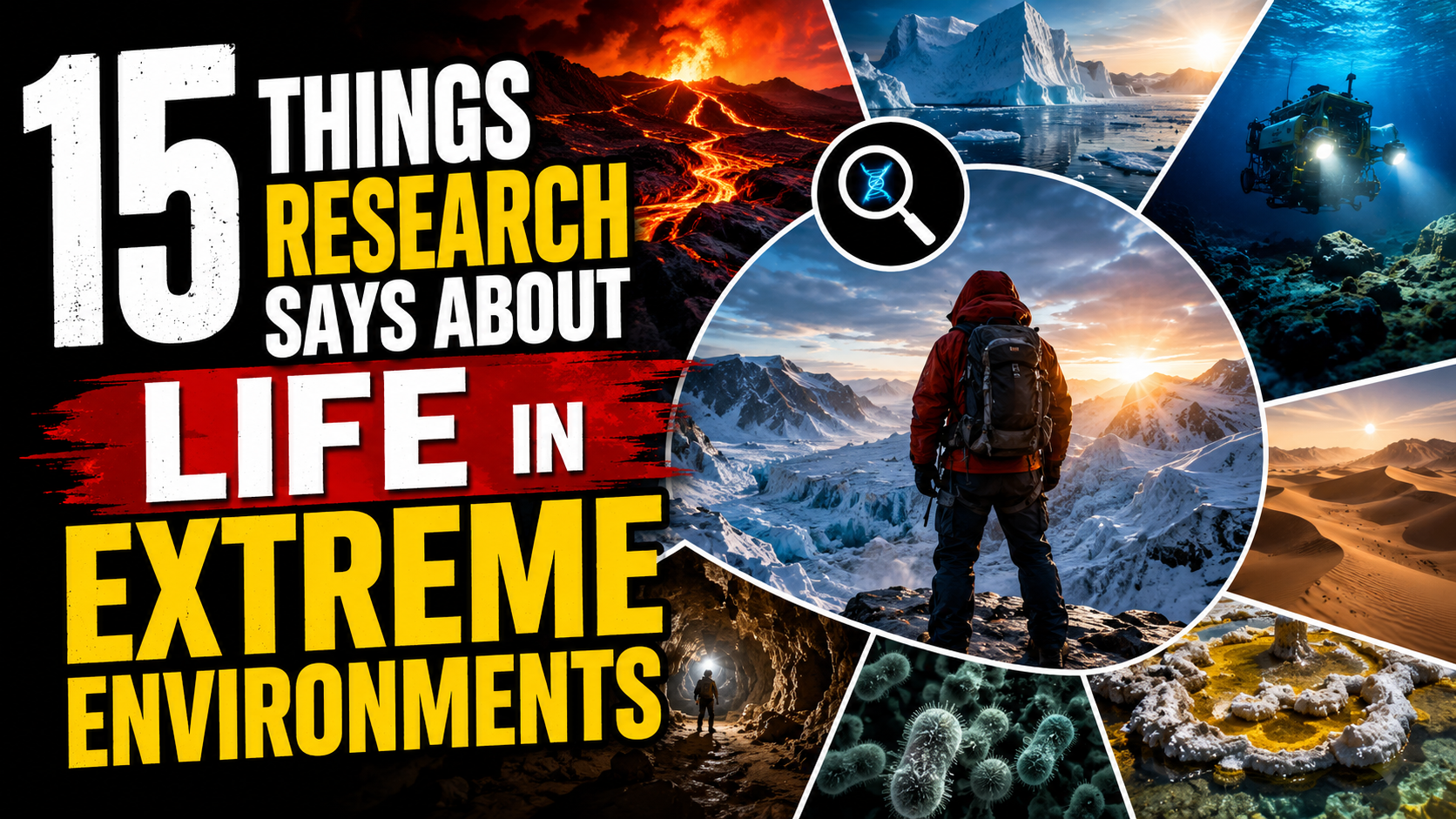
Life on Earth is far more resilient than most people imagine.
When we think about places where living things can survive, we usually picture forests, grasslands, oceans, and other environments that seem comfortable and familiar. Yet scientific research has repeatedly shown that life can flourish in places that appear completely hostile to survival.
From boiling hot springs and frozen polar deserts to deep-sea trenches and isolated cave systems sealed off for millions of years, organisms continue to surprise researchers with their ability to adapt. These extraordinary environments challenge our understanding of biology and reveal just how flexible life can be.
In recent decades, scientists have discovered countless species thriving under conditions once considered impossible. These discoveries have transformed fields such as ecology, evolution, microbiology, and even the search for extraterrestrial life.
Here are 15 fascinating things research has revealed about life in some of Earth’s most extreme environments.
1. Life Can Survive Without Sunlight
Most ecosystems depend directly or indirectly on sunlight.
Plants use solar energy through photosynthesis, forming the foundation of food chains across much of the planet. However, some ecosystems exist entirely without sunlight.
Researchers studying deep caves and ocean trenches have found organisms that survive using chemical energy instead of solar energy. Certain microbes obtain nutrients through chemical reactions involving sulfur, methane, and other compounds.
These discoveries showed scientists that sunlight is not always necessary for life to exist.
This finding has dramatically expanded our understanding of where living organisms can survive.
2. Some Creatures Thrive in Complete Darkness
Many underground cave systems remain permanently dark.
In these environments, animals have evolved remarkable adaptations. Some species lose their eyesight entirely because vision provides little advantage where light never reaches.
Instead, they develop heightened senses of touch, smell, or vibration detection.
Scientists have found fish, insects, spiders, and crustaceans that spend their entire lives in darkness, relying on alternative sensory systems to navigate and locate food.
These creatures provide powerful examples of evolution responding to environmental conditions over long periods.
3. Extreme Heat Doesn’t Always Prevent Life
Boiling temperatures might seem incompatible with survival, but research has revealed otherwise.
Certain microorganisms known as thermophiles thrive in environments with temperatures that would quickly kill most living organisms.
These heat-loving microbes inhabit volcanic regions, hydrothermal vents, and geothermal hot springs.
Their unique biological structures allow them to function under intense heat, offering valuable insights into the limits of life.
Scientists study these organisms to better understand evolution and develop applications in biotechnology and medicine.
4. Some Organisms Survive Extreme Cold
Just as some species tolerate heat, others excel in freezing conditions.
Microorganisms have been discovered beneath glaciers, inside Antarctic ice, and within permanently frozen soil known as permafrost.
Many of these organisms produce special proteins that help prevent ice crystals from damaging their cells.
These adaptations allow life to persist in environments where temperatures remain below freezing for extended periods.
Research into cold-adapted species continues to reveal remarkable survival strategies.
5. Deep-Sea Life Exists Under Crushing Pressure
The deepest parts of the ocean experience pressures hundreds of times greater than those found at sea level.
Yet these extreme conditions support a surprising diversity of life.
Fish, crustaceans, worms, and microorganisms inhabit trenches located miles beneath the ocean’s surface.
To survive, these organisms possess specialized biological structures that resist compression and maintain normal function under immense pressure.
Studying deep-sea species helps scientists understand how life adapts to physical challenges that seem unimaginable from a human perspective.
6. Isolation Can Drive Unique Evolution
When populations remain separated for long periods, they often evolve in distinctive ways.
This process is particularly evident in isolated caves, islands, and remote ecosystems.
Species living in these environments may develop unusual characteristics not found elsewhere.
Researchers frequently discover animals with unique body structures, behaviors, and physiological traits that evolved in response to local conditions.
Isolation acts as a natural laboratory for studying evolutionary change.
7. Microbes Are Often the True Survival Champions
When discussing extreme environments, microorganisms consistently dominate the conversation.
Bacteria and other microbes have been found in volcanic vents, acidic lakes, radioactive environments, deep underground rock formations, and frozen deserts.
Their extraordinary adaptability allows them to survive conditions that would be lethal to larger organisms.
Scientists increasingly recognize microbes as some of the most resilient forms of life on Earth.
Their success demonstrates how flexible biology can be.
8. Life Finds Creative Ways to Obtain Energy
One of the most important lessons from extreme environments is that life can acquire energy through surprising methods.
While plants depend on sunlight, some organisms rely on chemical reactions involving minerals and gases.
This process, known as chemosynthesis, supports entire ecosystems in places where sunlight never reaches.
Researchers studying these systems continue uncovering new ways that organisms meet their energy needs.
These discoveries challenge traditional assumptions about how ecosystems function.
9. Adaptation Often Happens Over Millions of Years
Many extreme-environment species did not develop their unique traits overnight.
Evolutionary adaptations typically emerge gradually across countless generations.
Features such as blindness in cave animals, heat resistance in thermophiles, and pressure tolerance in deep-sea species often reflect millions of years of evolutionary change.
Studying these adaptations provides valuable insight into how life responds to long-term environmental pressures.
It also highlights the remarkable patience of natural selection.
10. Extreme Environments Can Protect Ancient Lineages
Some isolated ecosystems serve as biological time capsules.
Because they remain relatively unchanged for long periods, they may preserve species or genetic traits that have disappeared elsewhere.
Researchers occasionally discover organisms whose characteristics resemble those of ancient ancestors.
These findings help scientists reconstruct evolutionary history and better understand how life diversified over time.
Hidden environments often contain important clues about Earth’s biological past.
11. Survival Requires Constant Trade-Offs
Adaptations that help organisms thrive in one environment may create disadvantages elsewhere.
For example, cave animals that lose eyesight conserve energy but may struggle if exposed to surface conditions.
Similarly, organisms specialized for extreme temperatures often perform poorly in more moderate environments.
Research consistently shows that adaptation involves balancing benefits and costs.
There is rarely a perfect solution—only strategies that work best within specific circumstances.
12. Extreme Ecosystems Can Be Surprisingly Fragile
Although life in extreme environments appears resilient, many of these ecosystems are highly vulnerable.
Species often occupy narrow ecological niches and depend on stable conditions.
Changes in temperature, pollution, groundwater flow, or habitat disturbance can threaten entire populations.
Because many organisms exist nowhere else on Earth, conservation becomes especially important.
Protecting these environments helps preserve unique forms of biodiversity and valuable scientific knowledge.
13. Studying Extreme Life Helps Search for Life Beyond Earth
One reason scientists are fascinated by extreme environments is their relevance to astrobiology.
Planets and moons throughout the solar system experience conditions that would seem inhospitable by traditional standards.
However, Earth’s extremophiles demonstrate that life can survive under far more challenging circumstances than previously imagined.
Researchers use these discoveries to guide investigations of places such as Mars and the icy moons of Jupiter and Saturn.
If life exists elsewhere, it may resemble some of Earth’s most resilient organisms.
14. Every Discovery Expands the Definition of Habitability
Historically, scientists held relatively narrow views about the conditions required for life.
Each new discovery in an extreme environment has broadened those assumptions.
Today, researchers recognize that life can tolerate a much wider range of temperatures, pressures, chemical conditions, and energy sources than once believed.
This expanding definition of habitability continues shaping scientific exploration.
The more we learn, the more possibilities emerge.
15. Earth Still Holds Countless Secrets
Perhaps the most surprising lesson is how much remains unknown.
Despite centuries of scientific exploration, researchers continue discovering previously unknown species and ecosystems.
Remote caves, deep oceans, underground aquifers, polar regions, and other extreme environments remain only partially explored.
Each expedition has the potential to reveal something entirely unexpected.
The fact that so much remains undiscovered reminds us that Earth is still full of mysteries waiting to be understood.
Why Extreme Environment Research Matters
At first glance, studying organisms living in remote caves or hydrothermal vents may seem disconnected from everyday life.
In reality, these discoveries often produce practical benefits.
Research on extremophiles has contributed to advances in medicine, biotechnology, environmental science, and industrial processes. Understanding how organisms survive extreme conditions can inspire new technologies and improve scientific understanding across multiple disciplines.
Furthermore, these studies help answer some of humanity’s biggest questions:
- How did life begin?
- What are the limits of biological survival?
- How does evolution work over long timescales?
- Could life exist elsewhere in the universe?
Extreme environments provide unique opportunities to investigate these fundamental mysteries.
The Future of Exploration
Technology is opening new frontiers for scientific discovery.
Advanced underwater vehicles, robotic explorers, genetic sequencing tools, and remote sensing technologies allow researchers to study environments that were once inaccessible.
As these tools improve, scientists expect to uncover even more remarkable examples of life thriving under extraordinary conditions.
Future discoveries may reveal organisms with entirely new adaptations and biological strategies that challenge current scientific understanding.
Final Thoughts
Life in extreme environments offers one of the most compelling reminders of nature’s creativity and resilience. From organisms thriving in darkness and crushing pressure to microbes surviving intense heat and freezing temperatures, these species demonstrate that life is capable of adapting in astonishing ways.
Research into these unusual ecosystems continues to reshape our understanding of biology, evolution, and the potential for life beyond Earth. Each discovery reveals that the boundaries of survival are far broader than once believed.
Perhaps the greatest lesson is that nature rarely conforms to human expectations. Just when scientists think they understand life’s limits, a new discovery emerges from a hidden cave, a deep ocean trench, or a remote frozen landscape—proving once again that our planet still has countless stories left to tell.







