Emergencies rarely give people time to think. Whether it is a natural disaster, an accident, or a sudden life-threatening situation, individuals are often forced to make decisions within seconds. In these moments, the human brain shifts into a different mode of functioning—one that prioritizes survival, speed, and instinct over careful reasoning.
While some people freeze under pressure, others act immediately and decisively. These rapid responses are not random. They are shaped by psychological patterns, instincts, and learned behaviors that influence how the brain processes danger.
Researchers in psychology and neuroscience have long studied how humans respond in crisis situations. Their findings reveal that instant decision-making is driven by a combination of emotional intelligence, experience, cognitive processing speed, and survival instincts.
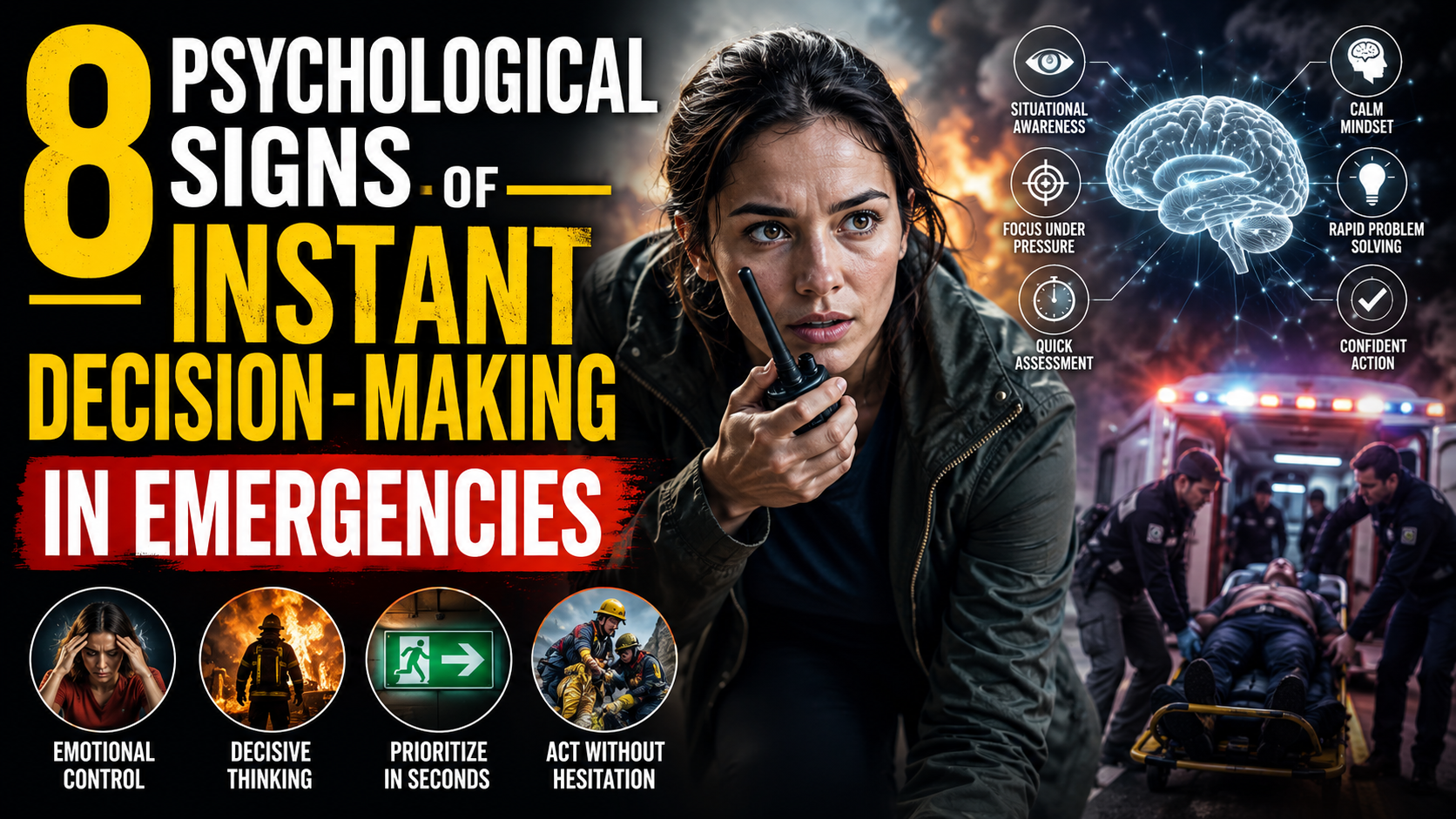
Here are eight key psychological signs that a person is capable of making fast, effective decisions during emergencies.
1. They Rely on Instinct Before Overthinking
One of the strongest indicators of quick decision-making ability is reliance on instinct.
In emergencies, individuals who act quickly often trust their gut feeling rather than overanalyzing the situation. This instinctive response is rooted in the brain’s amygdala, which processes threats and triggers immediate reactions.
Instead of getting stuck in “what if” scenarios, these individuals respond based on immediate perception. While not always perfect, instinctive reactions often save valuable time when every second counts.
2. They Stay Mentally Focused Under Pressure
People who make fast decisions in crises tend to maintain mental clarity even in chaotic environments.
While others may panic or become overwhelmed by noise, fear, or confusion, these individuals can filter out distractions and focus on what matters most.
This ability is closely linked to emotional regulation skills. When stress levels rise, their minds remain structured rather than scattered, allowing them to assess situations quickly and act accordingly.
3. They Quickly Identify What Matters Most
In emergencies, not all details are equally important. One of the key psychological traits of rapid decision-makers is the ability to prioritize information instantly.
They naturally identify threats, assess urgency, and focus only on critical factors. This skill is often described as “situational awareness.”
Instead of getting lost in unnecessary details, they immediately distinguish between what is essential and what can be ignored.
4. They Have Strong Emotional Control
Contrary to popular belief, fast decision-making is not driven by panic—it is driven by control.
Individuals who respond effectively in emergencies are often able to regulate their emotions even when fear is present. They acknowledge stress but do not allow it to dominate their thinking.
This emotional balance helps them avoid paralysis, which is a common reaction during high-pressure situations.
5. They Have Experience or Mental Preparation
Experience plays a major role in shaping how quickly someone reacts in an emergency.
People who have encountered similar situations before—whether directly or through training—are more likely to respond quickly and appropriately.
Even simulated experience, such as safety drills or mental rehearsal, can improve reaction speed. The brain learns patterns, which makes future decisions faster and more automatic.
6. They Are Comfortable With Uncertainty
Emergencies are unpredictable by nature. Individuals who can make instant decisions tend to tolerate uncertainty better than others.
Instead of waiting for complete information, they are willing to act based on partial knowledge. This willingness to move forward despite unknowns is a critical psychological advantage in crisis situations.
It allows them to respond before conditions worsen, rather than delaying action in search of perfect clarity.
7. They Show High Levels of Problem-Solving Flexibility
Fast decision-makers are not rigid in their thinking. They can adapt quickly when circumstances change.
If one approach does not work, they immediately switch to another without hesitation. This flexibility is a key component of cognitive agility.
In emergencies, where conditions can shift rapidly, this ability allows them to stay effective and responsive under pressure.
8. They Take Responsibility Without Hesitation
Another important psychological trait is the willingness to take responsibility.
In crisis situations, many people hesitate because they fear making the wrong decision. However, individuals who act quickly tend to accept responsibility for outcomes and focus on taking action rather than avoiding mistakes.
This mindset reduces delay and encourages decisive behavior, even when outcomes are uncertain.
Why Instant Decision-Making Matters in Emergencies
The ability to make fast decisions during emergencies can significantly impact survival and outcomes. In situations such as fires, earthquakes, accidents, or medical crises, delays of even a few seconds can change results dramatically.
Understanding the psychology behind quick decision-making helps explain why some individuals are able to act effectively while others struggle.
It also highlights that this ability is not purely instinctive—it can be developed and strengthened over time through training, awareness, and experience.
Can This Ability Be Developed?
Yes, research suggests that instant decision-making skills can be improved.
Training programs in fields such as emergency response, military service, aviation, and healthcare often focus on building rapid judgment skills. These programs use repetition, scenario-based learning, and stress exposure training to help individuals respond more effectively under pressure.
Even in everyday life, people can improve this skill by practicing calm decision-making in small stressful situations, learning basic emergency procedures, and improving emotional regulation techniques.
Over time, the brain becomes more efficient at processing information quickly and accurately.
Challenges in High-Pressure Decision-Making
While fast decisions are often beneficial, they are not always perfect.
One of the main challenges is balancing speed with accuracy. Acting too quickly without sufficient awareness can lead to mistakes. On the other hand, excessive hesitation can lead to missed opportunities for action.
The goal is not impulsiveness, but controlled rapid thinking—where the brain quickly processes available information and selects the best possible response.
The Science Behind Fast Thinking
Neuroscience shows that two systems in the brain influence decision-making:
- A fast, automatic system driven by instinct and emotion
- A slower, more analytical system driven by reasoning
In emergencies, the fast system often takes over, allowing immediate reactions. However, individuals who are well-trained or experienced can integrate both systems more effectively, leading to better outcomes.
This balance between instinct and reasoning is what defines highly effective decision-makers.
Final Thoughts
Instant decision-making in emergencies is a complex psychological skill shaped by instinct, experience, emotional control, and cognitive flexibility.
People who demonstrate these traits are not simply “brave”—they are mentally prepared to process danger quickly and respond effectively.
While some individuals naturally excel in high-pressure situations, this ability can also be developed through awareness, training, and practice.
Understanding these psychological signs not only helps explain human behavior in crises but also offers valuable insight into how we can improve our own ability to respond when it matters most.







