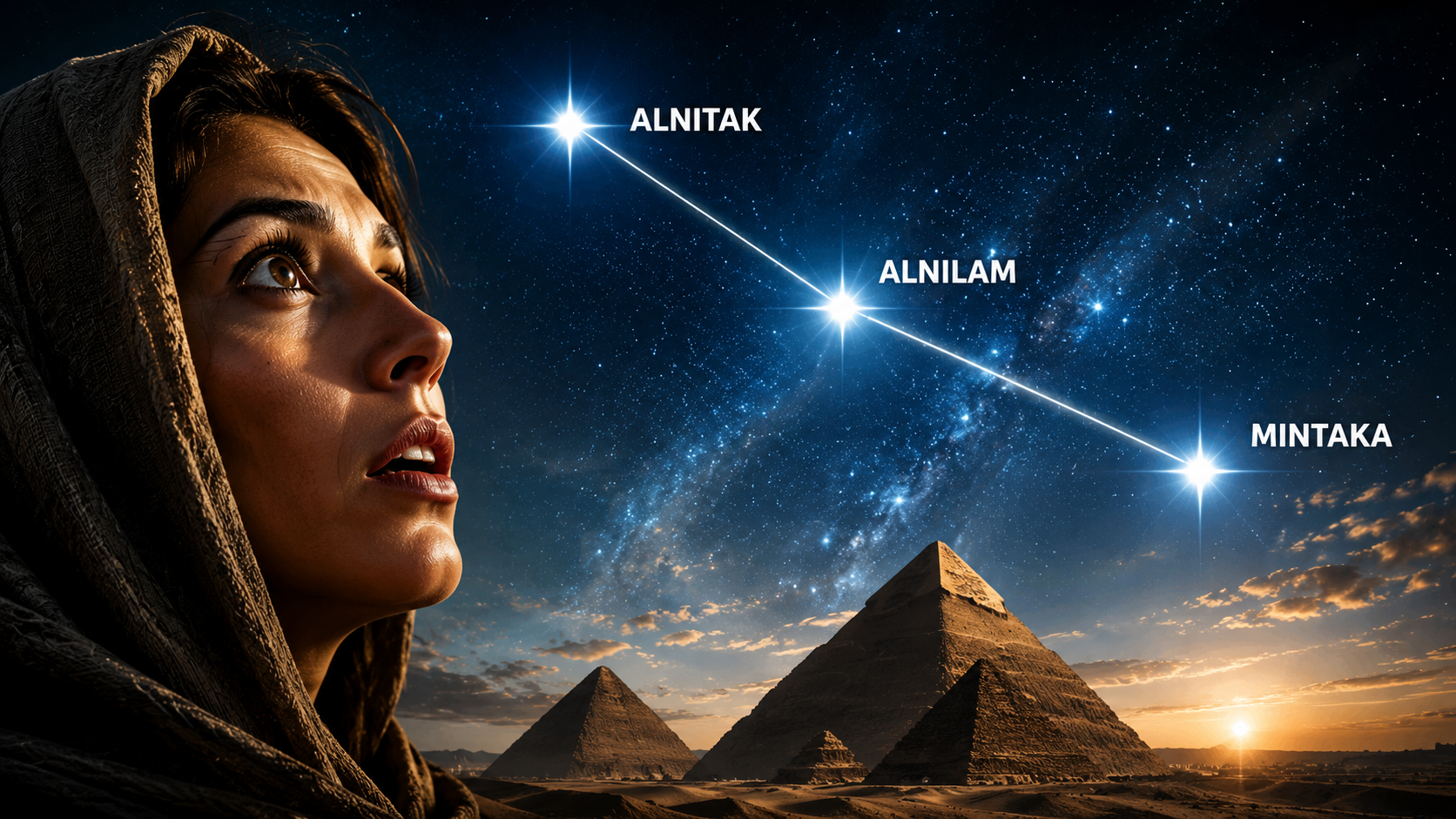
Look up at the night sky on a clear winter evening, and one constellation immediately stands out from the rest: Orion. Often called the Hunter, Orion is one of the easiest constellations to recognize thanks to three bright stars that form a nearly perfect line across its center. These stars—Alnitak, Alnilam, and Mintaka—make up the famous Orion’s Belt.
To the naked eye, they appear simple and orderly, like three identical points of light arranged with remarkable precision. But behind that familiar pattern lies a reality far more astonishing than most people realize.
These stars are not ordinary. They are among the most massive, luminous, and energetic objects visible without a telescope. Each one possesses characteristics that challenge our understanding of scale, distance, and stellar evolution. While they look close together from Earth’s perspective, they are separated by vast stretches of space and represent some of the most powerful stars in our region of the Milky Way.
The more astronomers learn about Orion’s Belt, the more incredible it becomes. Here are seven fascinating facts about Alnitak, Alnilam, and Mintaka that feel almost unreal when you consider what they truly are.
1. The Three Stars Only Appear to Be Neighbors
One of the biggest surprises about Orion’s Belt is that the stars are not actually lined up side by side in space.
From Earth, Alnitak, Alnilam, and Mintaka appear to form a straight, evenly spaced row. This creates the illusion that they exist relatively close to one another. In reality, each star sits at a different distance from Earth.
Mintaka is the closest of the trio, located roughly 1,200 light-years away. Alnitak lies farther out at around 1,300 light-years, while Alnilam is even more distant, approximately 2,000 light-years from our planet.
The alignment we see is purely a matter of perspective. If we could view Orion from another part of the galaxy, the familiar belt pattern would likely disappear entirely.
This serves as a powerful reminder that the night sky is a two-dimensional view of a three-dimensional universe.
2. Alnilam Is a True Stellar Giant
Among the three stars, Alnilam stands out as the heavyweight champion.
This blue supergiant is so enormous that it dwarfs our Sun in nearly every measurable way. Its diameter is dozens of times larger, and its mass is estimated to be many times greater than the Sun’s.
What makes Alnilam especially remarkable is its brightness. It shines with hundreds of thousands of times the Sun’s luminosity, making it one of the brightest stars visible in the sky despite being located thousands of light-years away.
If Alnilam were placed where the Sun currently sits in our solar system, its outer layers would extend far beyond the orbit of Mercury and possibly approach Venus.
The sheer scale of this star is difficult to comprehend, even for experienced astronomers.
3. These Stars Are Incredibly Young Compared to the Sun
The Sun is approximately 4.6 billion years old, making it a middle-aged star.
The stars of Orion’s Belt tell a very different story.
Alnitak, Alnilam, and Mintaka are relatively young in astronomical terms, with ages measured in only a few million years. While that may sound ancient from a human perspective, it makes them cosmic infants compared to the Sun.
Their youth is one reason they burn so brightly. Massive stars consume their nuclear fuel at extraordinary rates, producing tremendous amounts of energy over comparatively short lifetimes.
In astronomy, bigger stars often live faster and die younger.
The stars of Orion’s Belt are prime examples of this principle.
4. Each Star Is Far More Powerful Than the Sun
Most people think of the Sun as an unimaginably powerful object—and it certainly is.
Every second, the Sun produces enough energy to power life across our entire planet. Yet compared with the stars of Orion’s Belt, our Sun appears surprisingly modest.
Alnitak, Alnilam, and Mintaka emit vastly greater amounts of energy. Their intense radiation illuminates surrounding gas clouds and shapes entire regions of space.
If one of these stars replaced the Sun, the brightness in Earth’s sky would be overwhelming.
In fact, these stars are so luminous that they can be seen clearly across enormous distances within the Milky Way.
Their brilliance is one reason Orion remains one of the most recognizable constellations in the world.
5. Alnitak Helps Light Up One of Space’s Most Beautiful Nebulas
Alnitak, the easternmost star in Orion’s Belt, has a close connection to one of astronomy’s most famous deep-sky objects.
Located nearby is the Flame Nebula, a spectacular cloud of glowing gas and dust. The nebula shines because Alnitak’s intense ultraviolet radiation energizes the surrounding material.
Without Alnitak’s powerful light, the Flame Nebula would look dramatically different.
Astrophotographers frequently target this region because it contains multiple breathtaking celestial objects, including the Flame Nebula and the nearby Horsehead Nebula.
Together, they create one of the most photographed areas in the night sky.
This stellar neighborhood demonstrates how massive stars can shape their cosmic surroundings.
6. Mintaka Is Part of a Complex Multiple-Star System
At first glance, Mintaka appears to be a single star.
However, astronomers have discovered that it is actually part of a complex multi-star system.
What seems like one bright point of light is, in reality, a collection of stars gravitationally bound together. Some of these companions can only be observed using powerful telescopes and advanced instruments.
Multiple-star systems are surprisingly common throughout the galaxy, but Mintaka remains one of the most famous examples because of its prominent position within Orion’s Belt.
This hidden complexity reveals an important lesson about astronomy: appearances can be deceiving.
Even the brightest stars often have secrets invisible to the naked eye.
7. All Three Stars Will Die in Spectacular Supernova Explosions
Perhaps the most astonishing fact about Orion’s Belt is its future.
Stars like Alnitak, Alnilam, and Mintaka are far too massive to end their lives quietly.
Instead of gradually fading into white dwarfs as the Sun eventually will, these giants are expected to explode as supernovae.
A supernova is among the most energetic events in the universe. For a brief period, a single exploding star can outshine billions of other stars combined.
Although these explosions are still far in the future on human timescales, they are inevitable in astronomical terms.
When they occur, they will scatter heavy elements into space—elements that may one day become part of new stars, planets, and even living organisms.
In a very real sense, the death of massive stars helps create the ingredients for future worlds.
Why Orion’s Belt Continues to Fascinate Scientists
The stars of Orion’s Belt are more than just beautiful landmarks in the night sky. They are valuable scientific laboratories.
Astronomers study these stars to better understand how massive stars form, evolve, and influence their environments. Their intense radiation affects nearby gas clouds, while their eventual supernova explosions help enrich the galaxy with heavy elements.
Because they are relatively young and extremely luminous, Alnitak, Alnilam, and Mintaka provide important clues about stellar life cycles and galactic evolution.
Every observation helps researchers learn more about the processes that shape our universe.
How to Find Orion’s Belt
One reason Orion’s Belt remains so popular is its visibility.
Even people with little astronomy experience can usually find it within minutes.
During winter evenings in the Northern Hemisphere, look toward the southern sky. Three bright stars arranged in a straight line immediately stand out against the surrounding constellations.
Those three stars are Alnitak, Alnilam, and Mintaka.
Once you’ve identified them, you’ll notice that they serve as a guidepost for locating other celestial objects, including Sirius—the brightest star in the night sky—and the Orion Nebula, one of the most spectacular star-forming regions visible from Earth.
For generations, skywatchers have used Orion’s Belt as a celestial roadmap.
The Hidden Story Behind Three Tiny Points of Light
What makes Orion’s Belt so extraordinary is the contrast between appearance and reality.
To casual observers, these stars seem simple and familiar. They appear as three small lights shining peacefully overhead. Yet each one is a colossal stellar powerhouse, producing unimaginable amounts of energy while residing hundreds or even thousands of light-years away.
They are larger than the Sun, hotter than the Sun, brighter than the Sun, and destined for far more dramatic endings than our star will ever experience.
Their story reminds us that the universe is often far stranger than it first appears.
Final Thoughts
Alnitak, Alnilam, and Mintaka may look like a neat row of stars decorating Orion’s Belt, but they are among the most fascinating objects visible in the night sky. Their immense size, staggering brightness, youthful age, and explosive futures make them far more extraordinary than most people realize.
The next time you step outside on a clear winter night and spot Orion rising above the horizon, take a moment to appreciate what you’re really seeing. Those three points of light are not merely stars—they are gigantic cosmic engines operating on scales almost beyond human imagination.
And perhaps that’s what makes Orion’s Belt so captivating. It transforms an ordinary glance at the night sky into a reminder of just how vast, powerful, and mysterious the universe truly is.







