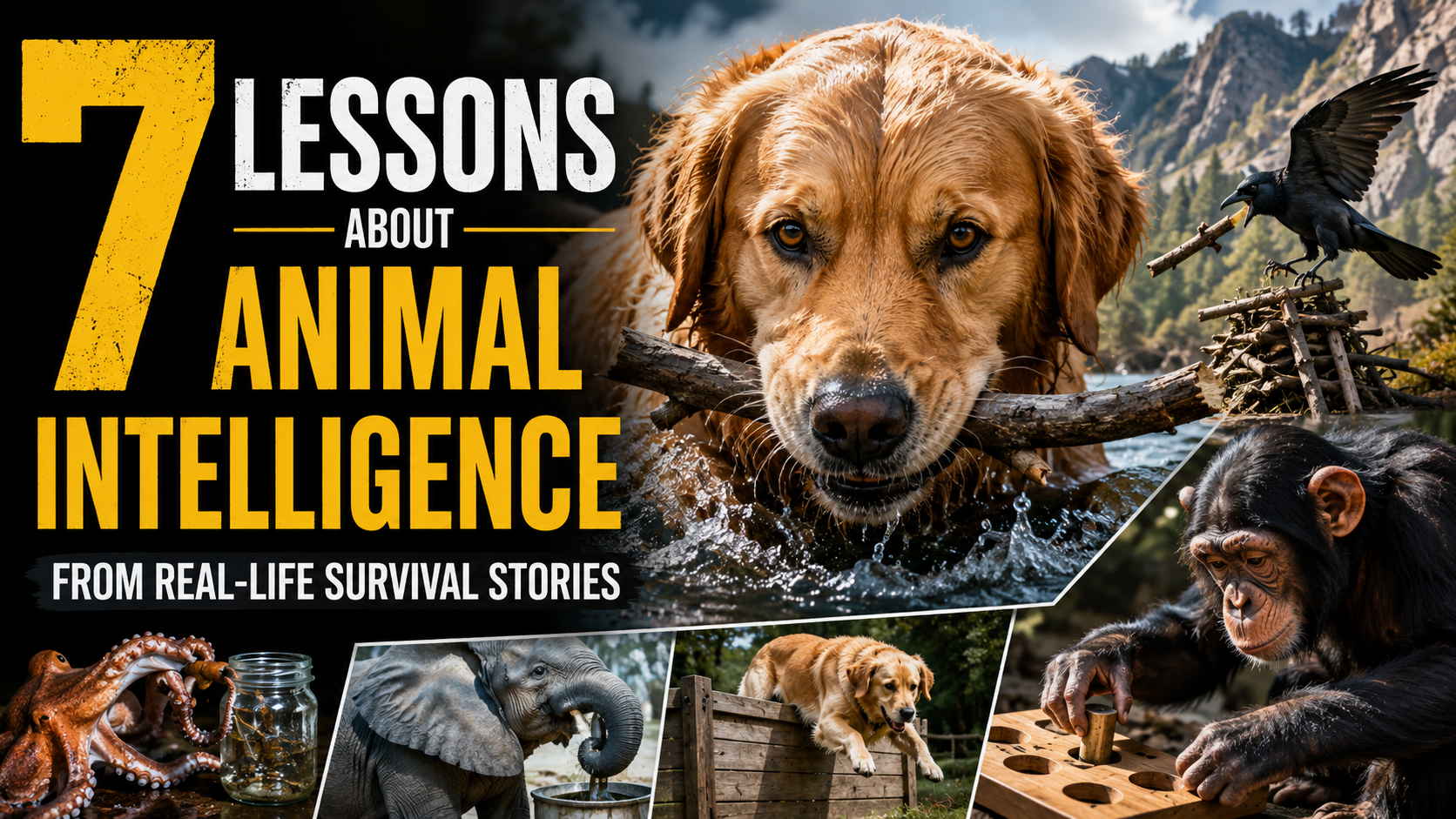
Animals often surprise us with their ability to adapt, survive, and solve problems in situations that challenge even human expectations. From escaping dangerous environments to protecting their young or finding their way back home across impossible distances, real-life survival stories continue to reveal just how intelligent animals truly are.
While scientists have long studied animal cognition, it is often real-world survival situations that provide the most compelling evidence of their intelligence. These moments show that animal behavior is not just instinct-driven—it can also involve learning, memory, emotional awareness, and even problem-solving under pressure.
Below are seven powerful lessons we can learn about animal intelligence from real-life survival stories around the world.
1. Animals Can Problem-Solve in Unexpected Ways
One of the most striking lessons from survival stories is that animals are capable of creative problem-solving. When faced with obstacles, they do not always rely on instinct alone—they adapt their behavior based on the situation.
For example, there are numerous accounts of dogs escaping locked areas by manipulating doors or finding weak points in fences. Similarly, birds have been observed using tools or altering their environment to access food.
These behaviors suggest that animals can assess problems and adjust their actions accordingly, rather than repeating fixed instinctive patterns.
In survival situations, this ability becomes even more apparent. When familiar routes or behaviors fail, animals often experiment with alternatives until they find a solution that works.
2. Memory Plays a Critical Role in Survival
Another important lesson is the power of animal memory. Many survival stories highlight animals traveling long distances to return to familiar places or caregivers, even after years of separation.
Cats, dogs, horses, and even wild animals have demonstrated the ability to remember specific locations, scents, and individuals. This memory is not limited to short-term recall—it can extend over long periods.
For example, dogs separated from their owners have been known to travel across cities or rural landscapes to find their way home. This suggests a strong spatial memory combined with emotional association.
In the wild, memory helps animals remember safe migration routes, water sources, and areas where predators are present. This stored information becomes a survival tool as important as physical strength or speed.
3. Emotional Intelligence Influences Decision-Making
Animal intelligence is not purely logical—it is also emotional. Many survival stories show that animals respond to stress, fear, and attachment in ways that influence their behavior.
For instance, mother animals often take extreme risks to protect their young, sometimes prioritizing offspring safety over their own survival. This behavior demonstrates emotional bonding that guides decision-making.
Pets also show emotional responses during abandonment or danger, often behaving differently depending on their level of attachment to humans or other animals.
Scientific research suggests that animals such as dogs and elephants exhibit emotional awareness, which plays a role in how they respond to threats or unfamiliar environments.
4. Cooperation Can Improve Survival Chances
While some animals are solitary, many survival stories highlight the importance of cooperation. Animals that work together often have higher survival rates in dangerous situations.
Wolves, for example, rely on pack coordination to hunt and protect territory. Dolphins use group strategies to herd fish or protect injured members. Even domesticated animals like dogs may cooperate with humans or other animals when navigating challenges.
In extreme survival situations, cooperation can mean the difference between life and death. Animals that communicate and coordinate actions are often more successful at escaping threats or finding resources.
This suggests that social intelligence is a key part of animal survival skills.
5. Adaptability Is More Important Than Strength
One of the most consistent lessons from survival stories is that adaptability often matters more than physical power. Animals that can adjust their behavior quickly tend to survive better than those relying only on strength or speed.
For example, urban wildlife such as raccoons, foxes, and pigeons have learned to thrive in human environments by changing feeding habits and nesting behaviors. Similarly, domestic animals abandoned in unfamiliar areas may quickly learn to navigate traffic, find food, or avoid danger.
Adaptability is a form of intelligence that allows animals to survive in changing environments. It reflects flexibility in thinking and behavior, even if it is not conscious in the human sense.
6. Instinct and Learning Work Together
A major insight from animal survival stories is that instinct alone does not explain behavior. Instead, instinct and learning often work together.
Instinct provides the foundation—basic survival behaviors such as fleeing danger or seeking food. However, learning allows animals to refine these instincts based on experience.
For example, a young animal may instinctively avoid predators, but over time it learns specific patterns of danger in its environment. Similarly, pets learn routines, human cues, and environmental signals that help them navigate daily life.
Survival stories often reveal this combination clearly. Animals facing unfamiliar threats rely on instinct initially, but quickly adjust based on what they observe and experience.
7. Animals Are More Aware of Their Environment Than We Think
Perhaps the most surprising lesson is the level of environmental awareness animals demonstrate during survival situations. Many animals are highly sensitive to changes in sound, smell, movement, and even atmospheric conditions.
This awareness allows them to detect danger earlier than humans in many cases. Wildlife often escapes natural disasters such as earthquakes, storms, or wildfires before humans realize what is happening.
Domesticated animals also show heightened awareness in survival situations, sometimes reacting to danger before it becomes visible.
This sensitivity suggests that animals continuously process environmental information in ways that support survival decisions.
Real-Life Survival Stories That Changed Scientific Understanding
Across the world, researchers have documented survival cases that challenge traditional assumptions about animal intelligence. From dogs surviving long journeys to reunite with owners, to wild animals escaping extreme environmental conditions, these stories provide valuable insights into cognitive abilities.
In some cases, animals have demonstrated behaviors that resemble planning or foresight, such as storing food, avoiding repeated danger zones, or choosing safer migration paths.
While scientists are careful not to over-interpret these actions, they acknowledge that animal intelligence is more complex than once believed.
Why Animal Intelligence Matters in Understanding Nature
Studying animal intelligence is not just about curiosity—it also helps us understand ecosystems, conservation, and human-animal relationships.
When we recognize that animals can adapt, learn, and respond emotionally, we are more likely to treat them with respect and care. It also helps scientists develop better strategies for wildlife protection and rehabilitation.
Understanding animal intelligence also bridges the gap between humans and other species, reminding us that intelligence exists in many forms beyond human reasoning.
Final Thoughts
Real-life survival stories reveal that animal intelligence is diverse, adaptable, and often underestimated. From problem-solving and memory to emotional awareness and cooperation, animals demonstrate a wide range of abilities that help them survive in challenging environments.
These seven lessons show that intelligence in the animal kingdom is not a single trait but a combination of instincts, learning, and environmental awareness.
As we continue to study and observe animals in both wild and domestic settings, we gain a deeper appreciation for their capabilities—and a greater respect for the natural world they inhabit.
Ultimately, these survival stories remind us of something powerful: intelligence is not exclusive to humans. It exists throughout nature, expressed in ways that are often subtle, surprising, and deeply inspiring.







