Voyager 1 is one of humanity’s most remarkable achievements in space exploration. Launched in 1977, this small spacecraft was designed for a relatively short mission to study the outer planets. Yet, decades later, it has traveled far beyond anything its engineers originally imagined.
Today, Voyager 1 is more than 22 billion kilometers from Earth, making it the most distant human-made object in existence. It has officially crossed into interstellar space, entering a region beyond the influence of our Sun’s solar wind.
Despite its age and distance, Voyager 1 continues to send back valuable scientific data, offering a rare glimpse into the environment between stars. Its journey is not just a technical triumph—it is a story of endurance, discovery, and human curiosity pushing far beyond its limits.
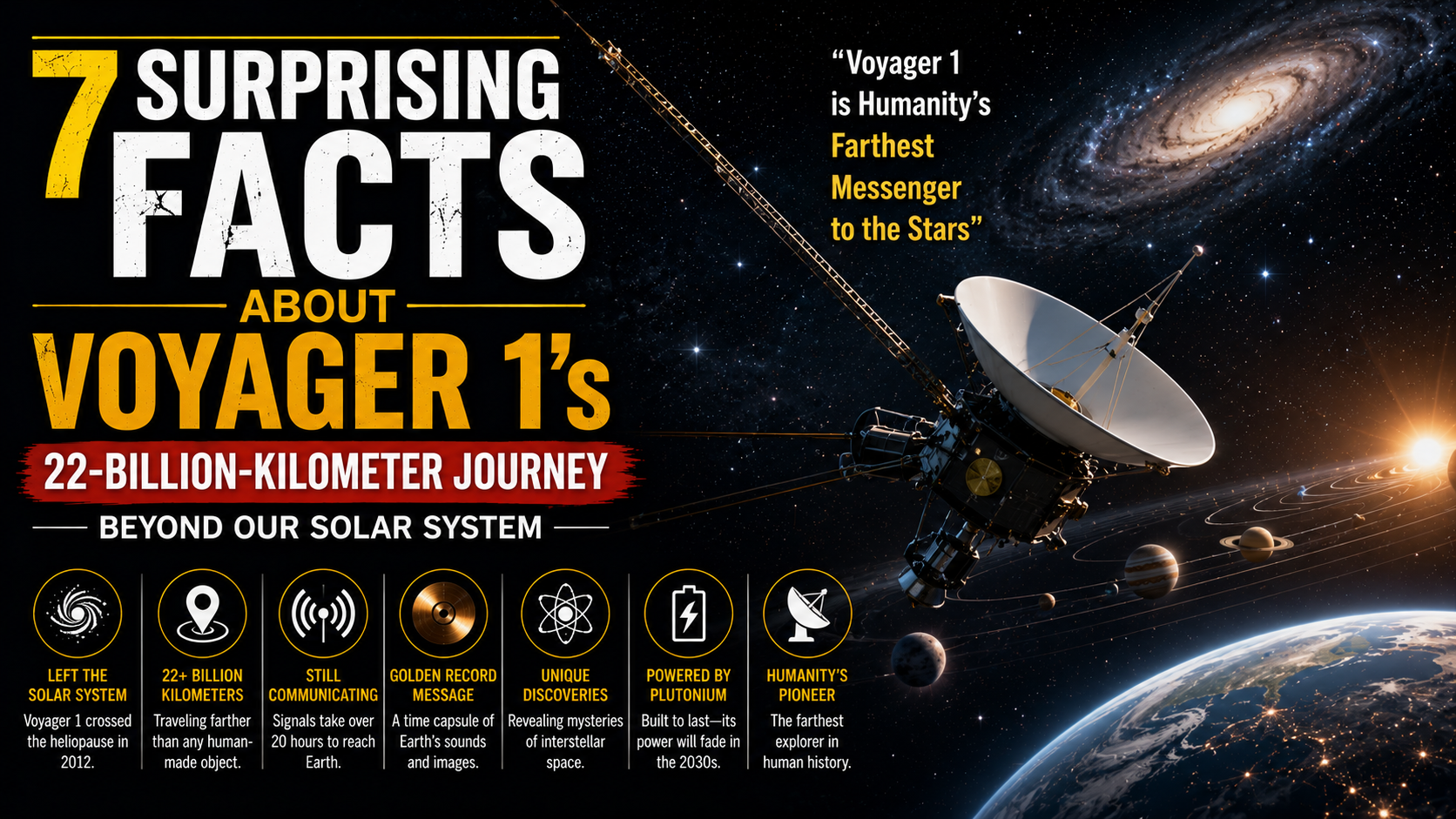
Here are seven surprising facts about Voyager 1’s extraordinary journey beyond our solar system.
1. Voyager 1 Was Never Originally Meant to Leave the Solar System
When Voyager 1 was launched, its mission was focused on studying Jupiter and Saturn.
Engineers designed it as part of the Voyager program, which aimed to take advantage of a rare planetary alignment that allowed spacecraft to use gravity assists to visit multiple outer planets.
There was never an expectation that Voyager 1 would travel into interstellar space. Its current journey far exceeds the original mission goals, turning it into an unexpected explorer of the galaxy.
2. It Took Decades to Reach Interstellar Space
Voyager 1 did not leave the solar system quickly. It took more than 35 years before it finally crossed into interstellar space in 2012.
This boundary is known as the heliopause, where the Sun’s solar wind no longer dominates and interstellar particles begin to take over.
Reaching this point required an incredible amount of time and distance, highlighting just how vast the space between stars truly is.
Even at its high speed, Voyager 1 needed decades to reach a region that still lies within our cosmic neighborhood.
3. It Travels Using No Engine Power
One of the most astonishing facts about Voyager 1 is that it no longer has an active propulsion system.
Instead, it continues to move through space purely by inertia, carrying the momentum it gained from its launch and planetary flybys.
There are no engines pushing it forward—just the momentum of decades of motion through the vacuum of space.
This makes Voyager 1 a perfect example of Newton’s first law of motion in action on a cosmic scale.
4. Its Signal Takes Over 20 Hours to Reach Earth
Because of its extreme distance, communication with Voyager 1 is incredibly slow by human standards.
Even traveling at the speed of light, radio signals from Earth take more than 20 hours to reach the spacecraft, and another 20 hours to return.
This means that any command sent to Voyager 1 takes nearly two days for a full round trip.
Despite this delay, NASA continues to communicate with the spacecraft using the Deep Space Network, a system of massive antennas around the world.
5. It Still Sends Back Scientific Data
Even after nearly five decades in space, Voyager 1 is still functioning—though with limited power.
It continues to send back data about cosmic rays, magnetic fields, and particle densities in interstellar space.
This information is extremely valuable because it represents direct measurements from a region no other spacecraft has ever reached.
Every bit of data helps scientists understand what lies beyond the influence of our Sun.
6. Its Power Source Is Slowly Fading
Voyager 1 runs on a radioisotope thermoelectric generator (RTG), which converts heat from radioactive decay into electricity.
However, this power source slowly weakens over time.
To conserve energy, NASA has been shutting down non-essential systems on the spacecraft.
Eventually, Voyager 1 will no longer have enough power to communicate with Earth, but it will continue drifting silently through space for millions of years.
7. It Carries a Message From Humanity
One of the most meaningful aspects of Voyager 1 is that it carries a golden record designed to represent Earth.
This record includes sounds, music, and images intended to communicate the story of our planet to any intelligent life that might encounter it.
It contains greetings in multiple languages, natural Earth sounds like wind and waves, and selections of music from different cultures.
Even if it is never found, the Golden Record remains a powerful symbol of human curiosity and hope.
Why Voyager 1’s Journey Matters
Voyager 1 is more than a spacecraft—it is a milestone in human exploration.
It represents our ability to reach beyond our immediate environment and explore regions no human could ever physically travel to.
Its continued operation decades after launch demonstrates the durability of engineering and the persistence of scientific curiosity.
More importantly, it helps us understand our place in the universe by showing just how small and isolated our solar system truly is.
Final Thoughts
Voyager 1’s journey across more than 22 billion kilometers is a reminder of what humanity can achieve when curiosity leads the way.
From its original mission to explore the outer planets to its current status as an interstellar traveler, it has exceeded every expectation placed upon it.
As it continues its silent journey through deep space, Voyager 1 carries with it not only scientific data but also a message from Earth itself—a small golden record drifting endlessly among the stars.
In many ways, it is not just a spacecraft. It is a symbol of human ambition, exploration, and the desire to reach beyond what we know.







