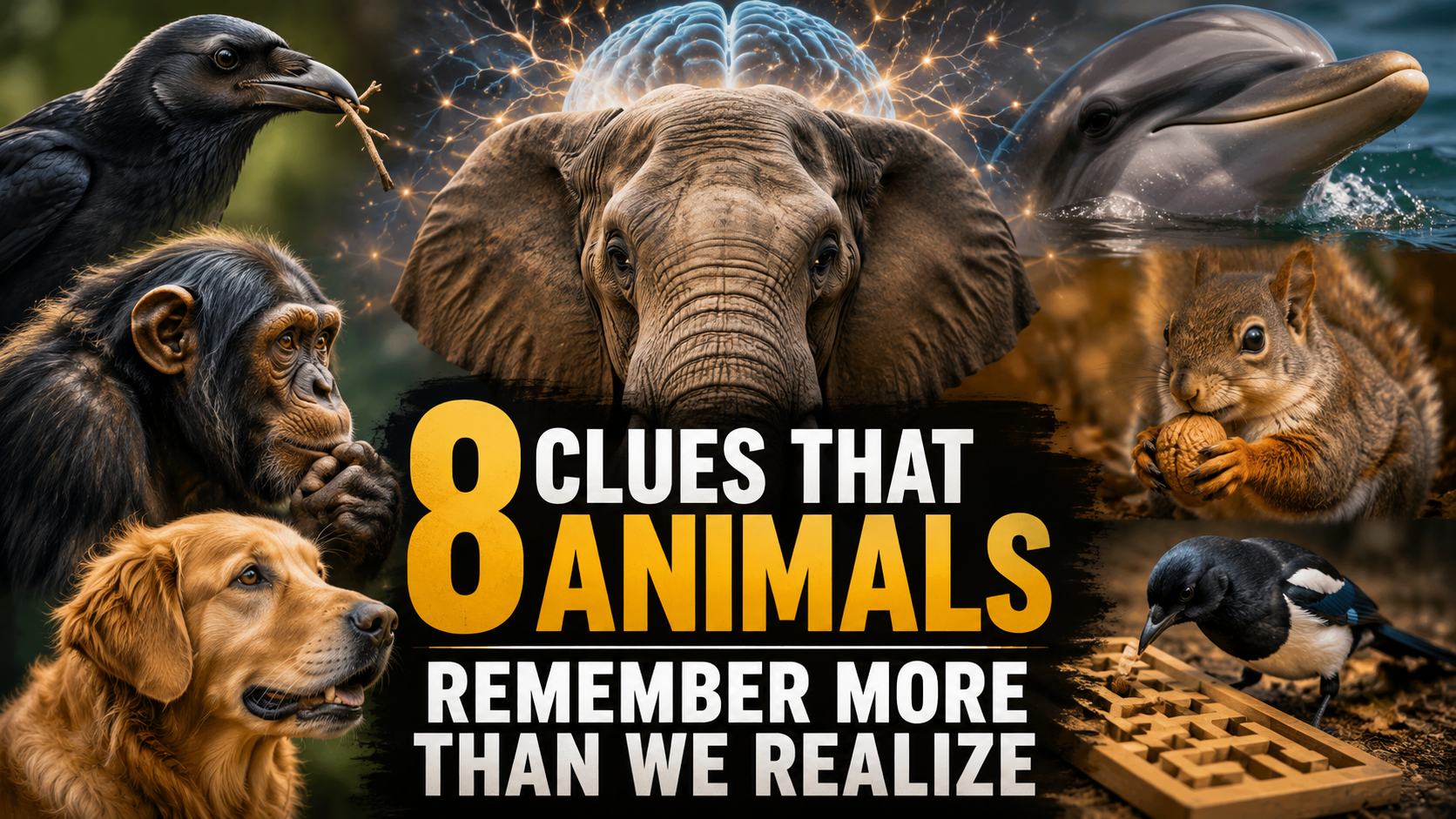
For centuries, humans have viewed memory as one of the defining features of intelligence. We often associate strong memory with people who can recall names, solve problems, or remember events from years ago. But as scientists continue studying animal behavior, a fascinating reality is emerging: many animals may remember far more than we once believed.
From elephants that recognize old companions after years of separation to birds that recall thousands of hidden food locations, the animal kingdom is filled with remarkable examples of memory in action. While animals don’t remember things exactly the way humans do, research increasingly suggests that memory plays a crucial role in their survival, relationships, and decision-making.
In fact, some species display memory abilities that rival—or even surpass—our own in specific areas.
Here are eight compelling clues that animals remember more than most people realize.
1. Some Animals Recognize Individuals Years Later
One of the strongest signs of memory is the ability to recognize specific individuals after long periods of time.
Elephants provide one of the most impressive examples. Studies have shown that they can remember other elephants they haven’t encountered in years. Older matriarchs often retain knowledge of family members, allies, and even rival groups across long stretches of time.
Dolphins display similar abilities. Researchers have discovered that bottlenose dolphins can recognize the unique whistles of former companions decades after their last interaction. These signature whistles function somewhat like names, allowing dolphins to identify one another even after years apart.
This kind of long-term social memory requires far more than simple instinct. It suggests animals can store and retrieve detailed information about individuals over extended periods.
2. Birds Remember Thousands of Food Locations
When people think about memory champions, birds don’t usually come to mind.
Yet some bird species possess extraordinary recall abilities.
Clark’s nutcrackers, for example, hide seeds across large territories and later recover them months afterward. Researchers estimate that these birds can remember thousands of separate storage locations.
Chickadees and jays demonstrate similar skills. They often cache food in hundreds of places and accurately relocate those hidden supplies long after burying them.
Without such memory abilities, these birds would struggle to survive harsh winters when food becomes scarce.
Their success depends on remembering exactly where resources were stored and which locations remain worth revisiting.
3. Animals Learn From Past Experiences
Memory isn’t only about remembering locations or individuals. It also involves learning from previous experiences.
Many animals adjust their behavior based on what has happened before.
A dog that once encountered a dangerous obstacle may avoid it in the future. A wild predator that successfully hunts in a particular area may return repeatedly. Primates often develop problem-solving strategies based on earlier successes and failures.
This ability to learn from experience helps animals make better decisions over time.
Rather than treating every situation as completely new, they build upon past knowledge to improve future outcomes.
In many ways, this is one of the most practical forms of memory.
4. Social Animals Remember Relationships
Life in social groups requires memory.
Animals living within complex communities must keep track of allies, family members, competitors, and social hierarchies.
Primates are particularly skilled at this.
Monkeys and apes often remember who has helped them, who has challenged them, and where they fit within group dynamics. These memories influence future interactions and cooperation.
Elephants, wolves, dolphins, and many other social species display similar patterns.
Maintaining relationships over time would be nearly impossible without the ability to remember previous encounters.
Their social success depends heavily on retaining information about those around them.
5. Certain Species Pass Knowledge Across Generations
Another clue that animals possess sophisticated memory systems is their ability to transfer information between generations.
Young animals often learn by observing experienced adults.
For example, elephant calves learn migration routes from older herd members. Young dolphins adopt hunting techniques used by their mothers. Chimpanzees acquire tool-use skills by watching others.
This process relies on memory in two ways.
First, older animals must remember valuable information accumulated throughout their lives. Second, younger animals must retain what they learn and apply it later.
These traditions can persist for decades, creating what some researchers describe as animal cultures.
The existence of cultural transmission strongly suggests that memory plays a much larger role in animal societies than previously assumed.
6. Animals Can Remember Human Faces and Voices
Many species don’t just remember other animals—they can also remember humans.
Research has shown that crows are especially skilled at recognizing human faces. In several studies, crows remembered individuals who had previously threatened them and responded differently when encountering those same people later.
Dogs also excel at recognizing familiar humans through sight, sound, and scent.
Horses, parrots, and certain marine mammals have demonstrated similar abilities.
These findings suggest that animals can create lasting mental representations of specific people and use those memories to guide future behavior.
The ability to distinguish between individuals is far more complex than many people realize.
7. Emotional Events Are Often Remembered Longer
Humans tend to remember emotionally significant events more clearly than ordinary ones.
Interestingly, many animals appear to show similar patterns.
Strong experiences—whether positive or negative—often leave lasting impressions.
For example:
- Animals may avoid locations where they previously encountered danger.
- They may return to places associated with food or safety.
- They may react strongly to individuals connected to important experiences.
Scientists believe emotions can strengthen memory formation because remembering significant events improves survival.
If an experience affects an animal’s well-being, remembering it can provide a future advantage.
This principle appears to operate across a wide range of species.
8. Problem-Solving Often Depends on Memory
Perhaps the clearest clue of all is the role memory plays in problem-solving.
Many intelligent species rely on remembered information when tackling challenges.
Crows recall successful tool-use methods.
Octopuses remember how to navigate mazes and solve puzzles.
Primates remember strategies that previously led to rewards.
Even animals that don’t display obvious signs of intelligence often depend on memory to locate resources, avoid threats, and navigate their environments.
Without memory, problem-solving would be limited to trial and error.
With memory, animals can build on past experiences and become increasingly effective over time.
This ability represents one of the strongest indicators of advanced cognition.
Why Animal Memory Matters
Understanding animal memory isn’t simply an academic exercise.
It changes how we view the natural world.
For many years, intelligence was often measured according to human standards. Scientists looked for language, mathematics, or other uniquely human abilities.
Today, researchers recognize that intelligence can take many forms.
Different species have evolved memory systems suited to their environments and lifestyles.
A squirrel’s ability to remember food caches, an elephant’s social memory, or a dolphin’s recognition skills may differ from human memory, but each serves an important purpose.
These abilities reveal that cognition exists on a broad spectrum rather than fitting into a simple hierarchy.
The Science Behind Animal Memory
Animal memory involves many of the same biological principles found in humans.
Brains store information by strengthening connections between neurons. Repeated experiences create lasting pathways that help organisms recall important information later.
While brain structures vary across species, the basic need for memory remains universal.
Animals must remember:
- Where to find food
- How to avoid danger
- Which individuals can be trusted
- Migration routes
- Nesting sites
- Hunting strategies
Without memory, survival would become dramatically more difficult.
Natural selection has therefore favored memory systems that help species navigate their environments successfully.
Common Misconceptions About Animal Memory
Many people assume animals live entirely in the present moment.
While it’s true that animals don’t reflect on the past exactly as humans do, growing evidence suggests they possess far richer mental lives than once believed.
Another misconception is that only highly intelligent animals have memory.
In reality, memory appears throughout the animal kingdom.
Even insects demonstrate impressive recall abilities in certain contexts. Bees can remember flower locations, navigate complex routes, and communicate valuable information to hive members.
The diversity of memory systems in nature is far greater than most people realize.
What Animal Memory Teaches Us
Studying animal memory offers valuable lessons about intelligence itself.
It reminds us that cognitive abilities evolve according to practical needs.
Different species solve different challenges.
As a result, memory develops in ways that support those challenges.
A bird may remember locations better than humans. A dog may remember scents with extraordinary precision. An elephant may retain social information across decades.
Each example highlights the incredible adaptability of life.
Rather than asking whether animals think exactly like humans, scientists increasingly ask how animals think in ways that help them survive and thrive.
Final Thoughts
The more researchers study animal behavior, the clearer one fact becomes: many animals remember far more than we once imagined.
They recognize individuals years later, recall food locations with remarkable accuracy, learn from experience, maintain social relationships, and pass valuable knowledge across generations.
These abilities challenge outdated assumptions about intelligence and reveal a deeper level of complexity within the natural world.
While human memory remains unique in many respects, it is no longer reasonable to assume that memory is exclusively a human strength.
Across forests, oceans, grasslands, and skies, countless animals are quietly relying on sophisticated memory systems every single day.
And with each new scientific discovery, we gain a greater appreciation for just how remarkable those abilities truly are.







